
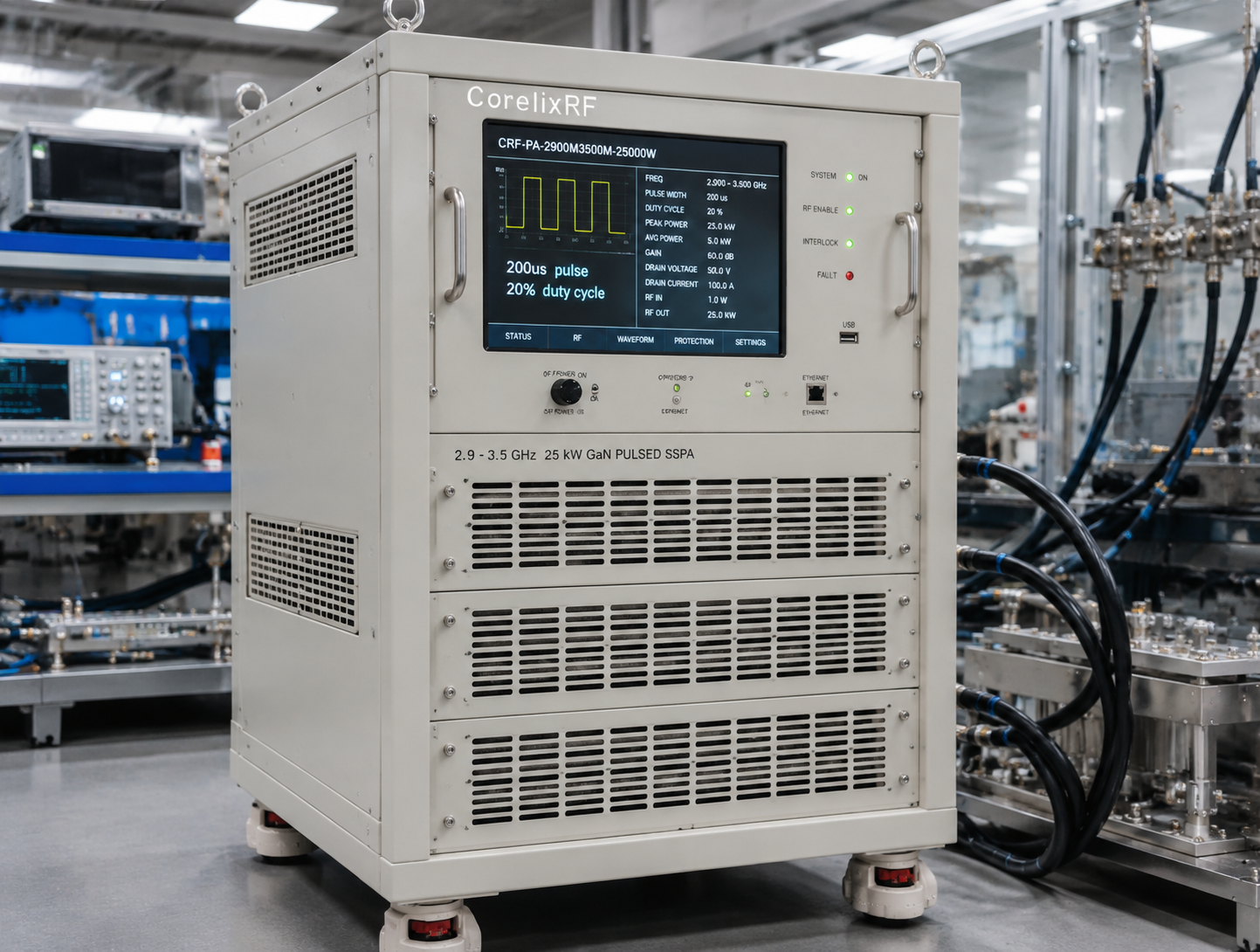
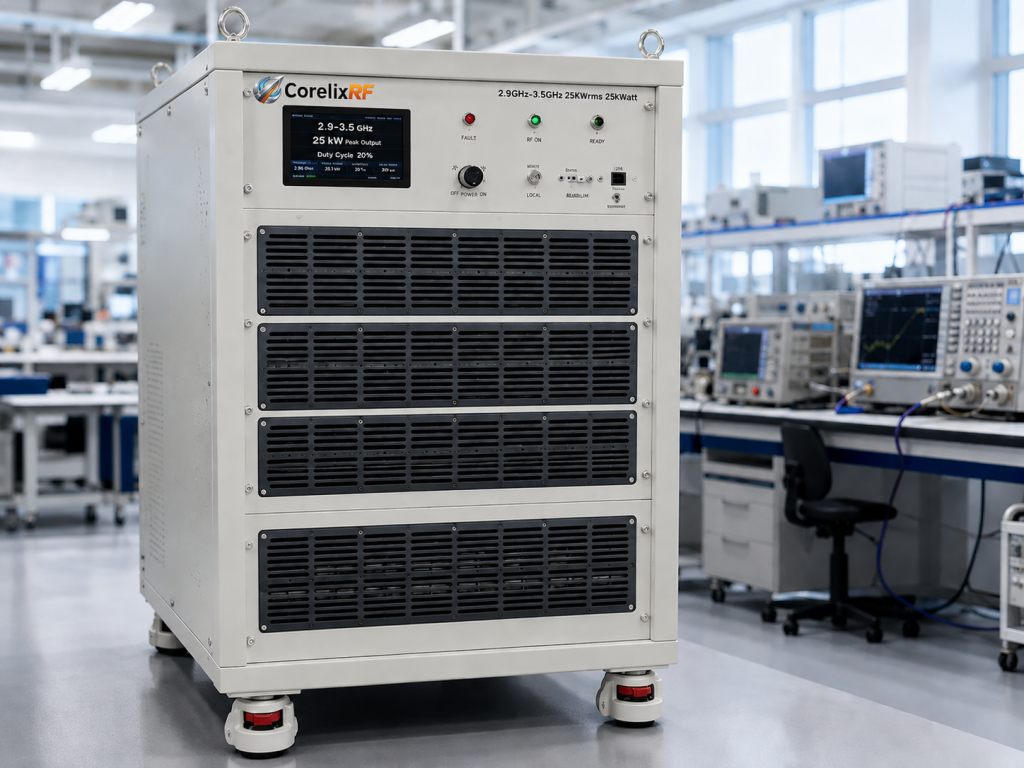
A 2.9 to 3.5 GHz 25 kW pulsed RF amplifier is not a normal bench amplifier purchase. It is a system-level power source that must be reviewed around waveform, duty cycle, cooling, waveguide interface, facility power and protection behavior. The CorelixRF CRF-PA-2900M3500M-25000W local datasheet gives a new, unused model for today’s replacement article: a 2.9-3.5 GHz GaN pulsed SSPA with 25 kW rated peak output power.
The datasheet lists 200 us typical pulse width, 20% duty cycle, 74 dB minimum gain, 20 dB gain control, N-Female RF input, WR284 waveguide output, RS485/LAN control, AC 380 V three-phase supply and water cooling. Those values make the main content angle clear: selection starts with the pulsed RF system, not just the peak wattage.
What the Local Datasheet Confirms
The CRF-PA-2900M3500M-25000W is described as a solid-state pulsed RF power amplifier for test and measurement instrumentation, communication systems, RF interference or EW system-level testing and aerospace control. It integrates temperature/current monitoring, alarm protection and project-ready RS485/LAN control interfaces.
Peak Power Is Only One Requirement
For a high power pulsed SSPA , peak power must be interpreted together with pulse width, duty cycle, repetition behavior and load path. A 25 kW peak output claim is meaningful only when the pulse conditions match the planned waveform. If the required pulse width or duty cycle differs from the datasheet reference, CorelixRF should review the configuration before the buyer assumes compatibility.
The input drive level also matters. With 74 dB minimum gain, source limits and interlock logic should be defined in the control system. Operators should not rely on manual caution when a small drive-level change can create a large output change.
WR284 Output and Water Cooling Need Early Planning
The listed WR284 output means the output path should be treated as waveguide hardware from the beginning. Loads, directional couplers, switch sections, antenna paths and measurement points must be suitable for the frequency range and power level. If adapters or transitions are needed, their loss, power handling and mismatch behavior should be included in the delivered-power calculation.
Water cooling is also part of the RF design. Flow rate, coolant temperature, service access, leak detection practice and cabinet placement should be discussed before quotation. The local datasheet lists a cabinet platform with three-phase five-wire aviation connector power input, so facilities planning belongs in the same review as RF performance.
Monitoring and Protection Should Be Logged
The datasheet lists real-time temperature monitoring, real-time current monitoring, optional forward/reverse power monitoring, optional LAN remote monitoring and alarm/fault protection. Protection functions include over-temperature, over-drive and VSWR protection with alarm functions. These features should be connected to the test procedure and logged during operation.
A good commissioning sequence starts with verified coolant, verified load, low-level pulse checks, reflected-power review where available, alarm-state confirmation and controlled increase to the target operating point. For an EMC or RF system-level test setup, that sequence helps separate amplifier behavior from fixture, waveguide or load problems.
RFQ Checklist for This Model Class
A strong RFQ should include frequency range, peak power requirement, pulse width, duty cycle, pulse repetition behavior, waveform details, source level, expected load, WR284 path details, cooling infrastructure, AC power availability, control interface, monitoring requirements and acceptance data needs. If the project requires modified control, extra monitoring or enclosure constraints, a custom RF amplifier development review is the right next step.
This topic also gives CorelixRF a distinct long-tail keyword that has not been used in the prior draft set. It avoids repeating earlier CW broadband themes and gives buyers a concrete framework for high-power pulsed S-band amplifier selection. Readers who are still comparing CW and pulsed platforms can continue into the broader RF power amplifier portfolio or related CorelixRF technical articles.
Safe Public Positioning
Public copy should avoid claims about certifications, stock status, customer installations or guaranteed standard compliance unless CorelixRF provides explicit publishable evidence. The strongest claim is simpler and more defensible: CorelixRF has a local specification for a 2.9-3.5 GHz, 25 kW peak, GaN pulsed SSPA platform, and engineering review is required to match it to the customer’s pulse, cooling, control and interface requirements.
FAQ
What frequency range does the CRF-PA-2900M3500M-25000W cover?
The local datasheet lists 2,900 to 3,500 MHz coverage.
Is 25 kW a CW output rating?
No. The datasheet describes a pulsed RF amplifier with 25 kW rated peak output power, 200 us typical pulse width and 20% duty cycle.
What output interface is listed?
The datasheet lists N-Female RF input and WR284 waveguide output.
What details are needed before quotation?
Send frequency range, peak power, pulse width, duty cycle, waveform, source level, load path, cooling infrastructure, power availability and control requirements.