
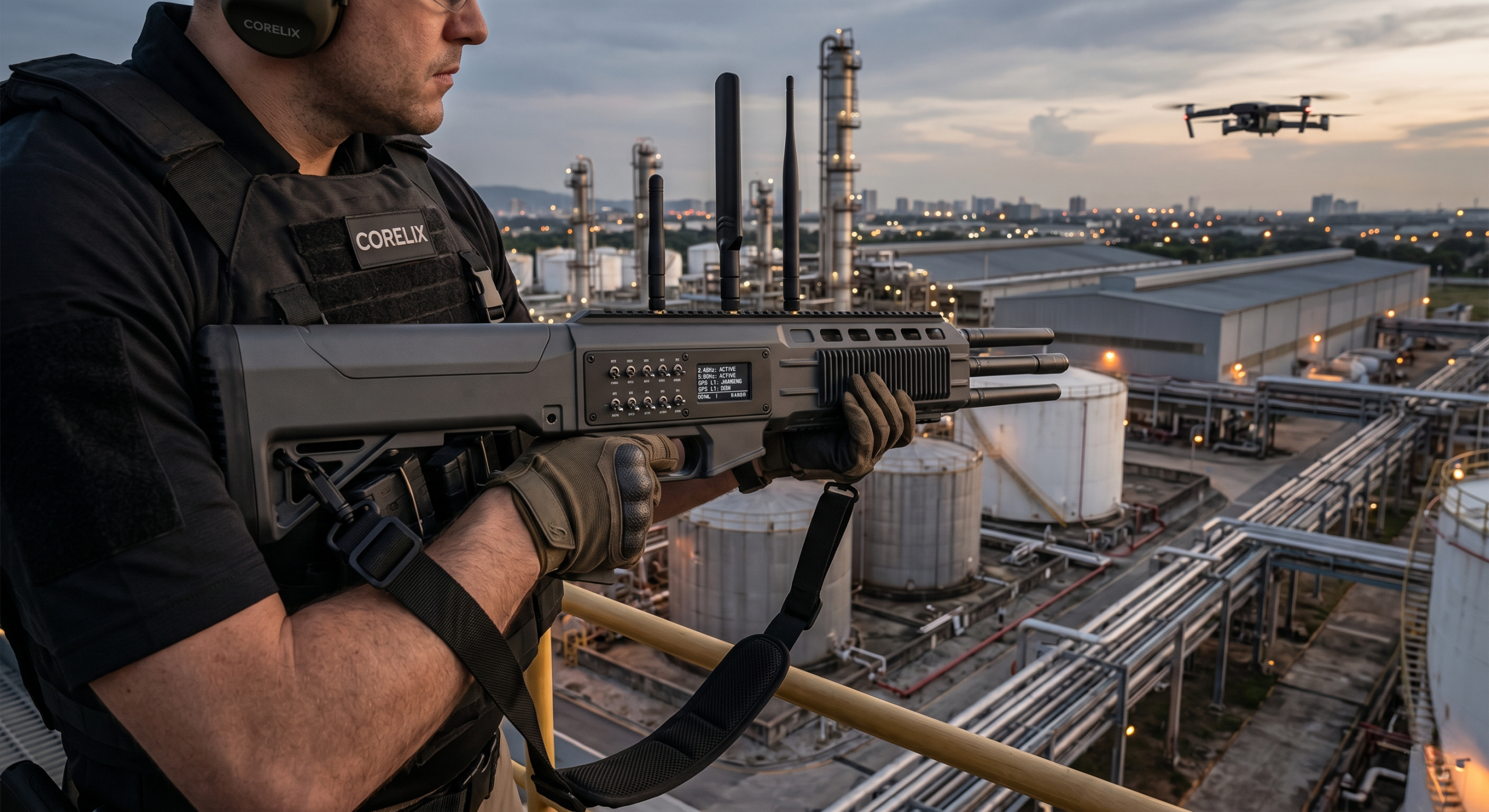
The technical specifications for a portable anti-drone system define its ability to neutralize unauthorized aerial threats through high-power radio frequency interference across multiple communication bands. You face a growing security challenge as unauthorized drones can easily bypass traditional perimeter defenses, potentially exposing your sensitive data or physical assets to surveillance and disruption. When a rogue craft enters your airspace, the window for response is incredibly small, requiring immediate and decisive action. To maintain total control over your local sky, high-performance Anti Drone Jammers provide the necessary non-kinetic defense to sever the pilot’s link instantly.
Why is multi-band frequency coverage essential for security?
Multi-band coverage is the foundation of a robust defense because modern UAVs utilize a wide variety of frequencies for control, video transmission, and navigation. You must ensure your equipment can address the specific radio signatures of both consumer quadcopters and professional-grade surveillance drones.
Which frequencies pose the highest risk to your facility?
The most common threats operate on the 2.4GHz and 5.8GHz ISM bands, but tactical-grade drones often use lower frequencies like 433MHz or 915MHz for extended range. Think about it: if your device misses even one of these bands, a sophisticated operator can maintain control while your security team remains helpless.
- 2.4 GHz: Global standard for Wi-Fi-based flight control.
- 5.8 GHz: Primary channel for high-definition video downlinks.
- 433/915 MHz: Low-frequency bands used for long-distance RC links.
- GPS L1/L2: Vital for autonomous flight and Return-to-Home functions.
How does frequency agility future-proof your investment?
A device with customizable frequency modules allows you to adapt as drone manufacturers shift to new transmission protocols. This flexibility ensures that you are not left with obsolete hardware when the next generation of industrial drones hits the market.
- Modular RF Boards: Easy replacement of specific band modules.
- Wide Spectrum Coverage: Ability to jam 6 to 8 bands simultaneously.
- Independent Control: Toggle specific frequencies to avoid local interference.
Key Takeaway: Investing in a multi-band system ensures that you can neutralize a diverse range of threats, from hobbyist units to advanced tactical drones, by targeting the entire spectrum of possible communication channels.
| Frequency Feature | Technical Requirement | Security Impact |
|---|---|---|
| Band Count | 6 – 8 Active Channels | Universal threat neutralization |
| Customization | Independent Toggle Switches | Selective jamming capability |
| Spectrum Range | 433MHz to 5.8GHz | Full-spectrum aerial dominance |
Buyers should prioritize systems with at least six bands to ensure coverage of all standard commercial and navigation frequencies.
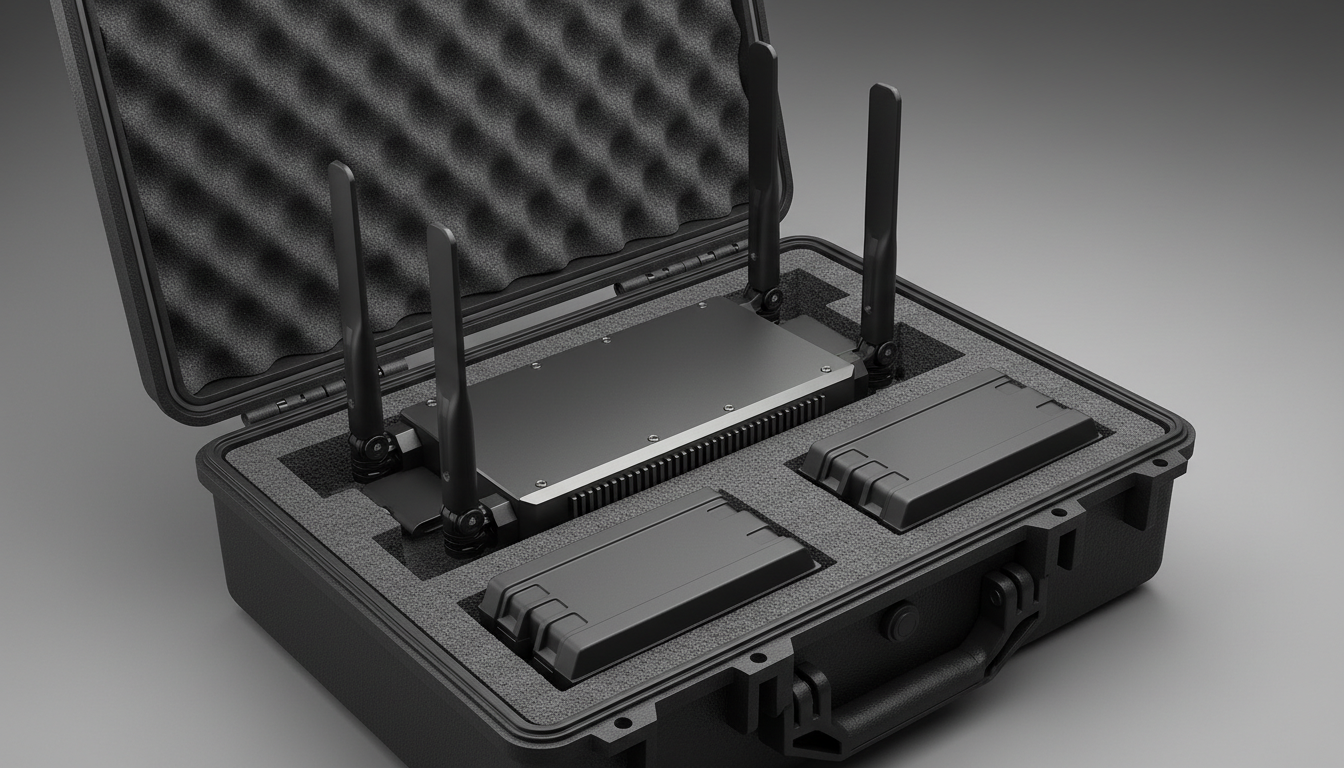
How does total power output influence effective jamming range?
The total output power of Anti Drone Jammers dictates how effectively you can overpower a drone’s command link at a significant distance from your protected zone. Higher wattage directly translates to a more dominant signal, allowing you to create a “no-fly” bubble that extends several kilometers.
Is 180W sufficient for high-altitude drone neutralization?
An output of 180W is currently the gold standard for portable units, providing enough energy to disrupt drones even when they are flying at high altitudes or at the edge of their range. But here is the kicker: raw power is only half the battle; the signal must be clean and stable to ensure the drone’s receiver is completely saturated.
- 180W Total Output: Provides a jamming radius of up to 2,000 meters.
- Per-Band Power: Typically 20W to 50W per frequency module.
- Signal Saturation: Ensures the drone cannot “hear” its pilot over the noise.
How do you balance power output with battery efficiency?
While you want maximum power to ensure security, you must also consider the thermal load and energy consumption that high-wattage modules generate. Think about it: a device that runs out of power in five minutes is a liability, not an asset, during a sustained security breach.
- Efficient Amplifiers: Minimize energy waste as heat.
- Power Density: High output in a compact, portable form factor.
- Adjustable Levels: Scale power based on the proximity of the threat.
Key Takeaway: High wattage is the primary driver of operational range, making a 180W system ideal for protecting large industrial sites where early detection and long-range neutralization are required.
| Power Metric | Specification | Operational Benefit |
|---|---|---|
| Total Output | 180 Watts | 2km effective jamming radius |
| Power per Band | 30W (Average) | High resistance to anti-jamming protocols |
| Power Supply | 24V DC Internal | Consistent signal strength |
Selecting a unit with high per-channel power is more important than total aggregate wattage when dealing with drones equipped with interference-resistant receivers.
What role do directional antennas play in signal precision?
Modern Anti Drone Jammers utilize high-gain directional antennas to focus interference energy toward the target rather than scattering it in all directions. This targeted approach allows you to neutralize a specific threat while minimizing the impact on authorized communications in the surrounding area.
Why is 10dBi gain the industry standard for portable units?
A 10dBi gain rating strikes the perfect balance between beam precision and ease of aiming for a human operator. Consider this: a higher gain would make the beam too narrow to track a moving drone easily, while a lower gain would drastically reduce your effective range.
- Narrow Beamwidth: Typically 30 to 45 degrees for targeted jamming.
- Signal Concentration: Multiplies the effective power reaching the drone.
- Reduced Collateral: Minimizes disruption to nearby Wi-Fi or cellular networks.
Can high-gain antennas reduce collateral signal interference?
By focusing the energy into a directional cone, you significantly reduce the risk of interfering with your facility’s own operational communications. Think about it: you don’t want to shut down your entire corporate network just to stop one unauthorized drone on the perimeter.
- Point-and-Shoot Logic: Energy only goes where the device is aimed.
- Safe Zones: Areas behind the operator remain largely unaffected.
- Tactical Accuracy: Allows for surgical drone removal in crowded environments.
Key Takeaway: Directional antenna technology is essential for tactical operations, as it maximizes the impact on the target drone while protecting your own infrastructure from unintended signal interference.
| Antenna Property | Specification | Tactical Result |
|---|---|---|
| Gain Rating | 10dBi – 12dBi | Long-range signal focus |
| Beam Width | 30° Horizontal / 30° Vertical | High tracking accuracy |
| Polarization | Vertical | Compatible with most drone antennas |
Operators should be trained to aim slightly ahead of a moving drone’s flight path to ensure the aircraft remains within the high-intensity center of the signal cone.
Why is GPS disruption critical for stopping autonomous flight?
Anti Drone Jammers utilize GNSS interference to prevent autonomous UAVs from executing pre-programmed flight paths or returning to their launch point. Without a valid satellite link, a drone loses its sense of position, which is the most effective way to force an immediate landing.
Does blocking the L1 band stop all satellite navigation?
While GPS L1 is the primary frequency for consumer drones, you must also target GLONASS, Galileo, and Beidou frequencies to be truly effective. But here is the kicker: if the drone can see even one satellite constellation, it may still be able to maintain a stable hover or continue its mission.
- GNSS L1/L2: Targets the most common positioning systems.
- Broad Spectrum: Covers GLONASS and Galileo constellations.
- Signal Flooding: Overpowers weak satellite signals with local noise.
What happens to a drone when it loses its GNSS link?
When you successfully jam the navigation bands, most drones will enter a failsafe mode where they either hover in place or descend slowly to the ground. Think about it: this effectively “grounds” the threat without having to physically destroy the aircraft, allowing for potential forensic recovery.
- Hover Mode: Drone stays static until the battery is depleted.
- Auto-Landing: Immediate descent to the current location.
- Telemetry Loss: Pilot loses the ability to see the drone’s location on a map.
Key Takeaway: Navigation jamming is the most reliable way to neutralize autonomous threats, as it strips the drone of its ability to move intelligently or return to its operator.
| Navigation Band | Frequency | Jamming Result |
|---|---|---|
| GPS L1 | 1575.42 MHz | Loss of primary positioning |
| GPS L2 | 1227.60 MHz | Disruption of precision flight |
| GLONASS L1 | 1602 MHz | Neutralization of backup satellites |
A comprehensive defense strategy must include navigation jamming to prevent drones from completing “dark” missions that do not rely on a constant remote-control link.
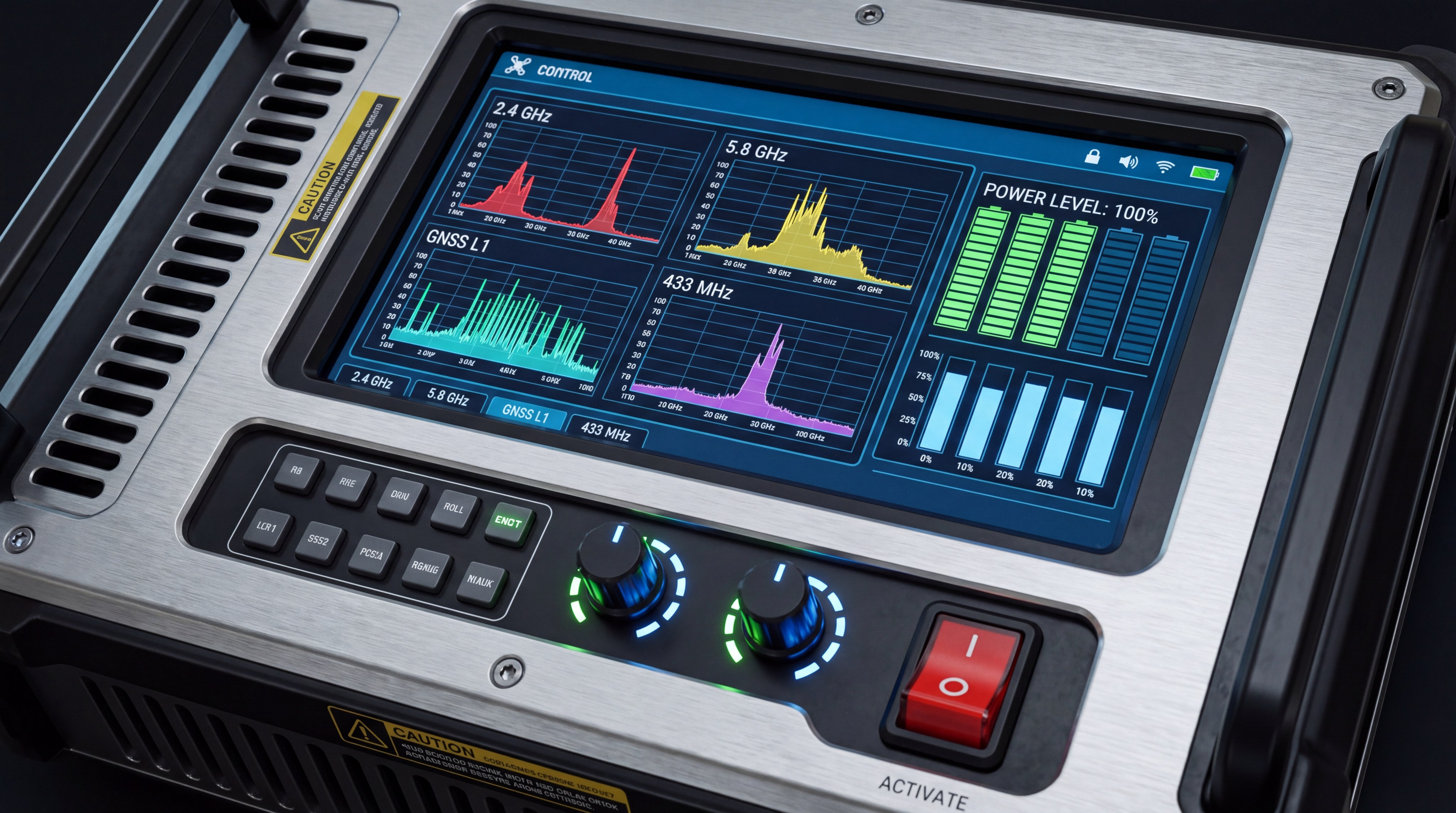
How do battery systems support prolonged field operations?
High-performance Anti Drone Jammers require sophisticated battery architectures to provide the high current needed for multiple RF amplifiers. You need a system that offers both high energy density for portability and the voltage stability required for a consistent jamming signal.
Is a 45-minute runtime enough for tactical deployments?
A continuous runtime of 45 to 60 minutes is usually sufficient for dozens of individual drone intercepts, as most encounters last less than three minutes. But here is the kicker: the battery must be able to sit in standby mode for days and still deliver 100% power the moment you pull the trigger.
- 24V 10Ah Lithium-Ion: The standard for high-power portable units.
- Quick Charging: Ability to reach 80% capacity in under two hours.
- Low Self-Discharge: Ensures the device is ready for emergency use.
Why are swappable battery modules preferred by professionals?
Modular battery designs allow your security team to keep the device in the field indefinitely by simply swapping out depleted cells for fresh ones. Think about it: in a high-alert scenario where multiple drones are appearing, you cannot afford to have your primary defense sitting on a charger.
- Hot-Swap Capability: Change batteries without losing system settings.
- External Power Ports: Connect to vehicle power for stationary defense.
- LED Status Indicators: Real-time monitoring of remaining “trigger time.”
Key Takeaway: A robust battery system with at least 45 minutes of active jamming time ensures that your security personnel can handle multiple threats throughout a shift without recharging.
| Battery Metric | Typical Spec | Operational Value |
|---|---|---|
| Runtime | 45 – 60 Minutes | Multiple intercept capability |
| Charge Cycles | 500+ | Long-term hardware lifespan |
| Voltage Display | Integrated LED | Immediate readiness assessment |
Buyers should verify that the battery chemistry is optimized for high-discharge rates to prevent voltage drops during full-spectrum jamming.
What cooling technologies ensure reliability in extreme heat?
Advanced cooling systems in Anti Drone Jammers are vital for maintaining peak performance during high-wattage operation, especially in outdoor environments. Without efficient heat dissipation, the internal RF amplifiers can quickly overheat, leading to a permanent reduction in output power or total system failure.
How do active fan systems prevent internal component failure?
Active cooling uses high-speed fans to pull air across internal aluminum heat sinks, rapidly removing the thermal energy generated by the 180W power modules. Think about it: your device is essentially a high-powered radio transmitter, and without those fans, it would become a decorative paperweight in a matter of minutes.
- Dual High-Speed Fans: Provide constant airflow through the chassis.
- Channeled Heat Sinks: Maximize the surface area for heat exchange.
- Thermal Sensors: Automatically adjust fan speed based on load.
Can high-power jammers operate continuously in desert climates?
Ruggedized units are designed with thermal management systems that allow for operation in ambient temperatures up to 55°C (131°F). But here is the kicker: even the best cooling system has limits, and users should avoid leaving the device in direct, mid-day sun for extended periods when not in use.
- Hard-Anodized Cases: Act as secondary heat sinks for internal components.
- Operational Thresholds: Built-in shutoff to prevent catastrophic damage.
- Ventilation Placement: Designed to resist dust while allowing air intake.
Key Takeaway: Superior cooling is what separates industrial-grade jammers from lower-quality units, ensuring the device remains functional during long-duration security events.
| Cooling Feature | Component | Purpose |
|---|---|---|
| Active Cooling | High-RPM Fans | Rapid heat removal during use |
| Passive Cooling | Aluminum Fin Sinks | Base-level thermal management |
| Protection | Thermal Auto-Shutoff | Prevents hardware burnout |
For sites in tropical or desert locations, ensure the jammer’s cooling system is rated for at least 50°C to guarantee operational reliability.
How does ergonomic design affect operator performance?
The physical layout of Anti Drone Jammers determines how quickly and accurately your security personnel can react to a sudden aerial intrusion. A well-balanced, “gun-style” design allows the operator to track fast-moving targets without the muscle fatigue associated with poorly designed hardware.
Is a 7.3kg weight manageable for single-person patrols?
While 7.3kg sounds heavy, an ergonomic design that includes shoulder straps and forward grips makes the weight feel significantly lighter during use. Think about it: if the weight is balanced over the operator’s center of gravity, they can maintain a steady aim for the duration of the intercept.
- Balanced Center of Mass: Prevents the “barrel” from dipping during use.
- Shoulder Support: Distributes weight across the torso.
- Rifle-Style Grips: Provides intuitive, steady handling.
How do intuitive control interfaces speed up response times?
The best devices feature simplified switches that can be operated while wearing tactical gloves, allowing for “blind” activation during high-stress moments. But here is the kicker: if the controls are too complex, your operator will be looking at the device instead of the drone.
- Tactile Switches: Immediate feedback when a band is activated.
- OLED Status Screens: Clear visibility of power and battery levels.
- Trigger Activation: Simple pull-to-jam mechanism for instant response.
Key Takeaway: Ergonomics are not just about comfort; they are a critical performance metric that determines how effectively your team can track and neutralize agile drones.
| Ergonomic Factor | Design Choice | Operational Benefit |
|---|---|---|
| Total Weight | ~7.3 Kilograms | Portable for single-operator use |
| Form Factor | Rifle/Gun Shape | Natural aiming and tracking |
| Controls | Large Tactile Buttons | Glove-friendly operation |
When evaluating weight, always test the unit with the battery installed, as this is the true weight your security team will be carrying.
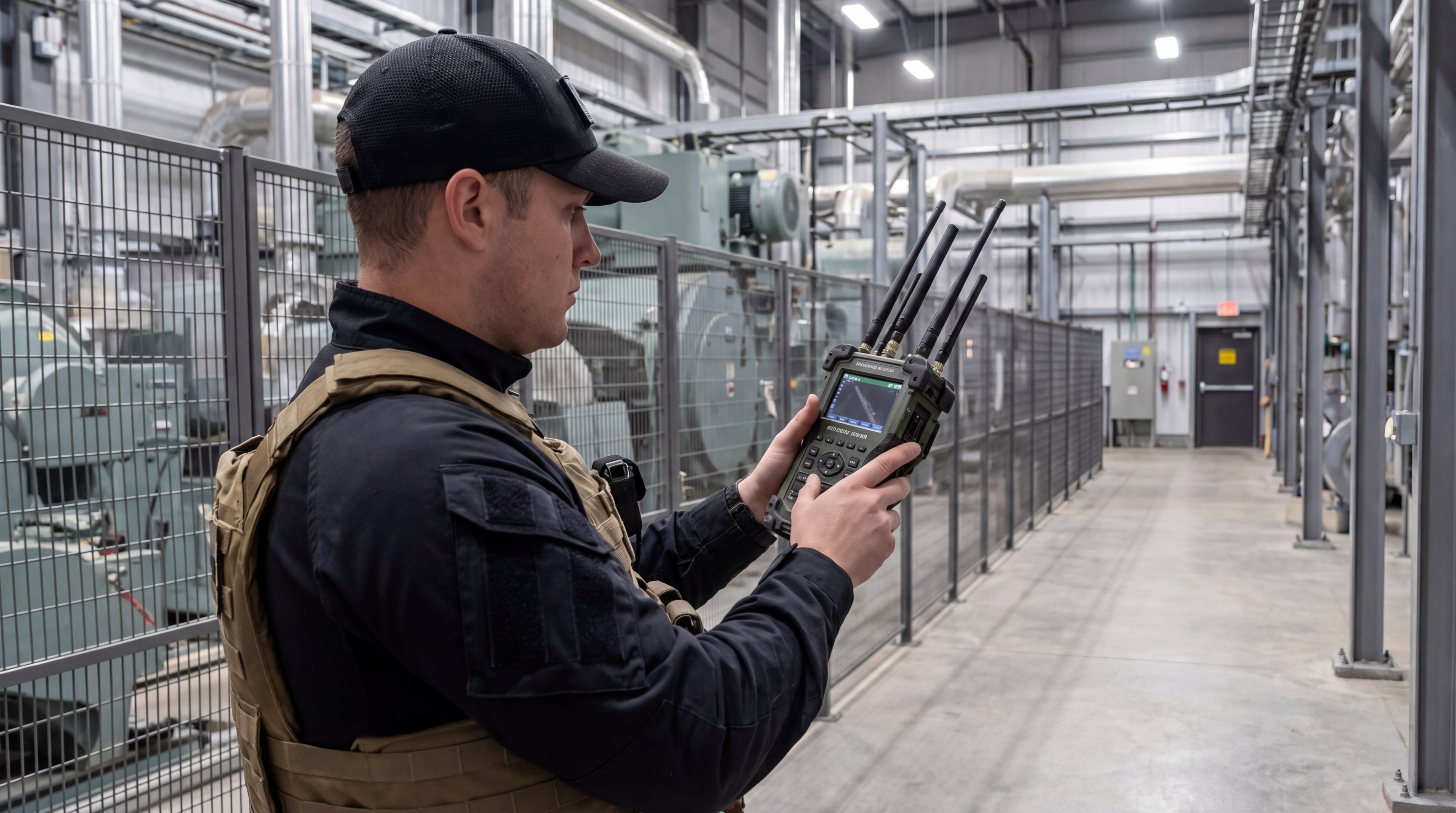
Which communication protocols are most vulnerable to jamming?
Modern Anti Drone Jammers must address a widening array of communication protocols to remain effective against professional UAVs. You need to understand that drones are increasingly moving away from simple Wi-Fi signals and toward proprietary, frequency-hopping digital links.
Why is the 5.8GHz band increasingly difficult to disrupt?
The 5.8GHz band is popular for high-bandwidth video, but its high frequency means the signal is easily blocked by physical obstacles like trees or buildings. Think about it: you need a very high-gain antenna and clear line-of-sight to ensure your jamming signal reaches the drone before its video downlink can transmit your facility’s secrets.
- High Bandwidth: Allows for 4K video streaming.
- Short Range: Requires the jammer to be closer to the target.
- Signal Bounce: Can be affected by multi-path interference in urban areas.
Can industrial jammers block proprietary telemetry links?
Advanced jammers use broad-spectrum noise to overwhelm proprietary protocols that try to “hide” within the standard ISM bands. But here is the kicker: some industrial drones use specialized frequencies like 1.2GHz for video, which many standard jammers completely ignore.
- 1.2 GHz Video: Often used by long-range surveying drones.
- Frequency Hopping: Jammer must cover the entire band to be effective.
- Telemetry Links: Data streams that tell the pilot the drone’s status.
Key Takeaway: Understanding the specific protocols used by drones in your region is vital for selecting a jammer with the correct frequency module configuration.
| Protocol Type | Frequency Band | Vulnerability |
|---|---|---|
| Wi-Fi (802.11) | 2.4 / 5.8 GHz | High (Standard protocols) |
| Digital Video | 1.2 / 5.8 GHz | Medium (Requires high power) |
| RC Telemetry | 433 / 915 MHz | High (Susceptible to noise) |
You should perform a local RF survey to identify if any specialized drone frequencies are common in your industry’s operational area.
How do certification standards ensure hardware reliability?
Selecting Anti Drone Jammers that meet international compliance and quality standards is the only way to ensure your investment will perform as advertised. These certifications guarantee that the device has been tested for electromagnetic compatibility and that the advertised power levels are accurate.
Why should you prioritize CE and RoHS compliance?
CE certification indicates that the device meets European safety and environmental standards, while RoHS ensures that no hazardous materials were used in its construction. Think about it: you are handing a high-power electronic device to your employees; you need to know it won’t catch fire or leak toxins.
- CE Certification: Proof of rigorous safety and RF testing.
- RoHS Compliance: Ensures environmental and operator safety.
- Build Quality: Guarantees the unit can withstand industrial use.
Does ruggedized housing improve the lifespan of your unit?
An IP-rated, ruggedized housing protects the sensitive internal electronics from moisture, dust, and physical impact. But here is the kicker: even a certified device will fail if it isn’t treated with care, so ensure your unit comes with a hard-shell transport case for field deployment.
- IP65 Rating: Protection against dust and low-pressure water jets.
- Military-Grade Materials: Resistance to vibration and shock.
- Integrated Heat Sinks: Metal chassis components that assist cooling.
Key Takeaway: Certifications are your insurance policy, proving that the hardware has been independently verified to meet the high performance and safety standards required for industrial security.
| Certification | Focus Area | Buyer Assurance |
|---|---|---|
| CE | Safety & RF Specs | Verified power and frequency |
| RoHS | Material Safety | Non-toxic construction |
| IP Rating | Environmental | Dust and water resistance |
Always ask for official certification documents from the manufacturer to verify that the equipment meets legal and safety requirements for your region.

What are the most common buyer questions?
Can I use these devices in any location?
Strictly speaking, the usage of high-power RF equipment is highly regulated and usually restricted to government, military, or authorized critical infrastructure. You must check your local laws and obtain the necessary permits before operating any jamming equipment in public or private airspace.
What’s the best way to maintain the internal battery?
Always store the battery at roughly 50% charge and perform a full charge/discharge cycle at least once every three months. Storing a lithium-ion battery while it is completely empty can lead to permanent cell damage and a significant loss of total capacity.
How do I know if the jammer is actually working?
Effective jamming is usually evidenced by the drone suddenly stopping in mid-air, drifting with the wind, or slowly descending toward the ground. Most commercial drones will also lose their video feed or display a “Signal Lost” warning on the operator’s screen the moment the jammer is activated.
Can I target multiple drones at once with one unit?
Yes, if multiple drones are flying within the 30-45 degree “cone” of your directional antenna, they will all be affected simultaneously. However, if the drones are spread out, you will need to sweep the jammer back and forth to maintain interference on all targets.
How do I choose between a portable and a fixed system?
Concise judgment: Choose portable for mobility and fixed for permanent 24/7 protection. Portable units are ideal for patrol teams and events, whereas fixed systems offer higher power and can be integrated with automated detection sensors for hands-off operation.
*
Securing Your Airspace with Professional Technology
Protecting your facility from unauthorized aerial intrusion requires a blend of high-power output, broad-spectrum coverage, and tactical precision. Our commitment at Corelix is to provide industry leaders with the most reliable information and technical guidance to navigate the complex world of drone mitigation. Whether you are defending a data center, a manufacturing plant, or a secure corporate campus, we believe that informed buyers make for safer environments.
If you are ready to enhance your security posture or have specific technical requirements for your site, please contact us today to speak with our specialists about your aerial defense strategy.
Authorized RF engineering and compliance review
For regulated RF systems, this page should be used as an engineering and compliance review path, not as a public deployment checklist. CorelixRF starts with authorization status, operating region, frequency plan, output limit, antenna interface, safety controls, thermal limits and acceptance documents.
- RFQ checklist – send the data buyers usually forget, including band, power, duty cycle, interface and test standard
- delivery documentation – check what documents can support incoming inspection, FAT review and long-term maintenance
- quality and certification review – review the quality and compliance evidence before the project moves into procurement
- RF front-end platform – compare the RF chain as a system instead of selecting one isolated module
- RF configurator – turn frequency, power, thermal and interface requirements into a first configuration brief
- case studies – review similar engineering paths before sending an RFQ
- engineering contact – send the application notes, block diagram or target specification to engineering sales
This keeps the discussion inside lawful, authorized RF programs while still giving procurement teams a clear way to request amplifier, antenna, SDR source, documentation and factory review.
Portable C-UAS RF Procurement Path
For authorized portable RF procurement, translate field-use constraints into RF power amplifier platform choices, RF front-end architecture and antenna/load planning. Share frequency bands, output targets, duty cycle, thermal margin, enclosure limits, control interface and required evidence records through the RF inquiry form.