
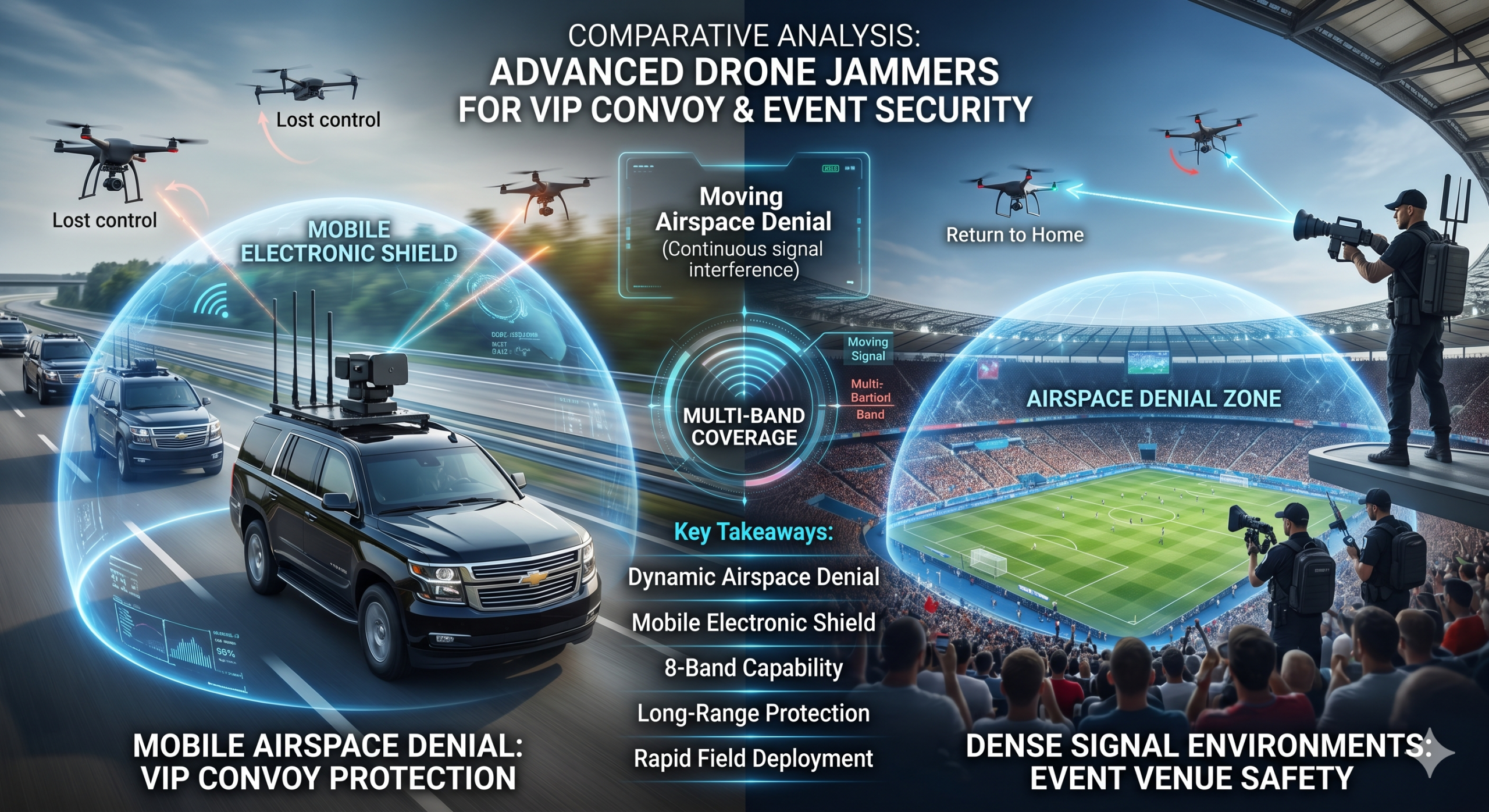
VIP convoys and high-profile events face unprecedented aerial threats that require sophisticated signal disruption strategies to ensure absolute protection. Imagine a high-stakes motorcade suddenly being shadowed by an unidentified UAV capable of recording private movements or delivering a hostile payload. You feel the tension as traditional perimeter security fails to account for the vertical dimension of risk. Utilizing advanced Drone Jammers provides a definitive solution by severing the link between the pilot and the device instantly.
Why are drone jammers vital for modern VIP convoy safety?
Drone Jammers create a mobile electronic shield that prevents unauthorized UAVs from tracking, recording, or attacking a moving motorcade. When you are managing high-stakes transport, the integration of Drone Jammers ensures that the “no-fly zone” moves with the vehicles. These devices disrupt the radio frequency links required for remote control and data transmission. This proactive approach eliminates the window of opportunity for aerial surveillance or targeted strikes.
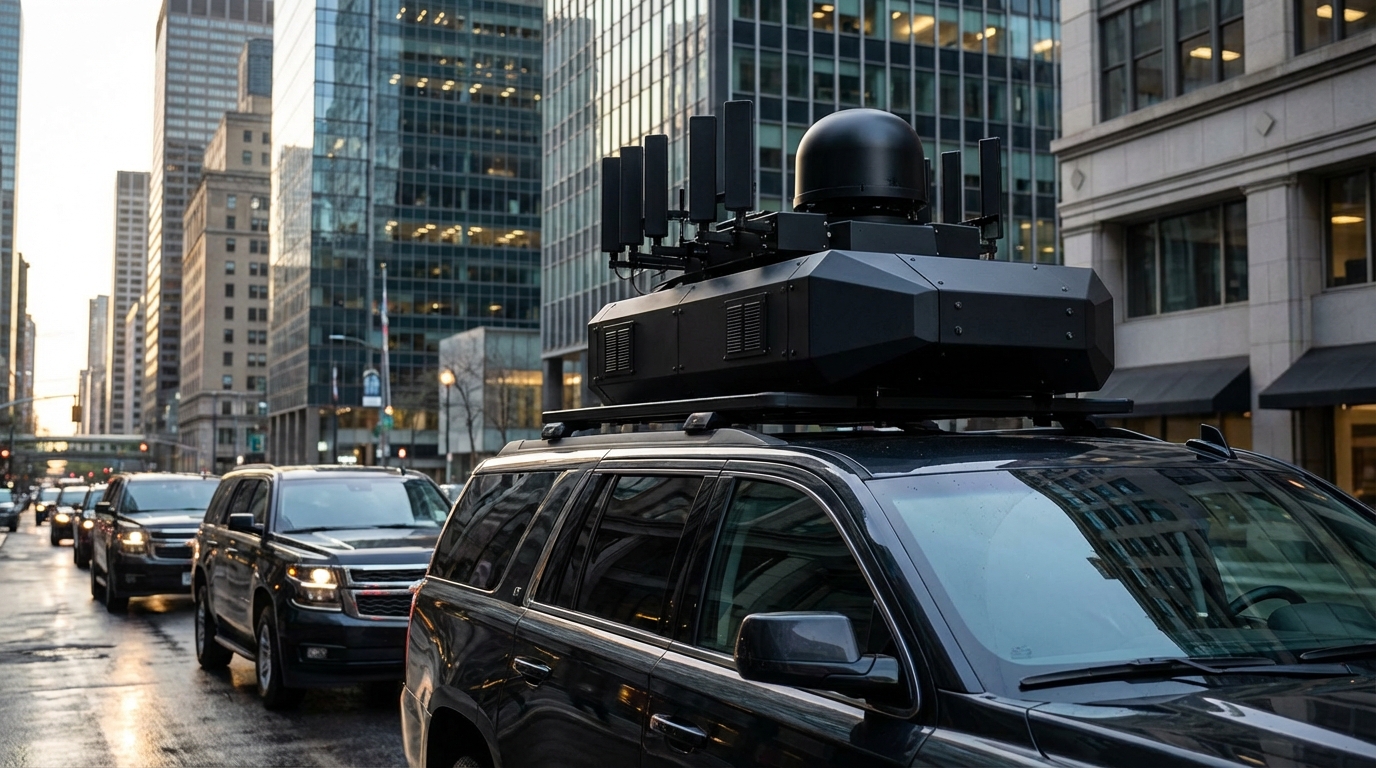
Countering aerial surveillance?
You must understand that modern drones can capture high-resolution footage from miles away.
But that’s not all.
- Disrupts live video downlinks to the operator.
- Prevents real-time tracking of vehicle routes.
- Forces the drone into a “return to home” mode.
Mitigating dynamic flight threats?
Unpredictable flight patterns of rogue drones make them difficult to track with visual means alone.
Here is the kicker:
- Jams signals across multiple frequency bands simultaneously.
- Neutralizes drones before they enter the immediate vicinity.
- Provides 360-degree protection for the entire convoy.
Protecting dignitaries in transit?
Ensuring the safety of a high-profile individual requires a multi-layered electronic defense.
You should know:
- Protects against payload-carrying drones.
- Maintains a secure corridor through urban environments.
- Works seamlessly with existing ground security measures.
Key Takeaway: Mobile drone disruption is the only way to ensure moving targets remain invisible and safe from persistent aerial threats during VIP transport.
| Feature | Convoy Benefit | Protection Level |
|---|---|---|
| Mobile Shielding | Real-time coverage | Maximum |
| Signal Interference | Blocks RC and GPS | High |
| Multi-vehicle Sync | Perimeter wide | Advanced |
Analysis: High-speed motorcades require low-latency jamming response to maintain security while traveling through diverse terrains.
How do 8-band drone jammers protect large event venues?
These specialized Drone Jammers block up to eight different frequency bands simultaneously to neutralize almost all commercial and custom-built drones. When you deploy these units at a stadium or rally, you gain the ability to manage a wide spectrum of electronic noise. This multi-band capability ensures that even drones using unconventional frequencies are successfully grounded. It is the gold standard for high-density public gatherings where safety is the top priority.
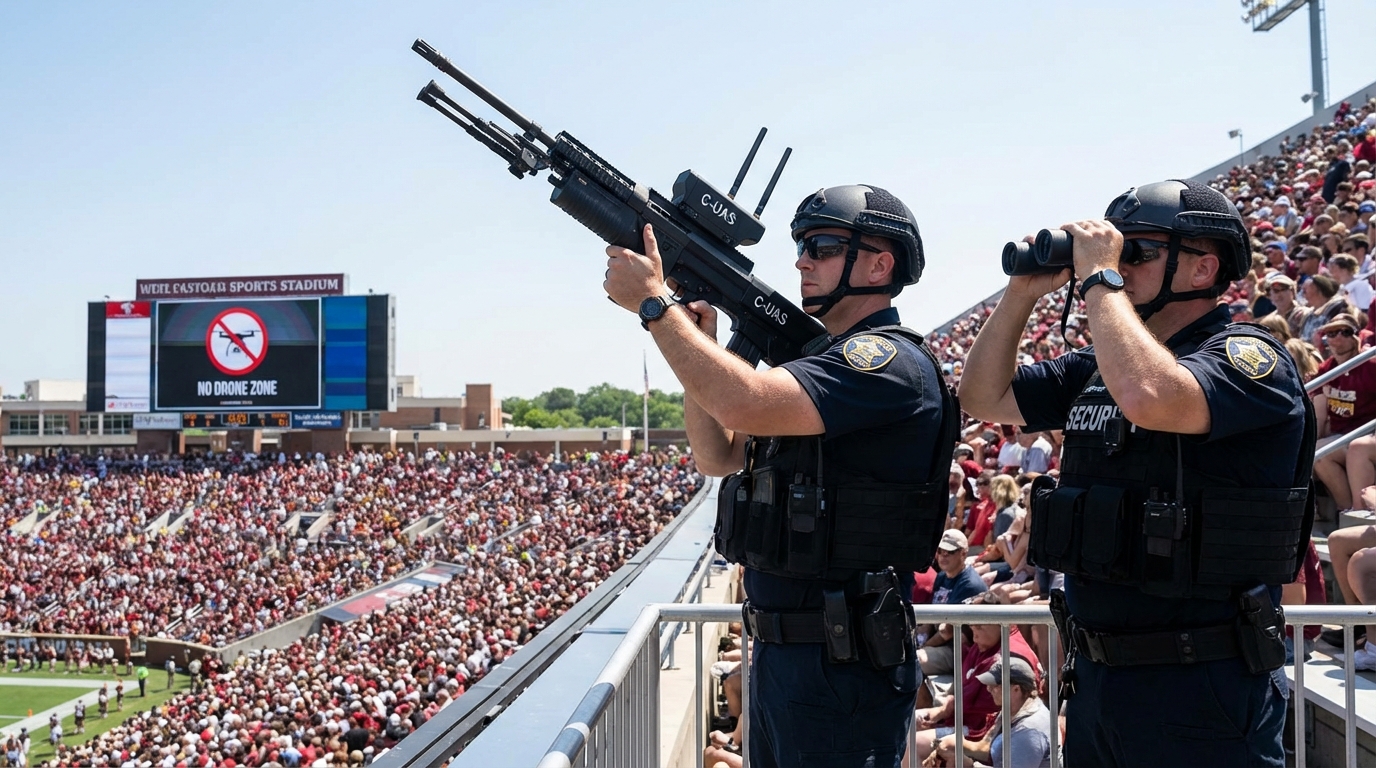
Neutralizing commercial UAV signals?
Most consumer drones rely on standard 2.4GHz and 5.8GHz frequencies for control and video.
Believe it or not:
- Instantly severs the command link.
- Prevents the drone from hovering over crowds.
- Ensures the pilot loses all telemetry data.
Managing dense signal environments?
Events are often filled with competing signals from mobile phones and wireless microphones.
The best part is:
- Targets specific UAV bands without affecting public Wi-Fi.
- Maintains clean communication for security personnel.
- Filters out non-threatening electronic interference.
Securing open perimeter spaces?
Wide-open venues like festivals present vast entry points for unauthorized aerial intruders.
You can’t ignore this:
- Creates a virtual fence around the entire venue.
- Allows for long-range detection and early neutralisation.
- Reduces the need for physical guards at every gate.
Key Takeaway: 8-band systems provide the necessary spectral depth to defend complex event venues against a wide variety of hobbyist and professional drones.
| Band Count | Target Drones | Coverage |
|---|---|---|
| 8-Band | Commercial & DIY | Full Spectrum |
| Signal Strength | High-density areas | Stable |
| Customization | Selective jamming | High |
Analysis: Multi-band systems are essential for large venues because they offer the versatility required to block diverse drone communication protocols.
What makes moving airspace denial effective for convoys?
Effective moving airspace denial relies on continuous signal interference that follows the convoy’s precise GPS coordinates to maintain a bubble of protection. By utilizing vehicle-mounted Drone Jammers, you ensure that the protection zone is never outrun by the motorcade’s speed. These systems use high-gain antennas to project an invisible barrier around the vehicles. This ensures that any drone attempting to approach the Drone Jammers zone is immediately disconnected from its controller.
Continuous signal interference?
A constant stream of interference is required to keep modern drones from re-establishing a connection.
It gets better:
- Automated signal sweeping for constant coverage.
- Prevents “dead zones” in the protective bubble.
- Ensures zero-gap security during transit.
Consistent output power levels?
Maintaining high power is critical when traveling through areas with high background radio noise.
Think about this:
- Overpowers the drone’s internal receiver easily.
- Maintains range even at high vehicle speeds.
- Provides stable performance in all weather conditions.
Shielding various transit routes?
Convoys often travel through tunnels, urban canyons, and open highways.
You’ll love this:
- Adapts to reflecting signals in city streets.
- Provides overhead coverage against high-altitude drones.
- Works effectively in both rural and metropolitan areas.
Key Takeaway: Airspace denial must be dynamic and persistent to counteract the mobility and speed of modern drone technology during VIP movements.
| Denial Type | Mobility | Efficacy |
|---|---|---|
| Dynamic | High-speed vehicle | Continuous |
| Static | Fixed position | Area-specific |
| Omni-directional | 360-degree | Full-shield |
Analysis: Moving airspace denial technology must be rugged enough to withstand vehicular vibration while maintaining peak electronic output.
How does operator mobility impact jammer success?
Operator mobility allows security teams to respond to drone threats from any vantage point, significantly increasing the success rate of tactical interceptions. High-quality Drone Jammers are often designed as handheld or backpack-mounted units to allow you to move freely through crowds or rough terrain. When your team can reposition quickly, they can maintain a direct line of sight with the aerial target. This agility is the difference between a successful defense and a security breach.
Reducing physical operator fatigue?
Heavy equipment can slow down a response team during long shifts at major events.
That’s not all:
- Lightweight materials allow for extended use.
- Ergonomic designs distribute weight evenly.
- Padded straps improve comfort for backpack models.
Enabling agile field deployment?
A drone threat can emerge from any direction in a matter of seconds.
Here is the kicker:
- Fast deployment from vehicles to the ground.
- Immediate activation once a target is spotted.
- Easy to carry through narrow passages or stairs.
Supporting fast repositioning needs?
If a drone changes its flight path, your operator must be able to follow it.
The truth is:
- Allows for better signal alignment with the target.
- Provides flexibility in large, complex venues.
- Ensures the operator can stay in the optimal jamming zone.
Key Takeaway: Portable and ergonomic jammer designs ensure that security personnel stay alert and capable of responding to threats for the entire duration of an event.
| Mobility Type | Operator Freedom | Deployment Speed |
|---|---|---|
| Handheld Gun | Maximum | Instant |
| Backpack | High | Rapid |
| Vehicle-mount | Limited | Continuous |
Analysis: Mobility directly correlates with reaction time, making portable jammers indispensable for fast-moving security scenarios.
Which frequencies must a drone jammer cover for security?
A comprehensive security system must cover frequencies ranging from 433MHz to 5.8GHz to ensure no drone communication channel is left open. Most Drone Jammers focus on the Drone Jammers frequencies used by popular manufacturers to maximize their defensive utility. You need to ensure that your device targets both the control signals and the navigation links like GPS. This dual-layered interference prevents the drone from both being steered and knowing its location.
Disrupting GPS and GLONASS signals?
Drones use satellite navigation to fly autonomous missions or return to their starting point.
But wait, there’s more:
- Forces the drone to drift aimlessly.
- Prevents pre-programmed waypoint missions.
- Disables the “return to home” safety feature.
Blocking standard WiFi frequencies?
Most consumer drones use 2.4GHz and 5.8GHz WiFi bands for command and control.
It’s a game-changer:
- Effective against the majority of “off-the-shelf” drones.
- Interrupts the high-bandwidth video transmission.
- Causes the drone to trigger emergency landing protocols.
Targeting 900MHz and 433MHz bands?
Long-range drones and custom-built units often use lower frequencies for better penetration.
Here is the secret:
- Prevents control from several miles away.
- Blocks signals that travel well through obstacles.
- Ensures coverage against advanced industrial drones.
Key Takeaway: A successful jammer must offer a broad spectral range to defend against everything from toy drones to professional-grade surveillance platforms.
| Frequency Band | Common Use | Security Impact |
|---|---|---|
| 433/900 MHz | Long-range Control | High |
| 2.4/5.8 GHz | Video & Command | Maximum |
| GPS L1/L2 | Navigation | Critical |
Analysis: Broad-spectrum coverage is the only way to future-proof security against drones that switch frequencies automatically to avoid detection.
How does range affect drone jammers in venue security?
Range determines how much time you have to react to an incoming threat, with longer-range jammers providing a much larger safety buffer. For large venues, Drone Jammers with a range of 1.5km to 3km are preferred to keep threats far from the crowds. If the range is too short, the drone may already be close enough to capture sensitive data or drop a payload before it is disabled. Maximizing this active denial zone is the key to managing large-scale venue safety.
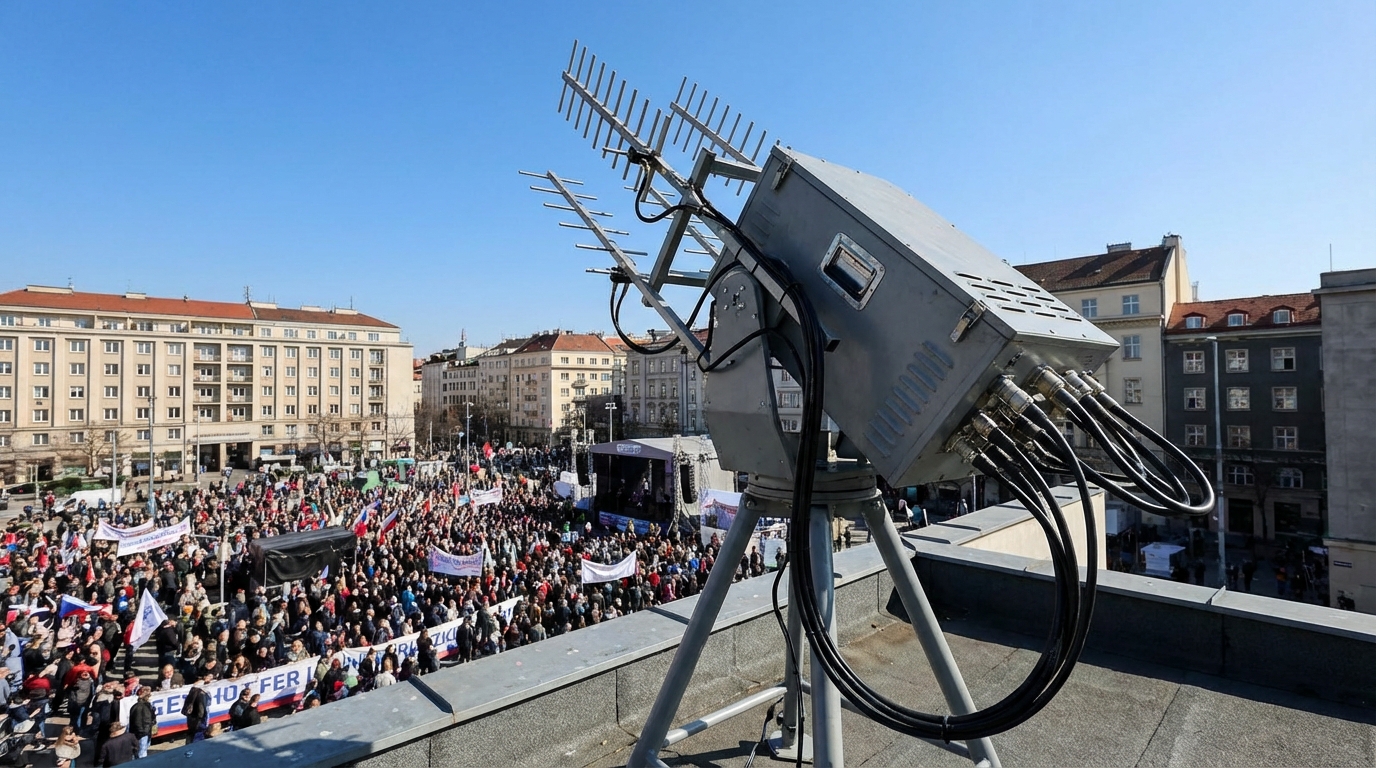
Analyzing effective distance limits?
The effective range of a jammer is influenced by the power of the drone’s remote controller.
Believe it or not:
- Higher wattage equals a longer disruption distance.
- Clear lines of sight maximize effective range.
- Environmental factors like buildings can reduce signal reach.
Scaling security for large rallies?
A small jammer might not be enough for a rally covering several city blocks.
The best part is:
- Daisy-chaining multiple units increases total coverage.
- Centralized control allows for massive denial zones.
- Protects thousands of people from a single drone.
Maximizing the active denial zone?
You want to stop the drone as far from the “red zone” as possible.
Think about this:
- Early intervention prevents panic in the crowd.
- Gives security teams time to locate the pilot.
- Reduces the risk of a drone falling on attendees.
Key Takeaway: Long-range capabilities are essential for event security to provide enough reaction time to neutralize threats safely and efficiently.
| Jammer Range | Application | Buffer Time |
|---|---|---|
| < 500m | Personal protection | Low |
| 500m – 1.5km | Convoy/Small event | Medium |
| > 1.5km | Large stadium/Rally | High |
Analysis: Power output must be balanced with battery life to ensure long-range protection stays active throughout the entire event duration.
Why is selective band activation crucial for operators?
Selective band activation allows you to target specific drone signals while keeping essential communication lines open for your own security team. Modern Drone Jammers often feature independent switches for each frequency band to give you total control over the electronic environment. When you manage a Drone Jammers deployment, this precision prevents accidental interference with medical equipment or local mobile networks. It is a vital feature for maintaining operational discretion in sensitive areas.

Conserving internal battery life?
Running all bands at once consumes a massive amount of power very quickly.
But that’s not all:
- Turns off unused bands to save energy.
- Extends field operation time significantly.
- Reduces the heat generated by the device.
Reducing interference with services?
Indiscriminate jamming can knock out critical local services like emergency radios.
Here is the kicker:
- Avoids jamming legal communications in the area.
- Ensures spectators can still use their phones.
- Meets strict regulatory requirements for event venues.
Tailoring response to drone types?
Different drones require different jamming approaches to be neutralized effectively.
You should know:
- Focuses power only on the active threat band.
- Increases the density of the jamming signal.
- Allows for a more surgical electronic response.
Key Takeaway: Selective activation provides the surgical precision needed to secure an area without causing unnecessary disruption to the surrounding electronic infrastructure.
| Activation Mode | Power Efficiency | Precision |
|---|---|---|
| All-Band | Low | Low |
| Selective | High | Maximum |
| Automated | Medium | High |
Analysis: Operators who master selective activation can keep their devices in the field longer while minimizing “friendly fire” on local networks.
How do antennas improve drone jammers in the field?
High-gain antennas concentrate the jamming signal into a narrow beam, allowing you to reach further and stay more precise than omni-directional models. When using directional Drone Jammers, you can point the device directly at the target drone to deliver maximum power. This targeted approach prevents the signal from scattering and affecting devices that are not in the line of fire. It is the most efficient way to utilize the available wattage of your system.
Concentrating power on the target?
An omni-directional signal wastes energy by spreading it in every direction simultaneously.
Here is the kicker:
- Directional beams reach up to 3x further.
- Focuses 100% of the energy on the threat.
- Overcomes high-powered drone controllers easily.
Minimizing collateral signal loss?
You don’t want to shut down every device in the neighborhood just to stop one drone.
But that’s not all:
- Shields nearby electronics from the jamming beam.
- Allows for jamming in crowded urban centers.
- Provides a “surgical” electronic strike capability.
Increasing precise signal delivery?
Accuracy is key when a drone is flying near sensitive infrastructure or people.
The truth is:
- Ensures only the target drone is affected.
- Reduces the risk of legal complications.
- Provides a clear operational boundary for security.
Key Takeaway: Directional antennas are the superior choice for professional security teams who require long-range precision and efficient power management.
| Antenna Type | Range | Precision |
|---|---|---|
| Directional | Very Long | High |
| Omni-directional | Short/Medium | Low |
| Patch Antenna | Medium | Medium |
Analysis: Integrating high-gain antennas into handheld units provides the best balance between operator mobility and long-range effectiveness.
What design features ensure rapid response in the field?
Design features like instant-on switches and ergonomic grips allow you to transition from detection to neutralisation in under three seconds. The best Drone Jammers are built for high-stress environments where every second counts. You need a device that feels natural in your hands and requires minimal setup before it is ready to fire. These user-centric features ensure that your security personnel can focus on the threat rather than the equipment.
Benefits of lightweight construction?
A heavy jammer is difficult to aim accurately and tiring to hold for long periods.
Here is the kicker:
- Carbon fiber and alloy frames reduce weight.
- Makes the device easy to swing and aim.
- Allows for one-handed operation in emergencies.
Impact of ergonomic grip designs?
Your hand should fit perfectly on the device to ensure stable aiming during high-speed chases.
But that’s not all:
- Reduces hand strain during prolonged targeting.
- Provides better control over the jamming beam.
- Non-slip surfaces ensure a firm hold in the rain.
Integration of high-capacity power?
A jammer is useless if the battery dies in the middle of a security event.
The best part is:
- Quick-swap batteries keep the unit active.
- Internal cooling prevents thermal shutdown.
- LED indicators show remaining life at a glance.
Key Takeaway: Superior industrial design is just as important as electronic power when it comes to the real-world success of drone defense missions.
| Design Feature | Security Benefit | User Impact |
|---|---|---|
| Instant-On | Fast response | Critical |
| Ergonomic Grip | Better aiming | High |
| Modular Battery | Zero downtime | Maximum |
Analysis: User-centric design ensures that technology becomes an extension of the operator’s intent rather than a bottleneck during a crisis.
Do quality standards ensure drone jammers stay reliable?
Strict quality standards and manufacturing protocols ensure that your drone jammers will perform consistently under the most demanding environmental conditions. When you invest in high-end Drone Jammers, you are paying for precision-engineered components that have been tested for extreme heat, cold, and vibration. These devices must meet regulatory safety protocols to ensure they do not harm the operator or the public. Reliability is the cornerstone of any VIP or event security plan.
Meeting regulatory safety protocols?
High-powered RF devices must be designed to minimize radiation exposure to the human user.
Believe it or not:
- Shielded internals protect the operator’s body.
- Complies with international electronic safety laws.
- Ensures the device is safe for use in public spaces.
Ensuring long-term device durability?
Security equipment is often subjected to rough handling and harsh outdoor weather.
Here is the secret:
- Waterproof and dustproof ratings (IP65+).
- Shock-resistant housings prevent internal damage.
- High-quality components reduce the need for repairs.
Impact of precision manufacturing?
Every frequency band must be tuned perfectly to ensure it hits the target drone’s receiver.
You’ll love this:
- Prevents frequency drift over time.
- Ensures consistent output power on every band.
- Guarantees that the device works the first time, every time.
Key Takeaway: Investing in certified, high-quality hardware is the only way to guarantee that your electronic defense will not fail when it is needed most.
| Standard | Benefit | Importance |
|---|---|---|
| IP65 Rating | Weather resistance | High |
| CE/FCC Cert | Safety compliance | Critical |
| Military Grade | Extreme durability | Maximum |
Analysis: Quality assurance in manufacturing prevents the catastrophic failure of electronic components during critical security operations.
As the drone landscape continues to evolve, the necessity for robust, multi-band, and portable jamming solutions becomes more apparent for both VIP protection and large-scale public safety. The future of security lies in the seamless integration of electronic warfare capabilities into the standard toolkit of security professionals worldwide. By staying ahead of the technological curve, you can ensure that the skies above your most sensitive locations remain clear and secure. To learn more about our advanced security solutions or to request a consultation, please contact us today.
Frequently Asked Questions
Can I use these jammers in any country?
You must check local laws first, as many regions restrict the use of signal jamming technology to authorized government or security agencies only. Most countries require specific permits for non-military use.
What’s the best way to maintain battery life?
Always keep your batteries at a partial charge for storage and utilize selective band activation to ensure you only use power when a specific threat is detected. Regular testing of the cells is highly recommended.
How do I know if a drone is being successfully jammed?
You will typically see the drone either hover in place, begin an emergency landing, or turn around and fly back to its starting point immediately. Most high-end units also provide visual or audio feedback to the operator.
Can I jam multiple drones at the same time?
Yes, most professional systems can jam an unlimited number of drones as long as they are within the jammer’s effective range and signal beam. Broad-spectrum units are particularly effective for swarm defense.
How do I know if the frequency I need is covered?
Check the technical specifications of your device to ensure it includes 2.4GHz, 5.8GHz, and GPS bands, which cover over 95% of the drone market. For specialized threats, look for 433MHz and 900MHz support.
Authorized RF engineering and compliance review
For regulated RF systems, this page should be used as an engineering and compliance review path, not as a public deployment checklist. CorelixRF starts with authorization status, operating region, frequency plan, output limit, antenna interface, safety controls, thermal limits and acceptance documents.
- RFQ checklist – send the data buyers usually forget, including band, power, duty cycle, interface and test standard
- delivery documentation – check what documents can support incoming inspection, FAT review and long-term maintenance
- quality and certification review – review the quality and compliance evidence before the project moves into procurement
- RF front-end platform – compare the RF chain as a system instead of selecting one isolated module
- RF configurator – turn frequency, power, thermal and interface requirements into a first configuration brief
- case studies – review similar engineering paths before sending an RFQ
- engineering contact – send the application notes, block diagram or target specification to engineering sales
This keeps the discussion inside lawful, authorized RF programs while still giving procurement teams a clear way to request amplifier, antenna, SDR source, documentation and factory review.
Mobile Convoy RF System Review Path
For authorized mobile convoy RF programs, connect mobility, vehicle power and thermal limits to RF front-end integration, RF power amplifier selection and antenna/load planning. Send frequency bands, output targets, duty cycle, enclosure constraints, control interface and validation evidence requirements through the RF inquiry form.