
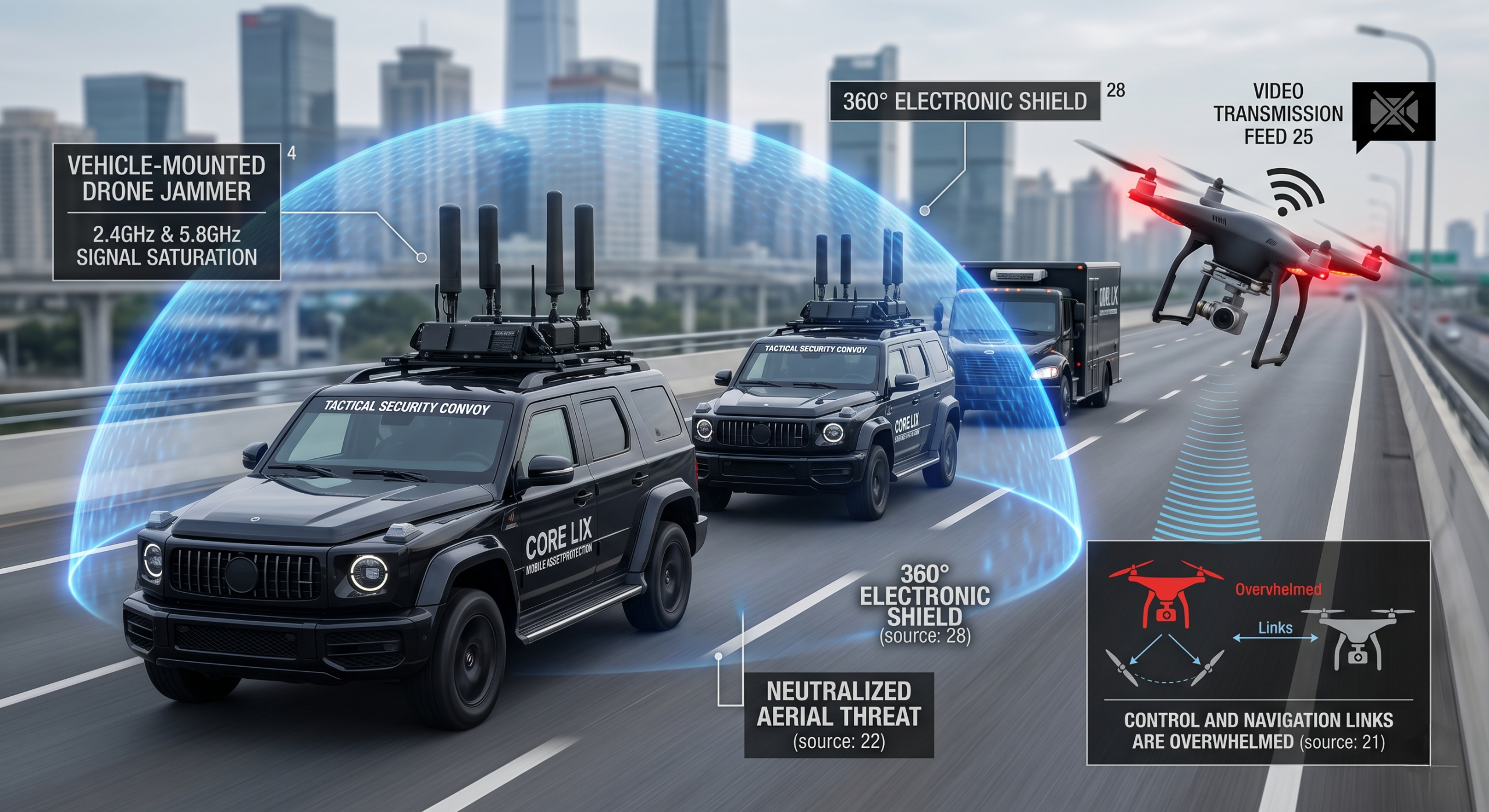
Protecting your mobile assets from aerial threats requires a proactive electronic defense that moves as fast as your fleet does. While your ground-level security might be airtight, the sky often remains an undefended corridor for corporate spies and bad actors. These intruders use low-cost technology to track your high-value cargo or monitor VIP movements without ever stepping onto your property. By deploying vehicle-mounted Drone Jammers, you create a 360-degree electronic shield that stays with your assets throughout their entire journey. This invisible perimeter ensures that unauthorized observers are neutralized the moment they attempt to breach your airspace.
Why Are Your Mobile Assets Targeted by Drones?
Unauthorized drones target your mobile assets to gather real-time intelligence on transport routes and high-value logistics schedules. The presence of Drone Jammers prevents these aerial scouts from maintaining the data links necessary to relay sensitive information back to their operators. Without this defense, your moving assets are vulnerable to visual reconnaissance and precision tracking in public spaces.
How Do Drones Breach Fleet Security?
The truth is, traditional security measures are built for stationary perimeters and fail to protect assets in transit. Drones bypass fences and gates, using high-altitude perspectives to monitor your every move.
- They utilize high-definition zoom lenses for remote spying.
- GPS tracking allows them to log your exact delivery patterns.
- Low-noise motors make them difficult to detect by ear.
- Real-time video feeds provide attackers with instant tactical data.
Are Your Surveillance Risks Increasing?
Here is the deal: drone technology is becoming more accessible and sophisticated every year, making your transit routes public knowledge. Modern unmanned aerial vehicles (UAVs) boast extended flight times and AI-driven tracking features.
Key Takeaway: Your assets are most vulnerable when moving through uncontrolled public airspace where ground security cannot reach.
| Threat Vector | Operational Impact | Mitigation Strategy |
|---|---|---|
| Visual Recon | Strategic Info Leakage | Signal Interruption |
| Signal Tracking | Route Hijacking Risk | Frequency Jamming |
| Payload Drop | Physical Asset Damage | Multi-Band Defense |
The shifting nature of aerial espionage requires a defense system that is as mobile and adaptable as the threats it faces.
How Do Vehicle Drone Jammers Secure Convoys?
Vehicle Drone Jammers secure convoys by emitting concentrated radio frequency signals that overwhelm the control and navigation links of hostile drones. This technology forces an intruder into a fail-safe mode, such as an immediate landing or a “return-to-home” sequence. By neutralizing the 2.4GHz and 5.8GHz bands, you effectively blind the pilot and sever their control over the aircraft.
What Happens to a Jammed Drone?
Believe it or not, a jammed drone becomes instantly useless to its operator as the command-and-control (C2) link vanishes. The drone’s internal software usually triggers a safety protocol once the signal is lost.
- The live video feed to the operator goes dark immediately.
- Onboard GNSS navigation is blocked to prevent hovering.
- Automated waypoints are overwritten by interference noise.
- The aircraft is forced to exit the protected airspace.
Can You Maintain 360-Degree Protection?
But wait, there is more: vehicle-mounted systems use omnidirectional antennas to ensure no blind spots exist during transit. This allows your security detail to maintain a constant “bubble” of protection around multiple vehicles.
Key Takeaway: Mobile jamming creates a moving fortress that protects the entire convoy without requiring physical contact with the threat.
| Protection Feature | Vehicle Benefit | Security Outcome |
|---|---|---|
| Omnidirectional | 360° Perimeter Coverage | Total Signal Saturation |
| Real-Time Disruption | Instant Threat Response | Zero-Lag Defense |
| Mobile Integration | Continuous Security | Safe Transit |
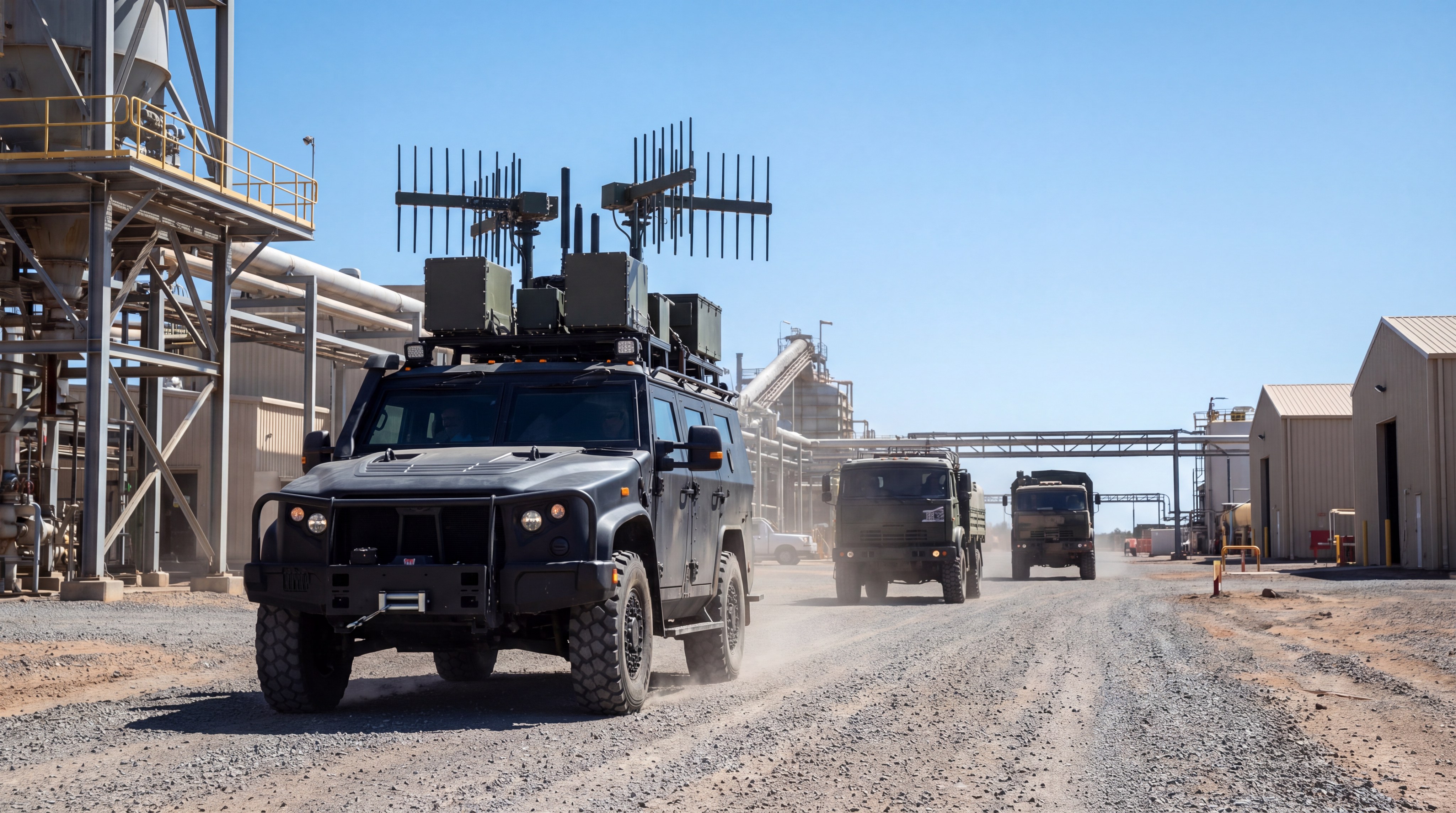
Understanding how signal saturation works is the first step in planning a comprehensive convoy defense strategy.
What Technical Specs Matter for Mobile Defense?
Technical specifications like power output and frequency agility are the primary factors that determine the effectiveness of Drone Jammers in the field. You need a system that can penetrate the “noise” of urban environments while covering the wide spectrum used by custom-built FPV drones. Effective systems typically offer wattage exceeding 150W to ensure the jamming signal remains dominant over the drone operator’s remote control.
Why Is High Power Output Crucial?
It comes down to this: a jammer must be louder than the signal the drone is trying to hear from its pilot. Higher wattage directly correlates to a larger effective range and better penetration through obstacles like trees or buildings.
- It overcomes heavy radio interference in city centers.
- Stronger signals provide a longer reaction window for security teams.
- High-power units maintain a stable radius at high vehicle speeds.
- It ensures reliability against high-gain remote control antennas.
Which Frequencies Should You Target?
The fact is, a single-band jammer is no longer enough to stop modern, multi-frequency aerial threats. You must look for systems that cover the standard commercial bands as well as specialized FPV and GPS frequencies.
Key Takeaway: Comprehensive frequency coverage is the only way to ensure that hobbyist drones and professional-grade UAVs are equally neutralized.
| Frequency Band | Drone Function | Jamming Necessity |
|---|---|---|
| 2.4 / 5.8 GHz | Control & Video Link | Critical Standard |
| 1.2 / 1.3 GHz | Long-Range FPV | High Tactical |
| GNSS / GPS | Stability & Waypoints | Essential for Recovery |
Evaluating these technical benchmarks allows you to select hardware that matches the specific threat profile of your operating region.
Can You Integrate Jammers into Standard Fleets?
You can easily integrate Drone Jammers into standard vehicle fleets using magnetic mounting systems and existing 12V or 24V power architectures. These systems are designed for rapid deployment, allowing security teams to equip SUVs, trucks, or armored vans without permanent structural modifications. This modularity is perfect for organizations that need to scale their protective measures across different missions.
Is the Installation Process Complex?
Here is the kicker: most professional vehicle systems can be fully operational in less than ten minutes. The plug-and-play nature of modern hardware means your existing drivers can manage the basic setup.
- Magnetic bases secure the antennas to the roof instantly.
- Power connects directly to the vehicle’s auxiliary ports.
- The control interface sits comfortably within the driver’s reach.
- Compact form factors leave plenty of room for other gear.
How Do You Manage Power Consumption?
Look at it this way: high-efficiency cooling and smart power management prevent the system from draining your vehicle’s battery during long shifts. You can run these units continuously as long as the engine is providing a steady charge.
Key Takeaway: Easy integration means you don’t need a specialized engineering team to upgrade your fleet’s security profile.
| Component | Installation Method | Maintenance Need |
|---|---|---|
| Antenna Array | Magnetic Roof Mount | Monthly Seal Check |
| Main Power Unit | Trunk / Cabin Secure | Air Filter Cleaning |
| Control Panel | Dash / Center Console | Periodic Software Sync |
The simplicity of modern installation ensures that your fleet can transition from standard transport to a secured convoy at a moment’s notice.
How Do Environmental Factors Impact Jamming?
Environmental factors like heavy precipitation, urban density, and extreme temperatures can significantly alter the signal propagation of Drone Jammers during transit. You must account for signal attenuation, where rain or thick fog can physically scatter the radio waves and reduce your effective defense radius. Ruggedized hardware is essential for mobile operations, as it must survive the vibrations of the road and the heat of a desert sun.
Does Rain Reduce Jamming Range?
The reality is that water molecules in the air can absorb high-frequency radio energy, potentially shrinking your protective bubble. During heavy downpours, the effective range might drop by as much as twenty percent.
- Moisture scatters the 5.8GHz video transmission signals.
- IP-rated enclosures are required to prevent internal shorts.
- Antennas must be cleaned of salt or grime regularly.
- Signal buffers should be planned into your convoy spacing.
Can Heat Cause System Failures?
Think about this: emitting 200 watts of radio power creates substantial internal heat that must be managed to prevent hardware throttling. Without active cooling, a jammer might reduce its own power to protect the circuitry, leaving you exposed.
Key Takeaway: Only use systems with forced-air cooling and industrial-grade thermal management for missions in hot or humid climates.
| Factor | Effect on Signal | Mitigation Strategy |
|---|---|---|
| High Humidity | Range Reduction | Over-Specced Power |
| Urban Canyons | Signal Reflection | Omnidirectional Units |
| Extreme Heat | Thermal Throttling | Active Fan Cooling |

Selecting ruggedized equipment ensures that your electronic shield remains active regardless of the weather or the terrain you encounter.
What Is the Effective Range of a Mobile Jammer?
The effective range of mobile Drone Jammers typically falls between 100 and 500 meters, depending on the power of the drone’s remote control and the local environment. You should understand that jamming is a game of proximity; the closer the drone is to your vehicle compared to its pilot, the more effective the disruption. Because your assets are moving, the goal is often area denial rather than permanent drone capture.
Why Does Operator Distance Matter?
It works like this: the drone’s receiver is constantly listening for the strongest signal on its operating frequency. If your vehicle is closer to the drone than the operator is, your jammer’s “noise” will drown out the pilot’s commands.
- Signals follow the inverse-square law of physics.
- Moving targets create a dynamic and shifting signal environment.
- High-gain antennas on the drone can sometimes resist weak jammers.
- Tactical positioning of the vehicle can maximize jamming impact.
Can You Extend the Protection Zone?
But wait, there is more: by utilizing multiple vehicles with overlapping jamming fields, you can protect a much larger area of the road. This strategy is essential for protecting long freight convoys or VIP motorcades.
Key Takeaway: Range is dynamic, so always aim for a system that provides a comfortable safety buffer beyond your immediate visual line of sight.
| Variable | Impact on Range | Desired Value |
|---|---|---|
| Output Power | Direct Correlation | 200W+ Per Band |
| Drone Sensitivity | Varies by Model | Wideband Saturation |
| Mounting Height | Line-of-Sight Access | Roof-Top Elevation |
A well-calibrated range setup allows your security team to neutralize threats before they can get close enough to capture useful data.
Will Jammers Interfere with Vehicle Systems?
Professional-grade Drone Jammers use advanced filtering and shielding to ensure they do not interfere with your vehicle’s essential electronic systems. You can operate high-power jamming equipment alongside GPS navigation and mobile communications if the bands are properly isolated. Lower-quality units may suffer from “signal bleed,” but B2B solutions are specifically engineered to keep the interference focused outward rather than inward.
How Is Signal Isolation Achieved?
To put it simply, engineers use band-pass filters that allow only specific frequencies to be emitted while blocking noise on internal vehicle bands. This ensures your radio and engine control units (ECUs) remain unaffected.
- Shielded enclosures contain the RF energy within the device.
- Antennas are tuned to prevent feedback into the vehicle’s wiring.
- Digital signal synthesis provides a “cleaner” jamming spectrum.
- Physical separation between antennas reduces electronic crosstalk.
Can You Still Use Onboard GPS?
The short answer is yes, provided your system supports “notched” frequencies or has adequate physical separation from the vehicle’s GPS receiver. Most modern units are designed to protect the vehicle’s own navigation while jamming the drone’s satellite link.
Key Takeaway: Quality hardware ensures that your defense measures never compromise the operation or safety of the transport vehicle itself.
| Vehicle System | Risk Level | Protection Method |
|---|---|---|
| GPS Navigation | Moderate | Physical Separation |
| Two-Way Radios | Low | Band-Pass Filtering |
| Engine ECUs | Very Low | RF Shielded Housing |
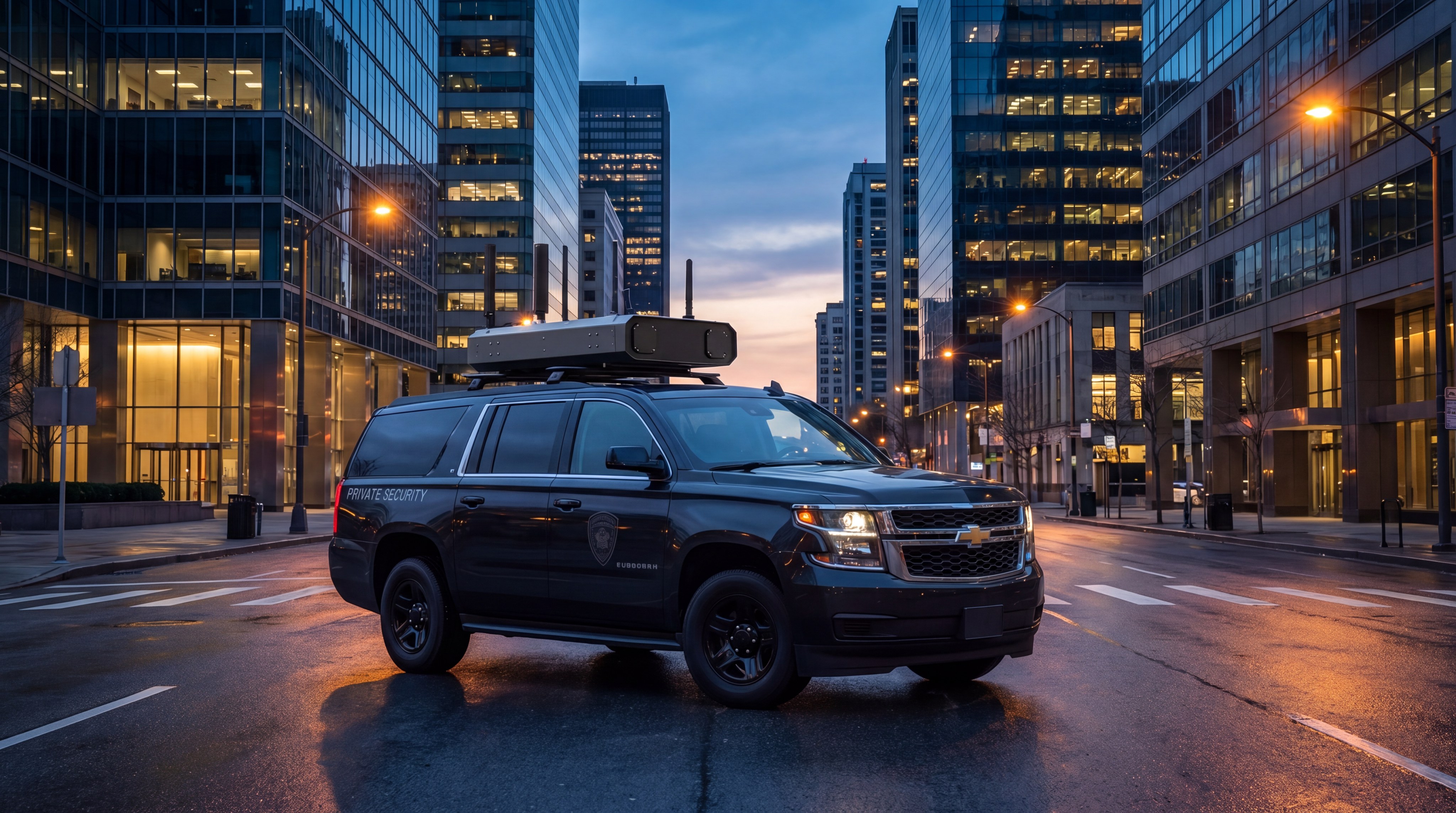
Testing your equipment in a controlled environment will confirm that your electronic shield and vehicle systems can coexist in perfect harmony.
What Are the Legal Bounds of Mobile Jamming?
The legal use of Drone Jammers is generally restricted to government, military, and authorized security entities due to strict radio frequency regulations. You must verify local and national laws before deployment, as unauthorized jamming can disrupt public emergency services or cellular networks. In the European and American markets, operating such technology typically requires specific permits or government contracts to ensure public safety.
Who Can Legally Operate Jammers?
The landscape is complex, but it usually centers on the concept of “authorized necessity” for high-risk operations. Most jurisdictions reserve the right to jam for those protecting critical infrastructure or high-profile individuals.
- Military units in conflict zones or training exercises.
- Federal law enforcement during tactical operations.
- Specialized security firms with government-issued waivers.
- Critical infrastructure teams (e.g., airports, power plants).
How Do You Manage Local Compliance?
Take a look: keeping detailed logs of when and where the jammer is activated is often a requirement for legal compliance. This transparency helps prove that the equipment was used only to mitigate legitimate aerial threats.
Key Takeaway: Legal authorization is just as important as the hardware itself; never deploy without a clear regulatory framework in place.
| Jurisdiction Type | General Rule | Documentation Need |
|---|---|---|
| Federal / National | Highly Restricted | Operator Permits |
| International | Varies by Border | Import / Export Licenses |
| Local / Municipal | Noise/RF Ordinances | Incident Usage Logs |
Navigating the legal requirements early in the procurement process will prevent costly regulatory penalties and operational shutdowns.
How Do Jammers Handle Swarm Drone Attacks?
Vehicle-mounted Drone Jammers are capable of neutralizing swarm attacks by saturating the entire frequency spectrum, affecting every drone that enters the signal bubble simultaneously. Unlike kinetic weapons that must target one drone at a time, electronic countermeasures act as a “blanket” defense. Whether there is one drone or twenty, the interference affects any aircraft operating on the jammed frequencies within your immediate vicinity.
Can One Jammer Stop Multiple Drones?
Essentially, the jammer does not care how many drones are in the air; it only cares about the frequencies they are using to communicate. As long as the swarm is using standard control bands, the interference will be effective against the entire group.
- The signal is omnidirectional, covering all angles at once.
- Power is distributed evenly across the targeted bands.
- Digital drones on the same frequency are all hit by the noise.
- The “area denial” effect creates a no-fly zone for all UAVs.
Is Bandwidth the Key to Swarm Defense?
The bottom line is that the more bands your system covers, the less likely a swarm is to find an open “gap” in your defense. Modern swarms may use frequency-hopping, which is countered by broad-spectrum white noise.
Key Takeaway: Omnidirectional jamming is the most efficient and reliable defense against coordinated, multi-angle aerial harassment.
| Attack Type | Jammer Response | Effectiveness |
|---|---|---|
| Single Drone | Targeted Interference | Very High |
| Coordinated Swarm | Spectrum Saturation | High |
| Frequency Hoppers | Barrage Noise | Moderate to High |
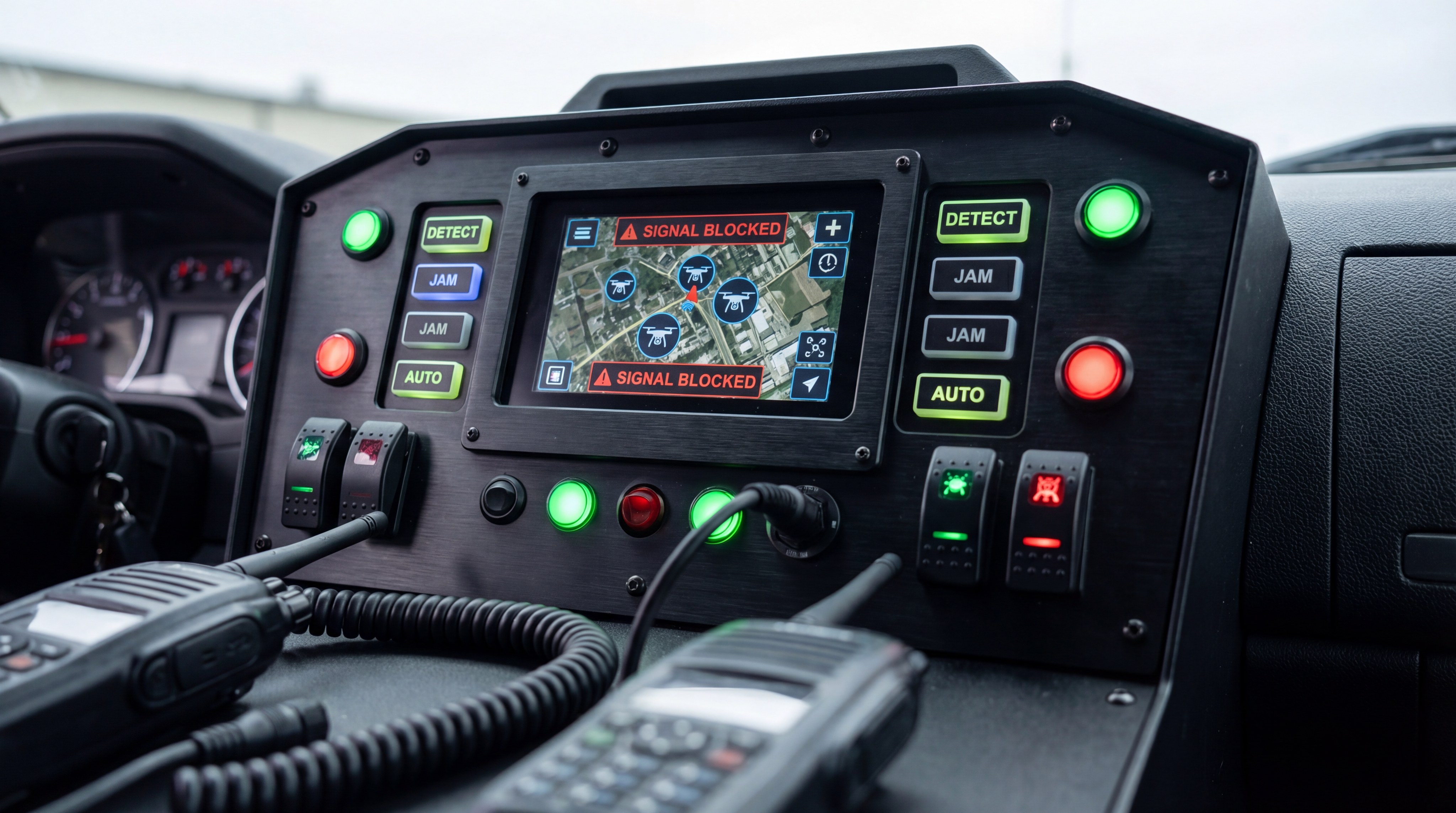
A broad-spectrum approach ensures that even the most complex coordinated attacks are neutralized before they can converge on your assets.
How Do You Choose the Best Vehicle Jammer?
Choosing the best drone defense for your fleet requires a careful balance of raw power, frequency modularity, and physical durability. You should look for a system that can grow with your needs, offering the ability to add new frequency modules as drone technology continues to evolve. Reliability in high-vibration environments is non-negotiable, as vehicle-mounted units must withstand the rigors of constant road travel without losing calibration.
Should You Prioritize Power or Range?
The truth is, power and range are two sides of the same coin; you cannot have a reliable perimeter without sufficient wattage. However, focus on “effective range”—the distance at which the jammer consistently overcomes a professional remote control.
- Higher wattage provides a more robust defense in noisy cities.
- Efficiency matters just as much as raw power to prevent heat issues.
- Adjustable power levels allow you to stay stealthy when needed.
- Modular systems let you prioritize specific bands based on threats.
Is Modular Hardware Better for ROI?
Consider this: a drone bought today will use different frequencies than one built five years from now. Modular hardware allows you to swap out components rather than replacing the entire multi-thousand-dollar system.
Key Takeaway: Investing in a flexible, high-power system ensures your mobile assets remain protected against the advanced aerial threats of tomorrow.
| Selection Factor | Business Importance | Ideal Specification |
|---|---|---|
| Frequency Range | Future-Proofing | 400MHz – 6GHz |
| Cooling System | Longevity | Active / Heat-Pipe |
| Mounting System | Versatility | High-Strength Magnetic |
Selecting the right partner for your hardware ensures that your fleet remains a step ahead of those who would use the sky to compromise your security.
Securing the Skyward Flank
Securing mobile assets in the age of accessible drone technology requires more than just ground-level awareness; it demands a sophisticated electronic perimeter. By deploying vehicle-mounted drone countermeasures, you ensure that your operations remain private and your cargo stays secure against the growing threat of aerial surveillance and interference. We have explored how high-power jamming, frequency isolation, and modular integration combine to create a moving fortress for your fleet. Don’t leave your skyward flank exposed to those looking to disrupt your business. To explore how our advanced systems can integrate into your existing security protocol, please contact us today for a customized consultation. Our vision is to provide unparalleled peace of mind through innovative technology that evolves faster than the threats of tomorrow.
*
Frequently Asked Questions
Can I install a drone jammer on any vehicle type?
Yes, you can install them on almost any car, truck, or armored transport. Most professional systems use versatile magnetic mounts or roof-rack adapters that require no permanent drilling or mechanical engineering.
What’s the best way to ensure full coverage in a multi-vehicle convoy?
The best method is to equip both the lead and the tail vehicles with omnidirectional jammers. This creates an overlapping electronic corridor that protects all the assets traveling in between the two units.
Can I operate a drone jammer without a specialized license?
It depends on your jurisdiction and status. In most regions, the operation of RF jamming equipment is strictly limited to government agencies, military, or authorized private security firms with specific waivers.
How do I know if a drone is currently being jammed by my vehicle system?
Most systems feature a cockpit control panel with real-time status indicators. These panels show when signals are being emitted and, in models with detection features, will alert you when a drone enters the interference field.
What’s the best frequency range for protecting against commercial quadcopters?
The most effective range targets the 2.4GHz and 5.8GHz bands for control and video transmission. For higher security, you should also include GNSS frequencies to prevent the drone from using GPS for stable flight.
Authorized RF engineering and compliance review
For regulated RF systems, this page should be used as an engineering and compliance review path, not as a public deployment checklist. CorelixRF starts with authorization status, operating region, frequency plan, output limit, antenna interface, safety controls, thermal limits and acceptance documents.
- RFQ checklist – send the data buyers usually forget, including band, power, duty cycle, interface and test standard
- delivery documentation – check what documents can support incoming inspection, FAT review and long-term maintenance
- quality and certification review – review the quality and compliance evidence before the project moves into procurement
- RF front-end platform – compare the RF chain as a system instead of selecting one isolated module
- RF configurator – turn frequency, power, thermal and interface requirements into a first configuration brief
- case studies – review similar engineering paths before sending an RFQ
- engineering contact – send the application notes, block diagram or target specification to engineering sales
This keeps the discussion inside lawful, authorized RF programs while still giving procurement teams a clear way to request amplifier, antenna, SDR source, documentation and factory review.
Vehicle RF Integration Review Path
For authorized vehicle-based RF systems, translate power, cooling and mounting constraints into RF power amplifier sizing, RF front-end integration and antenna/load interface planning. Share bands, duty cycle, output targets, VSWR exposure, enclosure limits and factory validation needs through the RF inquiry form.