
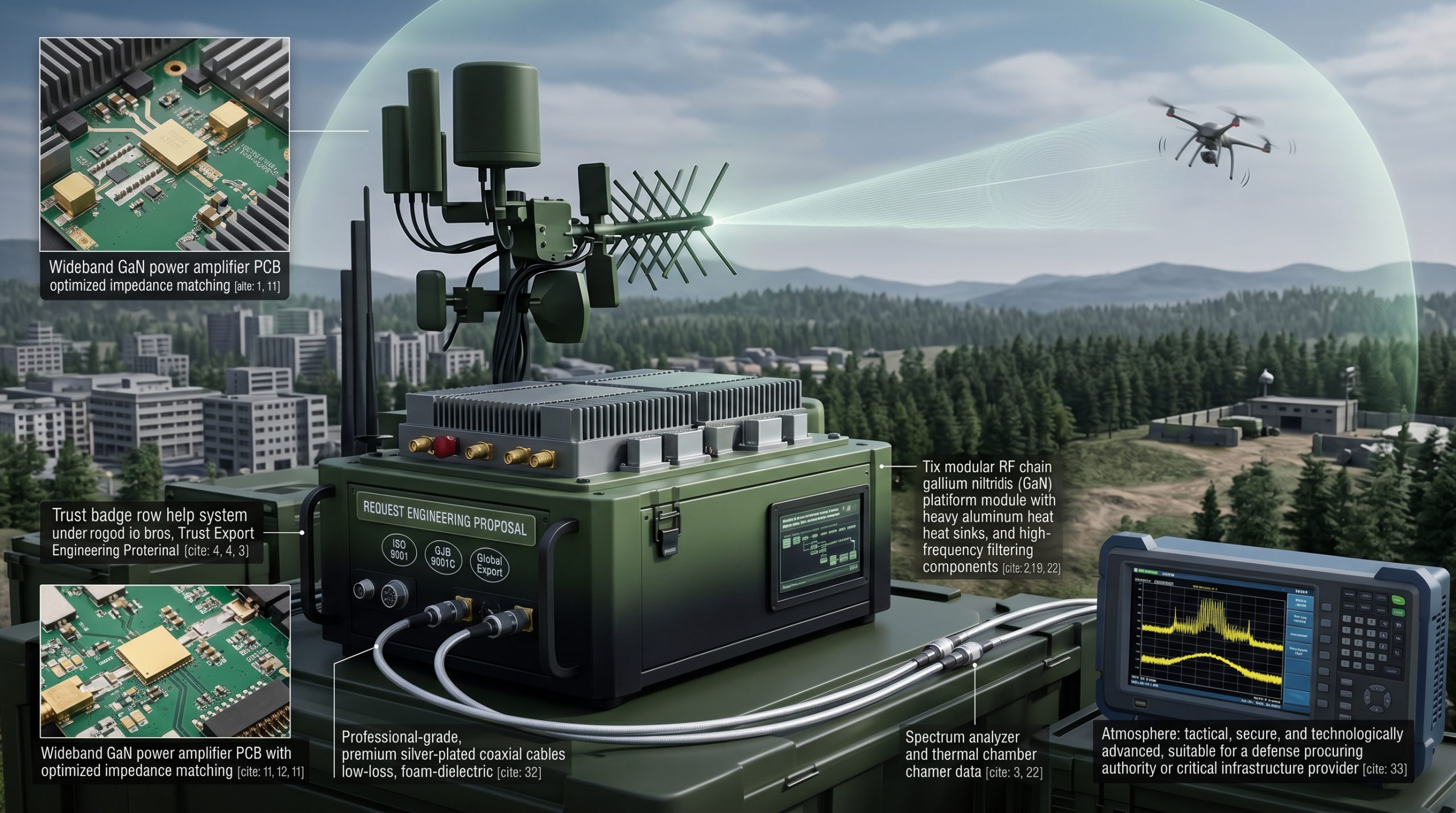
Operating a defense field setup presents sudden challenges when a security perimeter breaches due to unauthorized drone intrusions. This happens because minor environmental shifts drastically shrink your defensive boundary, leaving critical assets exposed to aerial threats. Here is the deal, implementing a high-performance Drone Jammer provides a reliable solution by establishing an impenetrable shielding barrier. Our engineering team brings years of field-tested hardware expertise to ensure your operational success.
Why does output power dictate the interference range?
Output power directly determines the interference range because higher wattage generates stronger disruptive signals that overwhelm threat reception over greater distances. You might be wondering, how much wattage do your defense systems actually require? A robust Drone Jammer platform utilizes continuous high-power transmission to suppress incoming remote control links effectively.
How does RF amplification maximize coverage?
Power amplifiers dictate how far a signal travels before losing its suppression capability. Choosing high-efficiency hardware prevents coverage degradation. ● CorelixRF GaN platforms provide configurable 30W–200W output ● Power headroom remains above fifteen percent for safety ● Thermal management systems prevent wattage drops during continuous operation
Can power stability protect your perimeter?
Unstable power output creates unpredictable blind spots in your defense perimeter. Maintaining flat signal transmission ensures consistent protection across variables.
This is where it gets interesting…
- Flatness stays under 1.5dB across target frequencies
- Impedance matching optimizes energy distribution to antennas
Key Takeaway
High output wattage coupled with premium thermal stability ensures your defense barrier remains constant without suffering from sudden coverage shrinkage.
| Power Level | Effective Range | Application Scenario |
| 30W | Up to 1,200 Meters | Tactical Border Patrol |
| 100W | Up to 3,500 Meters | Airport Perimeter Security |
| 200W | Over 5,000 Meters | Critical Infrastructure Defense |
Analyzing this data reveals that matching output power to specific location demands optimizes energy efficiency while securing the target zone.
How do environmental factors impact signal suppression?
Environmental factors impact signal suppression by introducing physical obstacles and atmospheric conditions that block or scatter radio waves. What is the catch, physical geography can block a Drone Jammer signal, which drastically reduces the protective coverage radius.
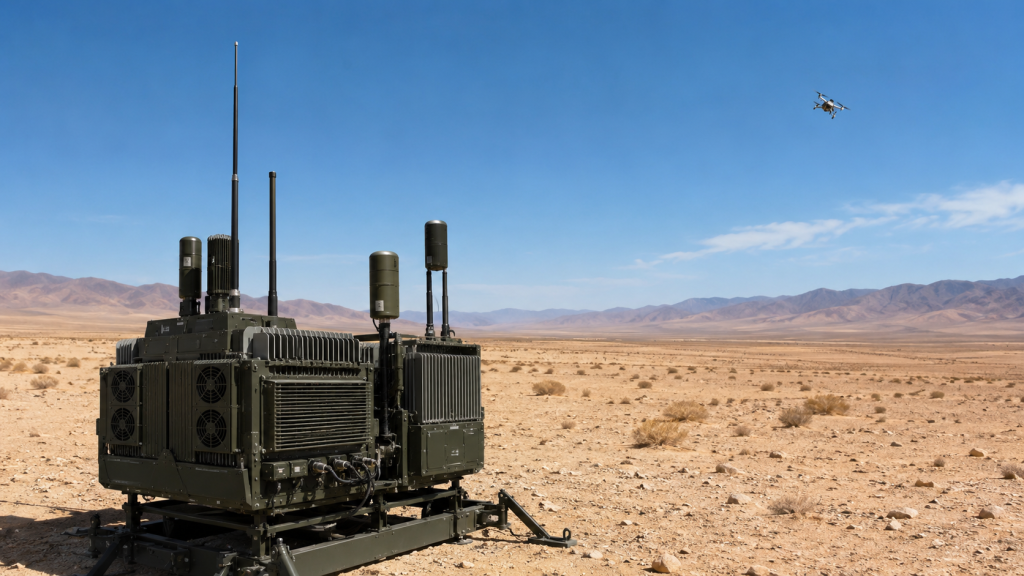
Do urban structures cause signal loss?
Concrete buildings and metal structures reflect radio frequency signals, creating severe propagation loss. Open spaces allow unhindered signal travel.
● Urban areas suffer from multi-path fading effects
● Forested zones absorb high-frequency signals quickly
● Line-of-sight clearance maximizes effective suppression distances
How does weather affect signal propagation?
Heavy rain, dense fog, and extreme humidity absorb electromagnetic energy at microwave frequencies. This attenuation reduces the total effective range of transmission.
Ready for the good part?
- Rainfall causes direct signal attenuation changes
- High temperature alters air density and signal refraction
Key Takeaway
Analyzing your specific terrain layout allows for strategic deployment positions, ensuring environmental blockages do not compromise system performance.
| Environment Type | Attenuation Level | Real-world Range Impact |
| Open Desert | Very Low | Maximum Rated Range |
| Dense Forest | Medium-High | 35% Range Reduction |
| Urban Center | High | 60% Range Reduction |
This breakdown indicates that regional deployment planning must account for physical terrain features to maintain defense integrity.
What role does frequency matching play in jammer range?
Frequency matching plays a vital role because a jammer must precisely target the exact operating frequency of the threat to disrupt its flight controls. What is the real story, if your Drone Jammer operates on a misaligned frequency band, it will exert zero defensive influence regardless of its power output.
Why is wideband coverage necessary?
Modern commercial and military drones utilize diverse frequency channels for control links and video transmission telemetry. A successful system must cover these bands continuously. ● CorelixRF modules span from 30MHz to 6000MHz continuously ● Full spectrum coverage prevents frequency gaps for threats ● Multi-band synthesis allows simultaneous disruption of several channels
How does SDR technology enhance matching?
Software Defined Radio provides the agility needed to counter adaptive threats that employ frequency hopping tactics. It tracks and targets shifting communication frequencies in real time.
But here’s the kicker…
- Real-time frequency hopping neutralizes smart electronic counter-measures
- Dual independent channels enable multi-threat targeting profiles
Key Takeaway
Employing agile wideband radio systems ensures your hardware never becomes obsolete when threats shift to new operational frequencies.
| Target Band | Frequency Range | Common Threat Application |
| UHF / VHF | 30MHz – 512MHz | Military Loitering Munitions |
| ISM Band | 2.4GHz / 5.8GHz | Commercial Surveillance Drones |
| GNSS Band | 1.2GHz – 1.6GHz | Satellite Navigation Systems |
The data confirms that continuous spectral dominance across multiple bands prevents threats from exploiting frequency gaps.
How does antenna selection influence the defense radius?
Antenna selection influences the defense radius by shaping and directing the radio frequency energy toward the target threat area. Let’s face it, choosing an incorrect antenna configuration scatters your defensive energy into empty space, which reduces the effective distance of your Drone Jammer platform.
Why choose directional antennas?
Directional antennas focus RF energy into a tight, concentrated beam, which significantly extends the interference range in a specific direction. ● High forward gain maximizes signal penetration distance ● Energy wastage in non-threat sectors is completely eliminated ● Ideal for fixed installation perimeters like airport runways
When are omnidirectional antennas required?
Omnidirectional antennas provide 360-degree dome protection, making them ideal for mobile convoy security operations. They cover all approach vectors simultaneously.
This is where it gets interesting…
- Full area coverage creates a complete local protective bubble
- Lower peak distance compared to focused directional designs
Key Takeaway
Selecting the proper antenna geometry allows operators to choose between maximum localized distance or complete area security.
| Antenna Type | Coverage Pattern | Best Strategic Use |
| High-Gain Directional | 60-Degree Focused Beam | Sectorized Boundary Defense |
| Mobile Omnidirectional | 360-Degree Circular | Convoy & VIP Protection |
| Panel Array | 120-Degree Directional | Fixed Facility Corners |
This comparison highlights that matching antenna radiation patterns to your site layout optimizes defensive coverage.
What is the impact of target drone distance?
Target drone distance impacts suppression success because the strength of a radio signal naturally degrades as it travels through open air. Here is the deal, a threat drone flying close to its pilot receives a strong control signal, making it harder for a remote Drone Jammer to successfully break that connection.
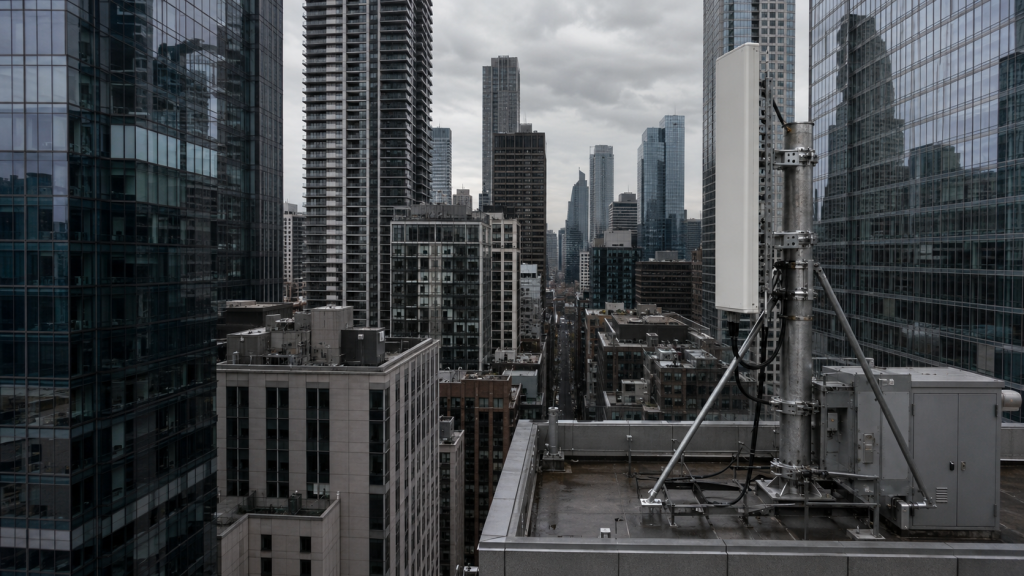
How does the distance ratio work?
The success of signal disruption depends heavily on the ratio between the jammer-to-drone distance and the pilot-to-drone distance. ● Closer pilot proximity requires higher jamming power output ● Greater drone isolation simplifies signal hijacking attempts ● System position optimization shifts the ratio in your favor
What is the inverse square law effect?
Radio wave energy decreases exponentially relative to the distance traveled from the source transmitter. This applies to both the controller signal and your disruptive signal.
You might be wondering…
- Signal attenuation doubles every time the distance doubles
- Early threat detection maximizes effective jamming windows
Key Takeaway
Deploying defensive assets closer to protected perimeters rather than boundaries enhances system effectiveness against oncoming remote-controlled threats.
| Jammer-to-Drone Distance | Pilot-to-Drone Distance | Disruption Success Rate |
| 1,000 Meters | 3,000 Meters | Excellent (Signal Overwhelmed) |
| 2,000 Meters | 2,000 Meters | Good (Balanced Signal State) |
| 3,000 Meters | 500 Meters | Challenging (Requires High Power) |
These metric ratios indicate that early electronic counter-measures are critical for successfully neutralizing close-range controlled threats.
How does electromagnetic background noise affect performance?
Electromagnetic background noise affects performance by creating competing radio signals that obscure the defensive transmission. What is the catch, operating a Drone Jammer in a crowded city center means competing against thousands of active Wi-Fi routers and communication towers.
What causes industrial spectral congestion?
Modern industrial environments are filled with background RF noise that reduces signal clarity for security equipment.
● High-power cellular towers create nearby channel interference
● Local wireless networks raise the base noise floor level
● Dense electronic traffic masks low-power defense transmissions
How do you bypass heavy background noise?
Bypassing noise requires high spectral purity and targeted frequency allocation from your signal generation core hardware. This keeps your defensive signals clear.
Ready for the good part?
- Precise impedance matching cuts down on stray signal distortion
- High-frequency filtering isolates the required jamming channels
Key Takeaway
Using clean signal generation hardware allows your system to pierce through intense urban electronic clutter to maintain defense distances.
| Location Profile | Background Noise Floor | Range Efficiency |
| Remote Border Facility | Very Low (-110 dBm) | 100% Core Capability |
| Suburban Industrial Park | Medium (-85 dBm) | 80% Core Capability |
| Metropolitan Area | High (-65 dBm) | 55% Core Capability |
This table clarifies that local environmental RF noise analysis is a necessary step before installing long-range security systems.
Why does receiver sensitivity define threat vulnerability?
Receiver sensitivity defines threat vulnerability because highly sensitive drone components can detect weak control signals from miles away. What’s the real story, overcoming a premium, military-grade drone receiver requires a Drone Jammer with enhanced signal output and superior waveform generation.
How do threat receiver designs vary?
Commercial toy drones utilize basic, low-sensitivity wireless chips, whereas professional systems integrate advanced, high-sensitivity radio components.
● High-sensitivity systems maintain links under extreme noise conditions
● Advanced shielding on threat drones resists external signal bleed
● Precise tuning allows drones to filter out stray defensive signals
How do you counter sensitive drone hardware?
Countering specialized military or industrial threats requires complex waveform transmission profiles that mimic their own communication protocols.
But here’s the kicker…
- Linear Frequency Modulation targets specific protocol patterns
- Digital modulation capabilities match advanced encrypted controls
Key Takeaway
Deploying an intelligent signal core ensures your system can disrupt high-sensitivity receivers used in advanced threats.
| Drone Receiver Quality | Sensitivity Level | Jamming Difficulty |
| Standard Commercial | Low Sensitivity | Simple Disruption Profile |
| Industrial Inspection | Medium Sensitivity | Advanced Waveform Needed |
| Military Reconnaissance | High Sensitivity | Multi-Channel GaN Power Needed |
The compiled data shows that hardware versatility is required to successfully counter sophisticated corporate or military airborne threats.
How do coaxial cable choices affect system range?
Coaxial cable choices affect system range by introducing internal signal loss between the power amplifier output and the transmitting antenna. You might be wondering, why does the choice of a simple wire matter so much in a complex Drone Jammer installation? High-frequency energy drops rapidly when traveling through sub-par cabling infrastructure.
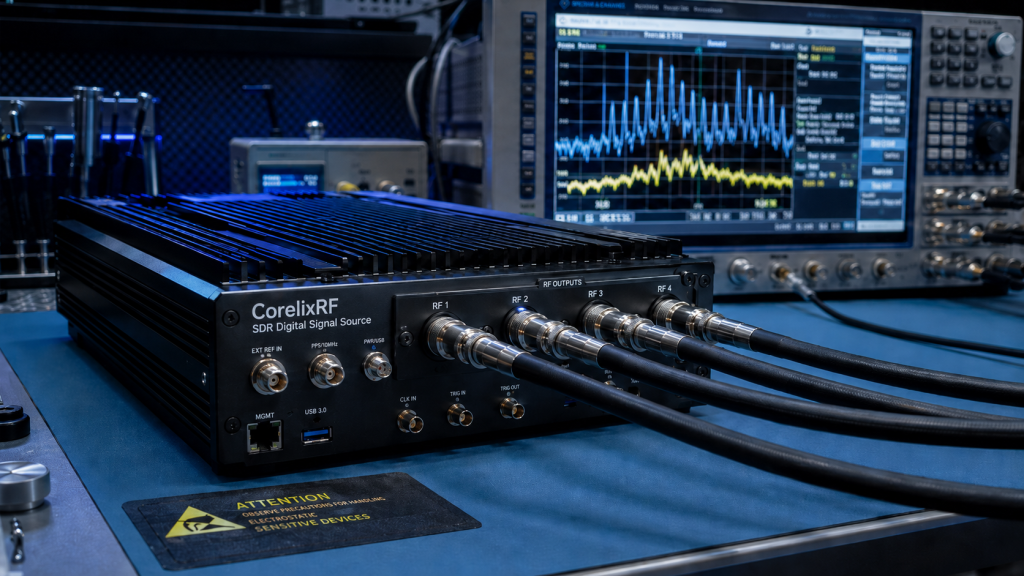
What is RF insertion loss?
Every centimeter of coaxial cable absorbs a fraction of your transmitter’s radio frequency energy, turning it into wasted heat. ● Higher operating frequencies suffer greater cable transmission losses ● Long cable runs degrade wattage before it reaches the antenna ● Improperly shielded cables leak defensive energy inside the enclosure
How do you minimize cable signal attenuation?
Minimizing attenuation requires short runs of high-grade, foam-dielectric coaxial cables with precision-matched connectors. This preserves signal strength.
This is where it gets interesting…
- Premium silver-plated connectors keep insertion losses minimal
- Rigid or semi-rigid cable assemblies offer optimal high-frequency efficiency
Key Takeaway
Investing in low-loss RF plumbing ensures that all generated amplifier wattage actually reaches the antenna to maximize your defensive range.
| Cable Type Selection | Loss per 10 Meters (at 2.4GHz) | Power Delivered to Antenna |
| Standard RG-58 | High Loss (approx. 7.5 dB) | Only 18% of Power Left |
| Low-Loss LMR-400 | Low Loss (approx. 2.2 dB) | About 60% of Power Left |
| Heliax 1/2″ Coaxial | Ultra-Low Loss (approx. 1.1 dB) | Over 77% of Power Left |
The loss metrics prove that utilizing low-loss coaxial cabling is vital for maintaining the line efficiency of defense hardware.
How does power supply stability affect signal range?
Power supply stability affects signal range by ensuring the RF amplifier receives the steady voltage required to maintain peak transmission output. Here is the deal, if your Drone Jammer suffers from internal voltage drops, the output signal will fluctuate, causing the defensive coverage area to shrink unpredictably.
Why do power supply fluctuations degrade performance?
High-power RF modules place immense, sudden power demands on system electronics during continuous multi-band operation. ● Voltage drops lower the peak output power of GaN amplifiers ● Unfiltered electrical noise distorts the target jamming waveform ● Power supply overheating causes system shutdowns during critical moments
How do professional systems ensure electrical stability?
Professional defense platforms utilize industrial-grade power converters with built-in surge filtering and voltage regulation. This maintains stable output power.
Ready for the good part?
- Over-engineered power modules handle rapid load switching easily
- Integrated voltage regulation protects sensitive software-defined radio cores
Key Takeaway
Using a highly stable power supply protects critical system components and guarantees continuous, maximum range performance when threats appear.
| Power Supply Type | Voltage Regulation Stability | Operational Range Consistency |
| Commercial Grade | Poor (+/- 10% Variance) | Fluctuation up to 30% |
| Industrial Switching | Standard (+/- 2% Variance) | Reliable Constant Range |
| Military Spec Regulated | Excellent (+/- 0.5% Variance) | Maximum Range Maintained |
This information highlights that reliable primary electrical systems form the backbone of dependable radio frequency defense hardware.
What is the effect of thermal management on range?
Thermal management affects range because radio frequency components generate intense internal heat that must be dissipated to prevent power drop-offs. What’s the real story, as your Drone Jammer runs continuously, accumulating heat reduces component efficiency, causing a drop in signal output power.
Why does heat degrade GaN performance?
Gallium Nitride components handle high power levels efficiently, but excessive heat buildup still impacts semiconductor performance over time. ● High internal temperatures trigger automatic safety power rollbacks ● Prolonged heat stress accelerates component degradation and failure ● Thermal stress alters precise frequency tuning parameters
How do premium thermal structures protect range?
Using advanced cooling setups like integrated heavy aluminum heat sinks and forced-air fans removes heat quickly to maintain maximum power output.
But here’s the kicker…
- CNC-machined copper heat blocks speed up internal heat transfer
- Smart thermal sensors adjust fan speeds based on real-time load
Key Takeaway
Integrating advanced thermal design directly into the product chassis ensures your systems run continuously at maximum range without overheating.
| Cooling Design Style | Continuous Run Time Limit | Range Drop After 30 Mins |
| Basic Passive Cooling | Max 10 Minutes Continuous | 45% Range Drop (Heat Soak) |
| Standard Fan Cooled | Max 60 Minutes Continuous | 15% Range Drop Observed |
| Heavy Heat Sink + Forced Air | Unlimited Continuous Run Time | 0% Range Drop (Stable) |
This final breakdown shows that advanced cooling engineering is required to maintain long-range signal suppression during extended operations.
FAQ
Can I expect consistent defense coverage across all seasons?
No, seasonal weather variations alter your defense boundaries because heavy rainfall, thick snow, and high summer temperatures absorb radio wave energy, which reduces signal range compared to clear, dry conditions.
What’s the best way to extend my current system’s reach?
The most effective approach is upgrading to high-gain directional antennas and swapping existing transmission cables for ultra-low-loss coaxial alternatives, which maximizes the concentrated forward energy of your system.
How do I know if regional background noise is reducing my safety boundary?
You can confirm this by conducting a local spectrum analysis with a vector network analyzer; a high base noise floor indicates that your system requires greater power output to maintain its rated range.
Can advanced threat drones bypass standard defensive signals?
Yes, sophisticated threats utilizing automated satellite navigation or real-time frequency hopping can bypass basic single-frequency setups, which makes agile SDR signal cores necessary.
How do I maintain peak performance during long operations?
Ensure your system uses integrated heavy aluminum heat sinks and stable power converters, which prevents voltage drops and thermal issues from reducing signal strength during extended use.
Contact Us Today
Managing defense security operations requires dependable hardware that performs flawlessly under challenging conditions. CorelixRF designs and manufactures robust RF chain modules—from agile signal generation cores to high-power GaN amplifiers and tuned antenna systems—all built to rigorous quality standards. Contact us today to receive an expert technical evaluation, and let our engineering team deliver the reliable hardware solutions your security infrastructure demands.
Authorized RF engineering and compliance review
For regulated RF systems, this page should be used as an engineering and compliance review path, not as a public deployment checklist. CorelixRF starts with authorization status, operating region, frequency plan, output limit, antenna interface, safety controls, thermal limits and acceptance documents.
- RFQ checklist – send the data buyers usually forget, including band, power, duty cycle, interface and test standard
- delivery documentation – check what documents can support incoming inspection, FAT review and long-term maintenance
- quality and certification review – review the quality and compliance evidence before the project moves into procurement
- RF front-end platform – compare the RF chain as a system instead of selecting one isolated module
- RF configurator – turn frequency, power, thermal and interface requirements into a first configuration brief
- case studies – review similar engineering paths before sending an RFQ
- engineering contact – send the application notes, block diagram or target specification to engineering sales
This keeps the discussion inside lawful, authorized RF programs while still giving procurement teams a clear way to request amplifier, antenna, SDR source, documentation and factory review.
Environmental RF Loss Review Path
For authorized RF range and loss reviews, connect cable loss, thermal margin and load mismatch concerns to RF power amplifier sizing, RF front-end protection and antenna/load planning. Send band, gain/loss budget, duty cycle, VSWR exposure, cooling limits and validation record requirements through the RF inquiry form.