
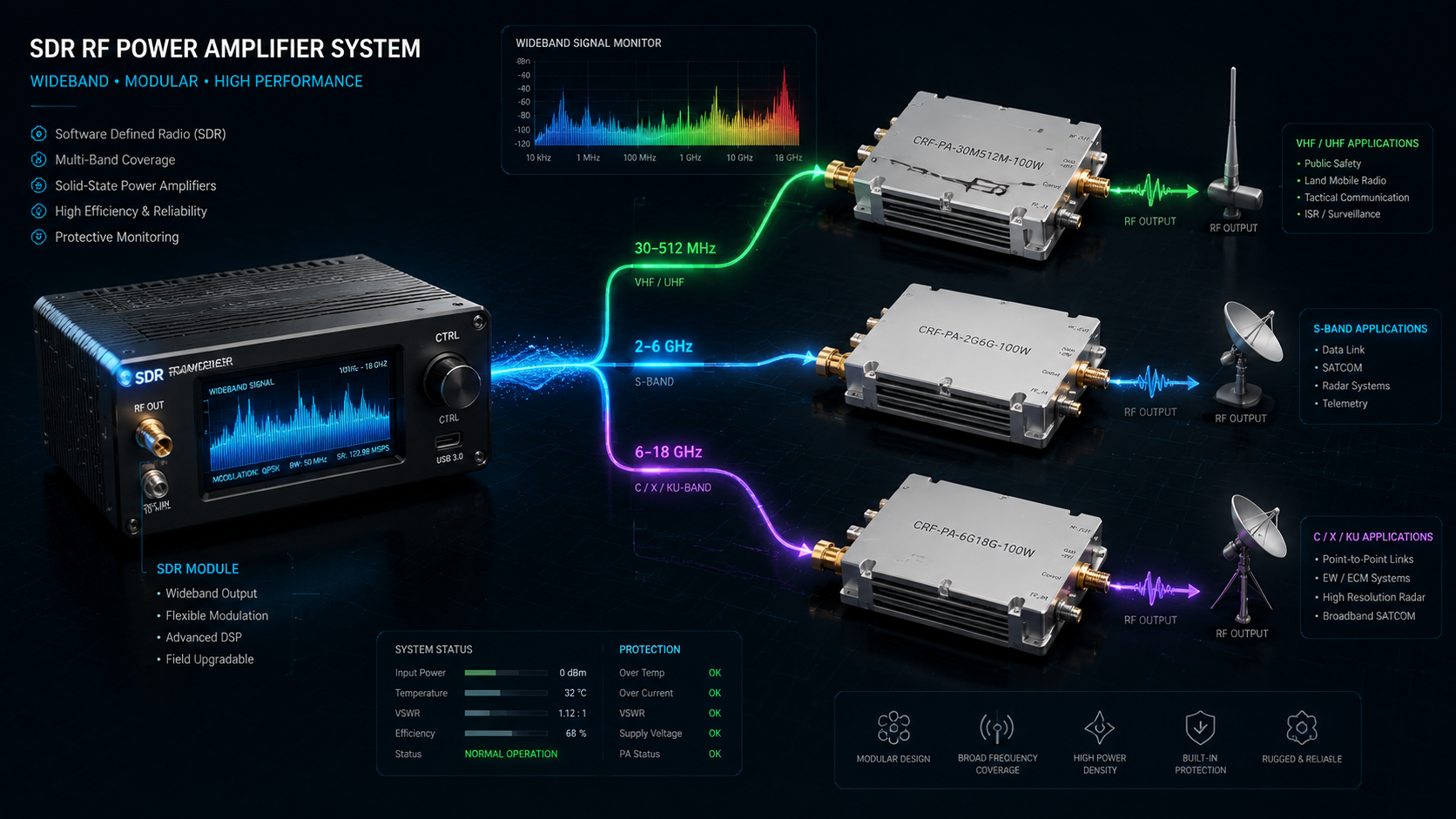
An SDR may generate the required waveform while the connected RF power amplifier module is still in the wrong operating state. Retuning, startup, enable commands and fault recovery expose this gap. Planning the control handover between source, amplifier and host is part of defining the RF chain, alongside selecting compatible frequency and power limits.
The handover should say which device owns each command, what the receiving device must confirm and what evidence shows that the transition completed. A communication reply alone does not establish RF output state. Tie command handling to the status signals and observations available on the supplied hardware.
Describe what happens when the source changes
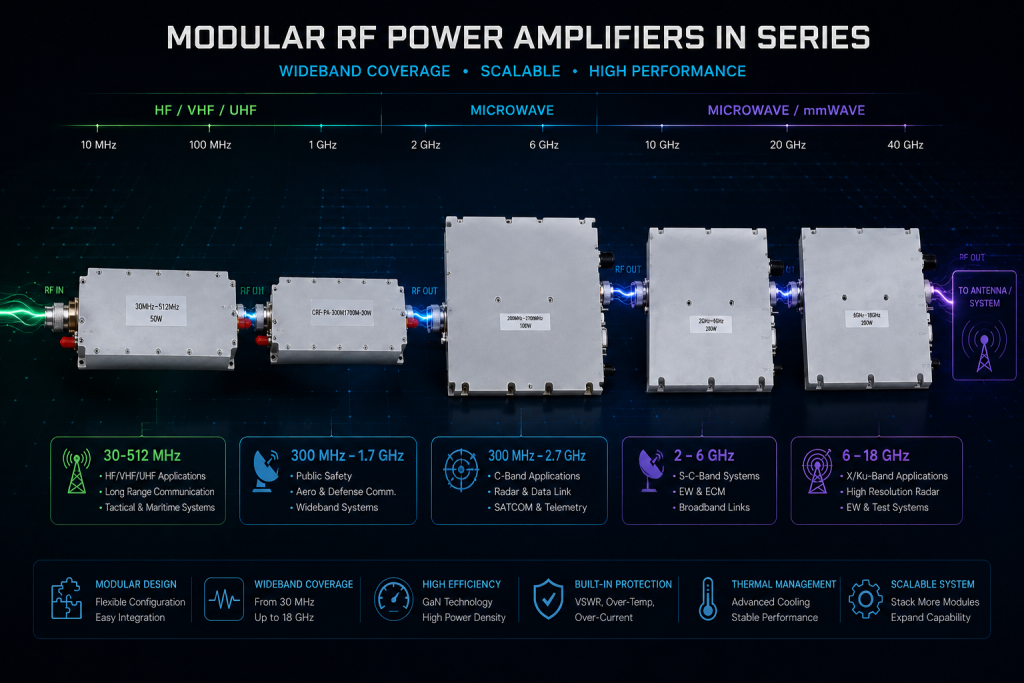
Define the required source frequencies and waveform modes first, then check the selected amplifier’s documented band and input limits. An SDR tuning range does not extend the amplifier’s usable band. Different amplifier models also cannot be drawn as one continuous path simply by adding their frequency labels.
For each required retune or mode change, identify the source’s documented transition behavior and how the host will know the requested state is ready. Do not assume that a steady-state level describes every transition. If the transition data are missing, keep that interface requirement open for review rather than inventing a settling time. The SDR and amplifier integration page provides the corresponding product and interface path for this chain-level review.
Give enable and mute commands an observable meaning
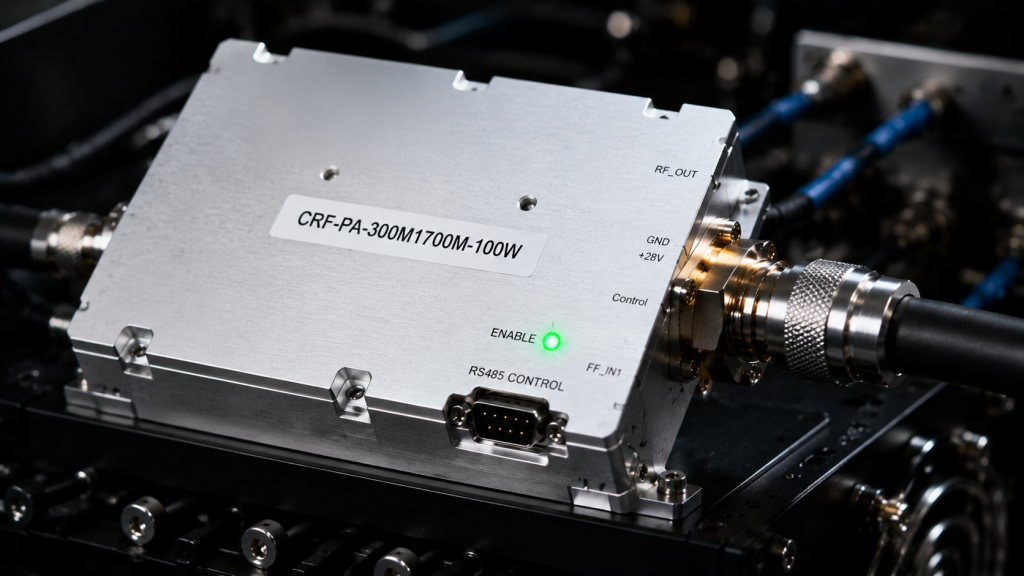
Write down whether a command acts on the source, the amplifier or another element. Identify the relevant status indication and the approved method for confirming RF state. “Muted” may refer to a software setting; the project needs to know which supplied function establishes the required condition.
Keep the source and amplifier command sets separate until their relationship is defined. A label such as RS485 identifies a communication method, not command timing, electrical isolation or a restart policy. Use the delivered protocol and interface specification for those details.
Agree the handover record between devices
| Transition | Questions to resolve | Record with the observation |
|---|---|---|
| Startup | Which states are reported before RF can be enabled? | Unit identity, configuration, initial commands and observed status |
| Retuning | How is source readiness established, and what amplifier state is required? | Requested and reported settings, timestamps and verification method |
| Communication loss | What does each supplied device do, and how is the host informed? | Interface condition, device state and observed RF condition |
| Fault recovery | What clears the fault, and which action permits restart? | Alarm, reset action, resulting status and reviewer disposition |
These questions define the interface contract; they do not assume that every product provides the same signals or automatic behavior. Assign an owner to each unresolved requirement before closing the integration specification.
Measure the chain state under declared conditions
During the approved integration test, record the source configuration, amplifier input level, output reference plane, load, supply and thermal state. Include the control commands and available status observations in the same time record. This allows an RF anomaly to be compared with a source transition, a device alarm or a communication event without assuming the cause.
Use the RF amplifier measurement guide for the RF conditions. A reported command success should be assessed separately from measured output, and a short test should retain its actual duration rather than implying sustained performance.
Hand over a configuration another team can reproduce
Provide the block diagram, exact source and amplifier configurations, protocol revisions, required transitions, observed results and remaining exceptions. Include the installed load and cooling arrangement. The RF front-end platform overview helps identify the source, power-stage and output-path responsibilities.
For an engineering review, send the waveform, operating band, output definition, interface documents and required startup, retune and recovery behavior. Request an SDR amplifier control-integration review with the transitions that still need to be established.