
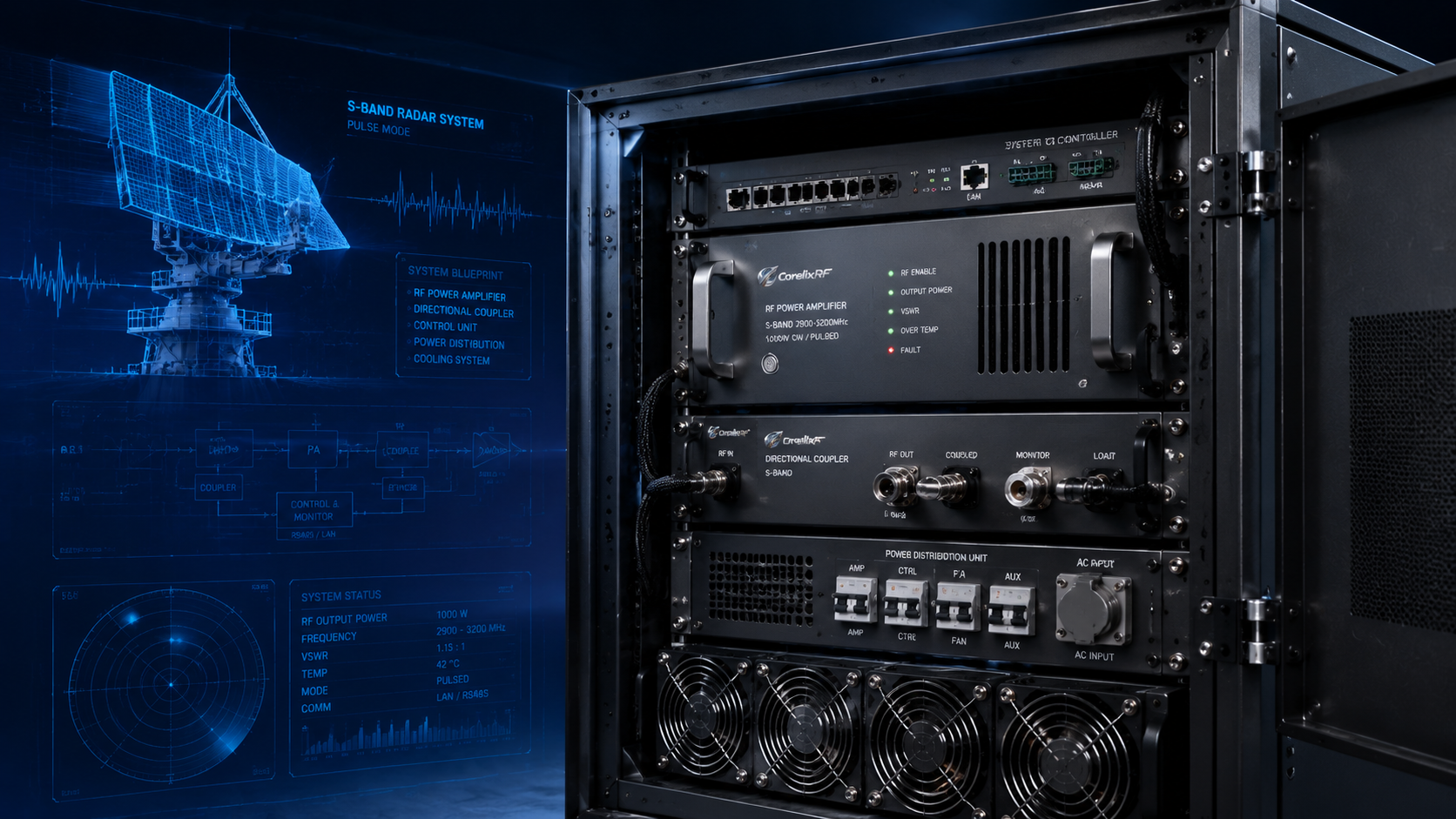
A pulsed RF power amplifier should never be selected by output power alone. Frequency range, pulse width, duty cycle, pulse repetition behavior, thermal margin, control interface, monitoring functions, and mechanical package all affect whether the amplifier will work in the real system. This is why a 500 W or 1500 W pulsed RF amplifier needs a clearer engineering review than a simple CW power stage.
CorelixRF lists pulsed RF amplifier platforms across 1.0-3.2 GHz, with rated output classes from 300 W to 1500 W. Standard review models include 1000-2000 MHz, 1200-1400 MHz, 2700-3100 MHz, and 2900-3200 MHz options. Custom frequency, pulse width, duty cycle, pulse frequency, control interface, monitoring, cooling, and OEM integration can also be reviewed.
Why Pulse Conditions Matter
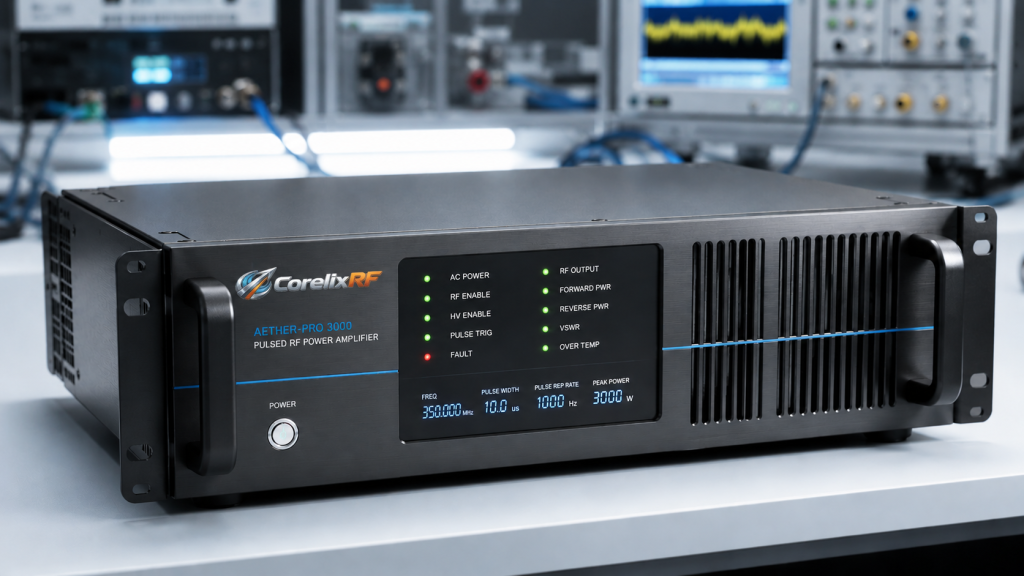
Pulse width and duty cycle directly affect thermal behavior. A short pulse with low duty cycle does not create the same heat load as a longer pulse at a higher duty cycle. Pulse frequency and rise/fall behavior can also affect the system response.
Before requesting a pulsed amplifier, define the waveform clearly. Include frequency range, rated output power, pulse width, duty cycle, pulse repetition frequency, input drive level, load condition, cooling environment, and control interface.
Representative CorelixRF Pulsed Models
CRF-PA-1000M2000M-1500W covers 1000-2000 MHz with 1500 W rated output, 62 dB gain, 1-50 us pulse width, 5% duty cycle, and RS485 / LAN interface. It is positioned for high-power L-band pulsed RF output and system-level RF integration.
CRF-PA-1200M1400M-500W covers 1200-1400 MHz with 500 W rated output, 57 dB gain, 50 us pulse width, 10% duty cycle, and RS485 / LAN interface. It fits focused L-band pulsed RF test and communication verification.
CRF-PA-2700M3100M-500W covers 2700-3100 MHz with 500 W rated output, 57 dB gain, 50 us pulse width, 10% duty cycle, and RS485 / LAN interface. It is an S-band pulsed RF amplifier platform for project-based RF test and communication review.
CRF-PA-2900M3200M-300W covers 2900-3200 MHz with 300 W rated output, 1-20 kHz pulse frequency, 1-15 us pulse width, 1-25% duty cycle, and RS422 / RS485-3.3V interface. It is useful where pulse frequency and control logic are part of the project requirement.
Control and Monitoring Review
CorelixRF lists RS485, LAN, RS422, and optional GPIB-related review paths depending on model and requirement. Optional monitoring can include forward/reverse power monitoring, input power detection, and protection logic. These functions are important when the amplifier is part of a larger RF test platform or OEM subsystem.
Cooling and Mechanical Integration
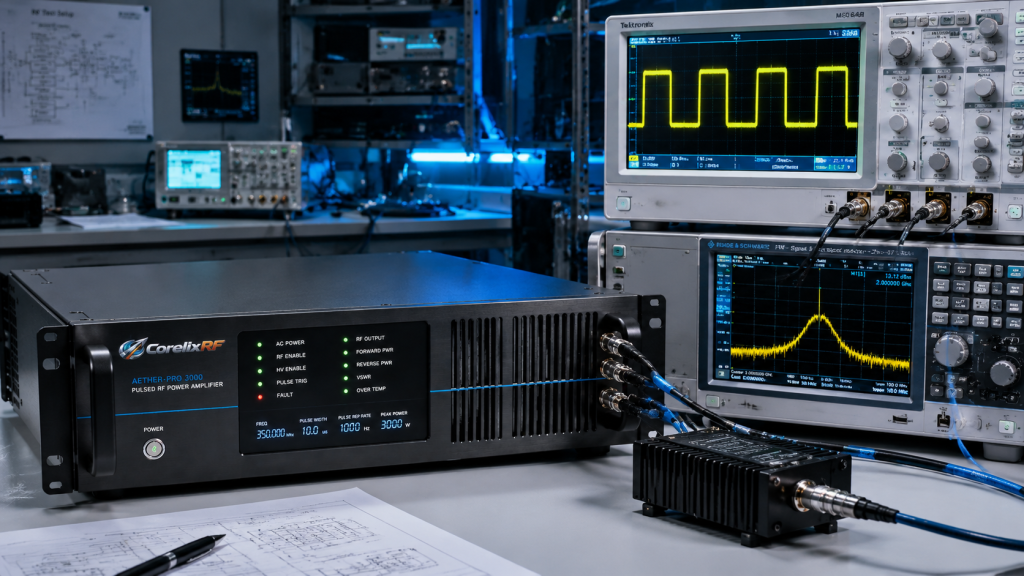
Pulsed power does not remove the need for thermal review. Higher duty cycle, long pulse width, high rated output, and compact rack space can increase cooling requirements. CorelixRF references 3U, 5U, and project-specific cabinet formats, so buyers should define rack space, airflow direction, connector layout, power supply, and installation environment early.
FAQ
What is the main difference between CW and pulsed RF amplifier selection?
Pulsed amplifier selection must include pulse width, duty cycle, pulse frequency, timing behavior, and thermal margin, not only output power and frequency.
What frequency ranges are listed by CorelixRF?
Representative listed models cover 1000-2000 MHz, 1200-1400 MHz, 2700-3100 MHz, and 2900-3200 MHz.
Can CorelixRF review custom pulse conditions?
Yes. Frequency range, output power, pulse width, duty cycle, pulse frequency, control interface, monitoring functions, and mechanical format can be reviewed.