
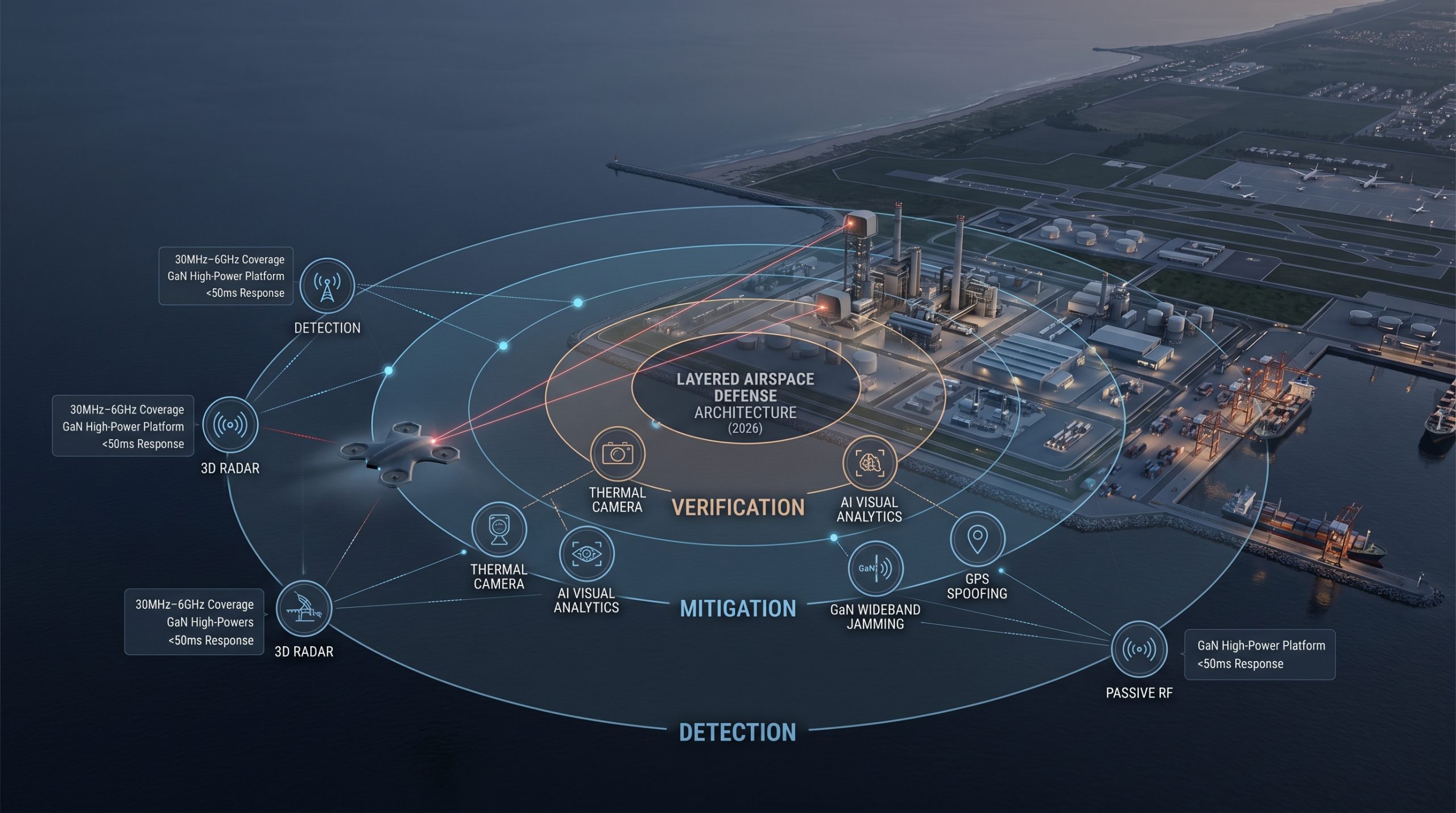
Authorized RF Review Boundary
Counter-UAS Technology Compliance Review 2026 is maintained as a compliance-first engineering page. CorelixRF discusses regulated counter-UAS RF topics only for authorized programs with documented scope, lawful operating boundaries and buyer-side approval.
- RF front-end platform review for amplifier, antenna, source and control interfaces.
- Custom RF system review for enclosure, thermal, control and documentation needs.
- RFQ checklist for band, power, duty cycle, load, interface and acceptance inputs.
- Delivery documentation for inspection records, test curves and FAT-style evidence.
- Contact CorelixRF engineering sales with authorized project documents.
This page does not provide public deployment, evasion, interference, power-setting or bypass instructions. If a project cannot document legal authority, the correct next step is compliance review.
Primary Topic Hub and RFQ Path
This primary guide now consolidates related authorized C-UAS and RF safety review topics. Use it for lawful scope definition, RF interface review, documentation and factory RFQ preparation.
- How to Understand What is Anti Drone Technology in 2026? – consolidated reference
For regulated counter-UAS or interference-adjacent topics, CorelixRF keeps the discussion at authorized RF engineering review, documentation, test evidence and procurement boundaries. This page does not provide public deployment, evasion or unlawful interference instructions.
- RFQ checklist – prepare band, power, duty cycle, interface, cooling and acceptance inputs.
- RF configurator – turn project requirements into a first engineering brief.
- Delivery documentation – align test curves, inspection records and FAT-style evidence.
- Case studies – review how CorelixRF frames RF problems for buyer decisions.
- Contact engineering sales – submit the documented scope for review.
Commercial commercialized airspace faces unprecedented vulnerability as advanced autonomous unauthorized commercial small unmanned aerial systems multiply globally. Choosing effective countermeasures involves deploying an integrated architecture encompassing radio frequency detection radar monitoring sensor fusion mitigating protocols to safeguard airspace asset investments. Here’s the deal: implementing high-power wideband radio frequency mitigation equipment through a reliable full-band manufacturing partner like CorelixRF transforms vulnerable parameters into military-grade secured defensive zones.
1. What Are the Primary Threats Driving Counter-Drone Demands?
The proliferation of low-altitude unauthorized remote aircraft represents a massive modern tactical complication across industrial infrastructure perimeter networks. Industrial intelligence reports indicate weaponized modified hobbyist quadcopters compromise logistic yards defense assets transport hubs daily. You might be wondering: how can facility personnel stop these versatile airborne vehicles before payload drop coordinates initiate? Investing in counter-drone defensive assets minimizes structural exposures preventing significant capital infrastructure damage. Commercial operations must address multiple unique low-altitude aerial threats:

- Unsanctioned reconnaissance payloads capturing sensitive corporate asset data.
- Kinetic payload delivery targeting electricity distribution infrastructure substations.
- Smuggling operations bypassing standard physical security perimeter fencing.
- Persistent logistical disruption delaying heavy cargo flight operational timelines.
Which Unmanned Aerial Systems Cause the Greatest Security Headaches?
Small consumer systems operating via standard communication frequencies represent the most common operational headaches for perimeter security administrators. Commercial group one classification platforms operate with very low radar cross-sections bypassing traditional civilian sensor configurations completely. What’s the catch? These readily available consumer units feature robust autonomous navigation capabilities making simple line-of-sight monitoring approaches wholly inadequate.
- Group one micro platforms carrying customized high-definition visual imagery equipment.
- Group two medium weight multi-rotor systems carrying variable operational payloads.
- Customized first-person view racing platforms flying rapid low-altitude paths.
- Modified fixed-wing model airplanes engineered for long-distance perimeter penetration.
Key Takeaways
Modern industrial facilities face multifaceted low-altitude structural exposures from consumer or custom modified small aircraft platforms. Recognizing individual platform capabilities empowers your security team to procure appropriate targeted frequency neutralization equipment.
| Threat Category | Typical Frequency Bands | Primary Risk Factor |
| Surveillance FPV | 2.4 GHz, 5.8 GHz | High-speed data leakage |
| Payload Delivery | 433 MHz, 915 MHz | Kinetic facility disruption |
| Long-Range Fixed-Wing | 1.2 GHz, 2.4 GHz | Perimeter penetration |
Analyzing this specific tactical data highlights the explicit necessity for flexible wideband signal disruption mechanisms.
2. How Do Modern Radar Systems Detect Low-Altitude Airspace Intruders?
Airspace tracking radar mechanisms evaluate ambient environments utilizing specialized electromagnetic pulse reflections to identify moving airborne targets. Modern software-defined continuous wave Doppler array radar configurations distinguish low-altitude small cross-section signatures from standard environmental avian clutter patterns. This is where it gets interesting: implementing specialized continuous three-dimensional volume coverage arrays ensures early detection of rapid low-altitude threats. Effective counter-drone tracking platforms utilize multiple specific high-precision radar technical architectures:
- Frequency modulated continuous wave tracking for close-range targeting precision.
- Active electronically scanned array panels providing rapid hemispherical spatial awareness.
- Pulse Doppler processing architectures maximizing velocity validation performance metrics.
- Digital beamforming sensor configurations tracking multiple concurrent target trajectories.
Why Does Target Classification Present Significant Environmental Obstacles?
Urban environments contain numerous moving reflective objects creating considerable processing challenges for basic military airspace tracking units. Heavy industrial machinery ambient vegetation patterns migrating bird flocks generate false positive indicators across standard tracking screens. But here’s the kicker: advanced machine learning classification algorithms filter out normal environmental noise to isolate true multi-rotor micro-Doppler signatures.
- Micro-Doppler signature analysis identifying rotating carbon fiber propeller movements.
- Velocity filtering mechanisms eliminating stationary or slow-moving localized clutter.
- Clutter map generation isolating permanent industrial structural steel reflections.
- Multi-frequency verification verifying tracking metrics across separate operating bands.
Key Takeaways
Implementing specialized high-resolution Doppler radar equipment guarantees early detection of low-altitude threats before tactical boundaries are crossed. Proper sensor validation prevents costly false alarms while maintaining persistent perimeter surveillance capability.
| Radar Architecture | Detection Range | Primary Benefit |
| FMCW Panel Arrays | 1.5 km to 3 km | Exceptional close-range precision |
| AESA 3D Systems | 3.0 km to 5 km | Simultaneous multi-target tracking |
| Pulse Doppler Units | 2.0 km to 4 km | Reliable high-velocity extraction |
Deploying appropriate radar infrastructure forms the crucial foundational step for a layered localized airspace defense network.
3. What Role Does Radio Frequency Monitoring Play in Early Identification?
Passive radio frequency monitoring interceptors scan local environments for electromagnetic control links between controllers and aircraft. This non-emitting processing mechanism identifies incoming target hardware signatures without alerting operators or violating local transmission restrictions. Check this out: wideband digital receiver architectures monitor multiple transmission frequencies simultaneously providing rapid identification of remote pilots. Deploying a passive counter-drone receiver system provides distinct operational benefits for commercial critical facilities:
- Zero electromagnetic emissions ensuring zero interference with local wireless corporate networks.
- Instantaneous telemetry analysis identifying precise commercial model manufacturer identifiers.
- Rapid geolocation calculating original remote control operator launching coordinate positions.
- Continuous directional monitoring determining incoming trajectory vectors before physical sighting.
How Do Advanced Receivers Capture Elusive Frequency-Hopping Transmissions?
Modern commercial airframes utilize sophisticated spread-spectrum frequency-hopping algorithms to maintain communication links under challenging conditions. Standard fixed-frequency listening devices miss these rapid sub-millisecond signal changes entirely during standard monitoring operations. Think about it: utilizing high-speed digital signal processing allows your security equipment to track rapid spectrum transitions continuously.
- Fast Fourier transform processors tracking wide frequency spans instantly.
- Real-time digital down-conversion capturing complex digital modulation wave profiles.
- Automated signature matching matching captured packets against updated firmware profiles.
- Synchronized multi-station direction finding triangulation maximizing regional accuracy metrics.
Key Takeaways
Passive radio frequency monitoring delivers critical non-line-of-sight early warning identification metrics without disrupting facility electronics. Tracking pilot control links allows defensive forces to intercept operators while identifying incoming threats.
| Receiver Type | Spectrum Range | Channel Count |
| Single Station Omni | 70 MHz to 6 GHz | Dual parallel channels |
| Multi-Array DF | 30 MHz to 6 GHz | Quad synchronized channels |
| High-Speed Panoramic | 100 MHz to 6 GHz | Eight independent channels |
Integrating passive listening components dramatically extends your defensive perimeter warning timeframe without emitting detectable radiation.
4. Why Is Electro-Optical and Infrared Verification Crucial for Airspace Defense?
Optical sensor arrays deliver definitive visual confirmation regarding detected airborne objects after radar or radio tracking triggers. High-definition thermal cameras track target components through darkness fog rain or complex background factory structures effortlessly. Ready for the good part? Integrating long-range optical telemetry with computerized tracking mounts ensures continuous line-of-sight observation during active incidents. Advanced counter-drone electro-optical configurations use specific imaging technologies to validate targets:
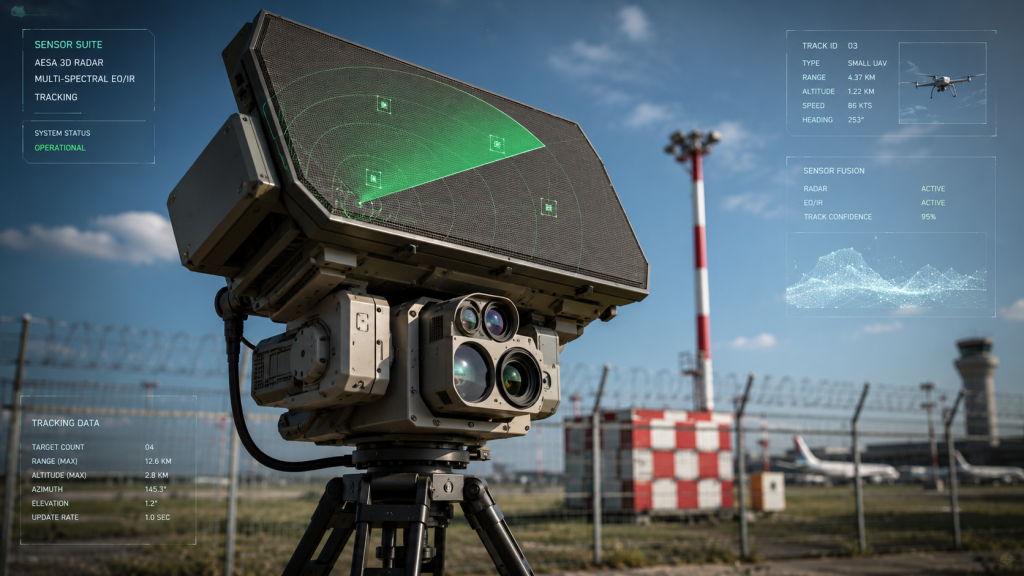
- Continuous optical zoom lenses tracking microscopic structural details at distance.
- Cooled indium antimonide thermal cores detecting minuscule battery heat signatures.
- Automated video tracking software keeping moving targets centered in frame.
- Integrated laser rangefinder equipment establishing precise altitude coordinate data points.
How Does Algorithmic Visual Tracking Prevent Dangerous Defensive Delays?
Manual camera control during high-speed low-altitude aerial excursions frequently results in tracking losses due to human error. Artificial intelligence visual analytics algorithms evaluate incoming camera frames instantly adjusting motorized pan-tilt heads dynamically without operator lag. What’s the real story? These smart camera tracking loops lock onto moving pixels maintaining clear identification profiles regardless of erratic flight maneuvers.
- Convolutional neural networks classifying target silhouettes against bright sky backgrounds.
- Multi-spectral image fusion overlaying optical frames onto thermal sensor outputs.
- Automated target prioritization tracking closest platforms during multi-vehicle scenarios.
- Optical stabilization mechanics eliminating structural vibration induced by heavy wind conditions.
Key Takeaways
Visual tracking provides the concrete confirmation required to execute neutralization protocols without risk of misidentification. Thermal imaging guarantees consistent tracking capability regardless of local visibility fluctuations or nighttime conditions.
| Sensor Platform | Resolution Metrics | Effective Range |
| HD Optical Payload | 1920 x 1080 Pixels | Up to 2.5 km tracking |
| Cooled MWIR Thermal | 640 x 512 Pixels | Up to 3.5 km tracking |
| SWIR Specialized Core | 1280 x 1024 Pixels | Up to 4.0 km tracking |
Combining distinct optical wavebands eliminates sensor blindness ensuring reliable tracking verification across diverse industrial environmental settings.
5. How Does RF Jamming Neutralize Malicious Low-Altitude Airframe Operations?
Radio frequency directional jamming equipment interrupts target communication channels by emitting targeted electromagnetic noise fields. This disruption severs controller connections causing aircraft to activate safety routines like immediate landing or returning home. Here’s the deal: utilizing high-power gallium nitride semiconductor platforms guarantees sufficient output power to overcome modern remote controls. Modern counter-drone jamming devices apply specific RF distribution methods to secure local airspace zones:
- Directional antenna arrays concentrating output power towards specific target vectors.
- Multi-band frequency generation coverage disrupting control channels alongside telemetry links.
- Swept-frequency modulation masking rapid signal hopping sequences across wide bands.
- Configurable power output adjustments preserving close-in industrial operational safe zones.
Why Are Custom GaN Amplifiers Changing Active Electronic Warfare Efficiencies?
Traditional silicon-based amplification components suffer severe thermal losses leading to significant power degradation during sustained transmissions. Gallium nitride solid-state power modules deliver exceptional power densities while sustaining stable outputs across wide industrial temperature ranges. You might be wondering: can your defensive infrastructure sustain continuous wideband emissions without experiencing component failures?
- High-efficiency thermal dissipation designs minimizing internal amplifier junction heat.
- Wide continuous frequency bandwidths eliminating multi-amplifier hardware stacking requirements.
- Excellent gain flatness performance insuring stable energy transmission across full bands.
- Robust output VSWR protection circuits preventing damage during extreme load mismatches.
Key Takeaways
Deploying high-power gallium nitride amplification equipment ensures consistent communication disruption over long distances. Selecting rugged solid-state hardware protects critical facilities against persistent long-range low-altitude intrusion strategies.
| Amplifier Technology | Power Density | Frequency Bandwidth | Efficiency Metric |
| Legacy Silicon LDMOS | Moderate | Narrow Band Only | 35% to 45% Typical |
| Advanced GaN Core | High Power | 30 MHz to 6 GHz | 50% to 65% Excellent |
Transitioning to gallium nitride modules increases transmission ranges while optimizing overall electrical energy usage.
6. What Are the Technical Benefits of Spoofing and Protocol Manipulation?
Protocol manipulation systems intercept targeted aircraft digital transmissions and inject modified commands to gain operational control. Unlike standard raw noise jamming platforms, smart spoofing modules redirect targets along predefined safe paths without requiring excessive transmission power. This is where it gets interesting: implementing software-defined architecture enables direct control over target navigation chips. Advanced counter-drone control interception applies multiple precise manipulation methodologies to redirect targets:
- Fake satellite navigation signal generation altering onboard global positioning coordinates.
- Precise control packet injection overriding factory remote control operational telemetry links.
- Dynamic timing synchronization matching active transmission windows for precise insertion.
- Safe waypoint programming steering compromised targets into secure recovery zones.
How Do Software Defined Radio Frameworks Enable Protocol Control?
Fixed-architecture transmitters lack the software flexibility needed to emulate complex modern commercial control configurations. Advanced software-defined radios manipulate wireless signal attributes via digital code adjustments allowing rapid updates for newly discovered protocols. But here’s the kicker: updating digital profiles guarantees long-term protection against newly released commercial flight controllers.
- Multi-waveform generation capabilities adjusting to complex signal standards instantly.
- Real-time frequency hopping tracking rapid transmission changes during active incidents.
- Dual independent channel outputs managing multiple frequency targets concurrently.
- Flexible programming access accommodating quick integration with external radar systems.
Key Takeaways
Protocol manipulation delivers surgical mitigation capabilities allowing security teams to capture targets without causing local wireless disruptions. Software-driven architectures protect equipment investments from becoming obsolete as new commercial models enter the market.
| SDR Configuration | Processing Depth | Channel Control | Interface Protocol |
| Dual Channel Transceiver | 12-Bit DAC/ADC | Independent I/Q | RS422 Real-Time |
Utilizing software-defined hardware provides flexible signal modulation capabilities to counter evolving low-altitude threats.
7. How Do Kinetic and Hard-Kill Options Complete Layered Airspace Security?
Kinetic mitigation mechanisms eliminate airborne threats by physically disabling target components or capturing systems using physical containment networks. Hard-kill solutions offer definitive resolution when strong radio interference or protocol encryption renders electronic countermeasures ineffective. Ready for the good part? Integrating automated physical capture options into layered defense networks guarantees protection against completely autonomous threats.
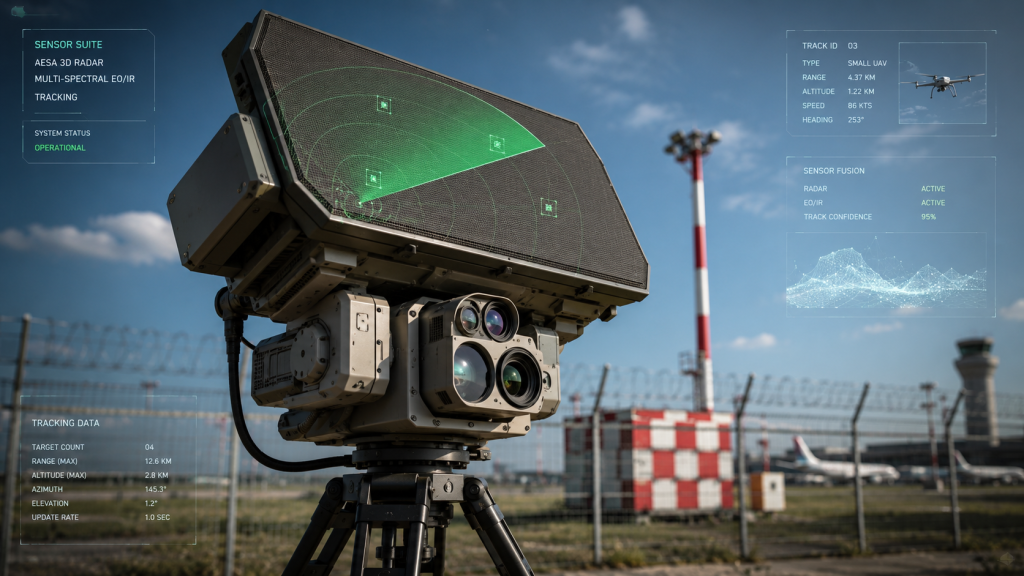
Industrial counter-drone facilities deploy specific mechanical options for absolute perimeter defense:
- Interceptor aircraft launching high-tensile nets to physically snare targets.
- Compressed gas launchers firing weighted capture nets from fixed perimeter stations.
- High-power directional laser devices destroying critical structural frame links.
- Controlled ballistic systems neutralizing internal avionics components at close range.
When Should Facilities Deploy Physical Capture Rather Than Electronic Disruption?
Autonomous platforms navigating purely via pre-programmed inertial tracking systems are immune to standard radio frequency jamming. When encountering these non-communicating dark targets, physical interception represents the only reliable methodology to prevent facility penetration. What’s the real story? Deploying high-speed automated interceptor platforms allows facilities to neutralize autonomous threats far beyond sensitive asset lines.
- Inertial guidance navigation overrides ignoring standard satellite spoofing attempts.
- Pre-programmed data collection missions operating without active operator radio controls.
- Complete silent operation modes minimizing target radio frequency radiation signatures.
- Hardened internal structural designs resisting basic low-energy physical interference.
Key Takeaways
Physical mitigation provides a definitive final line of defense against fully autonomous or electronically hardened airborne targets. Combining kinetic capabilities with electronic tracking creates a comprehensive barrier for high-security industrial facilities.
| Kinetic Platform | Engagement Distance | Collateral Risk Profile |
| Net-Gun Interceptor | 50 m to 150 m | Extremely low risk footprint |
| High-Energy Laser | 500 m to 1.5 km | Moderate thermal risk factors |
| Ballistic Terminal | 100 m to 300 m | High debris risk potential |
Careful assessment of local risk conditions guides the optimal deployment of terminal physical mitigation platforms.
8. What Legal and Regulatory Hurdles Impact Global System Deployment?
Deploying active transmission equipment involves navigating complex regional telecommunication frameworks and civil aviation safety rules. Unauthorized radio emissions can disrupt nearby commercial communications or airport navigation arrays, leading to severe legal penalties. Think about it: understanding regional legislative constraints before procuring high-power transmission hardware prevents costly regulatory violations. International counter-drone deployment managers evaluate several regulatory considerations before installation:
- National telecommunication approvals governing high-power frequency transmission systems.
- Strict civil aviation laws restricting active interference inside commercial transit zones.
- Industrial property liability rules regarding damaged aircraft falling onto public pathways.
- Data privacy laws regulating passive radio frequency packet collection operations.
How Can Industrial Facilities Deploy Active Mitigation Within Strict Legal Frameworks?
Operating active jamming devices in urban zones requires explicit authorization from national security agencies. Modern technical systems utilize narrow directional antennas and adjustable power outputs to restrict high-power emissions strictly to facility boundaries. Here’s the deal: implementing automated fail-safe overrides guarantees compliance with strict regional telecommunication policies.
- Sector-blanking configurations disabling transmissions toward public transportation routes.
- Automated power attenuation matching measured target distances to limit signal spillover.
- Verified end-user declarations validating legal operation within sovereign defense zones.
- Comprehensive activity logging recording all system emissions for regulatory reviews.
Key Takeaways
Navigating regulatory frameworks is critical to deploying active electronic countermeasures without causing illegal interference. Selecting precision directional hardware allows facilities to secure private airspace while complying with telecommunication standards.
| Regulatory Domain | Primary Constraint | Compliance Strategy |
| Telecommunications | Frequency allocation limits | Precision band filtering arrays |
| Aviation Authorities | Airspace safety mandates | Strict directional sector blocking |
| Privacy Frameworks | Data interception limits | Telemetry parsing restrictions |
Proactive regulatory alignment secures long-term operational viability for your airspace defense infrastructure investments.
9. How Do You Choose the Ideal Architecture for Facility Protection?
Selecting an effective defensive configuration requires an analysis of site-specific geography, local interference levels, and asset layouts. A coastal seaport demands vastly different sensor configurations than a crowded urban data processing hub or a remote refinery. You might be wondering: how can your engineering team design a scalable system that balances budget limits with high security demands? Integrating a reliable counter-drone infrastructure requires a structured evaluation of technical capabilities:
- Modular component interfaces supporting the addition of future sensor technologies.
- Multi-sensor tracking integration combining radar, radio frequency, and optical detection data.
- Ruggedized weatherproof enclosures that endure long-term outdoor operation.
- High-power amplification modules that provide stable output during extended alerts.
Why Is a Single-Supplier Full-Chain Architecture Better Than Multi-Vendor Assembly?
Assembling separate tracking and mitigation components from multiple vendors often introduces software lags and interface mismatches. Sourcing an integrated solution from a single full-chain manufacturer ensures seamless communication between sensors and amplifiers. What’s the catch? Multi-vendor integration often creates complex troubleshooting loops that delay system response times during critical incidents.
- Standardized software interfaces eliminating configuration delays between tracking and jamming components.
- Factory-matched impedance links optimizing power transfer between amplifiers and antennas.
- Single-point technical support accelerating system updates and maintenance routines.
- Scalable manufacturing capabilities supporting large-scale site rollouts under uniform quality protocols.
Key Takeaways
Sourcing full-chain hardware minimizes integration risks and guarantees rapid response times during low-altitude incidents. Choosing an engineering-driven manufacturing partner ensures your system is optimized for your facility’s unique environment.
| Integration Approach | Latency Profile | Component Match | Support Lifecycle |
| Multi-Vendor Assembly | 250 ms to 500 ms | Variable / Mismatched | Complex / Multi-Contact |
| Full-Chain Integrated | < 50 ms Optimized | Factory Synchronized | Unified Single Source |
Investing in factory-integrated components ensures high reliability when defending your critical airspace boundaries.
10. What Innovations Will Shape the Future of Airspace Interception?
Evolving low-altitude threats require continuous innovation in software-defined signal processing and high-frequency power electronics. Future defensive networks will rely on deep neural networks for automated target tracking and high-frequency amplifiers to counter advanced threats. This is where it gets interesting: next-generation systems will operate across millimeter-wave bands to address shifting threat profiles. Developing forward-looking counter-drone solutions requires investing in key technical innovations:
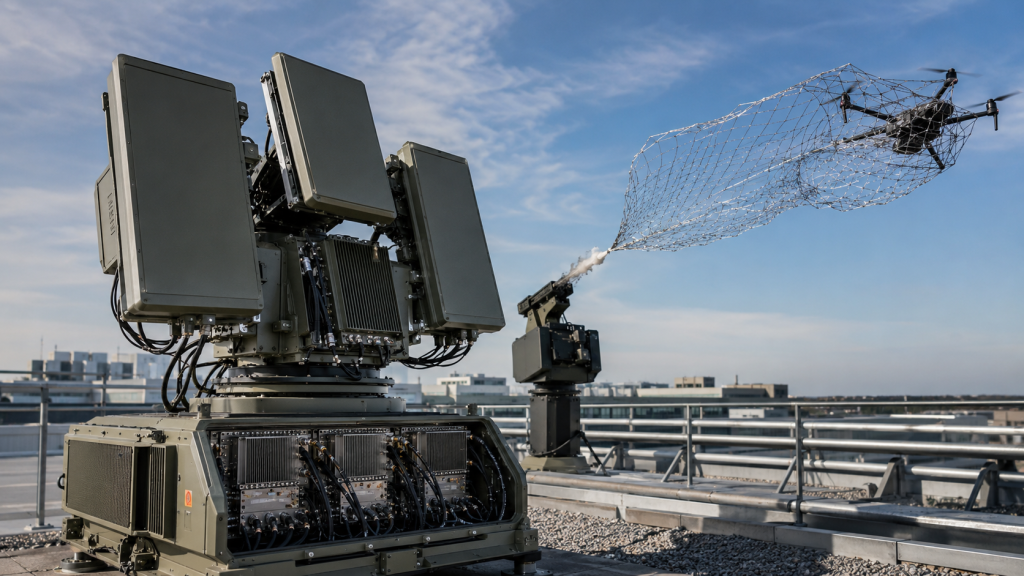
- Distributed mesh sensor networks providing complete coverage across wide industrial facilities.
- Cognitive radio architectures that detect and counter unknown signal frequencies automatically.
- Solid-state amplification modules engineered for millimeter-wave bands.
- High-speed automated coordination software that manages multi-layered defensive responses.
How Are Shifting Transmission Frequencies Changing Modern System Design?
New commercial airframes are moving away from saturated wireless bands toward less crowded, higher frequency channels. Traditional defensive equipment built for standard consumer frequencies cannot counter these high-frequency platforms. But here’s the kicker: integrating wideband amplification platforms ensures your security infrastructure remains effective against next-generation threats.
- Multi-band digital synthesis architectures generating precise signals up to high frequencies.
- Advanced semiconductor configurations delivering stable output power across wider bands.
- Smart antenna designs adjusting radiation patterns dynamically to match target headings.
- High-speed data processing units identifying complex digital waveforms instantly.
Key Takeaways
Sustained security requires adopting flexible, wideband hardware architectures that adapt easily to changing target frequencies. Partnering with an agile, engineering-driven manufacturer keeps your facility protected as technology evolves.
| Trend Vector | Engineering Focus | System Impact |
| Higher Frequencies | Millimeter-wave modules | Counters next-gen control links |
| Automated Swarms | Multi-channel SDR sources | Neutralizes multi-target threats |
| Cognitive Defense | Real-time signal analysis | Adapts to unknown frequencies |
Staying ahead of technical trends ensures your long-term security investments continue to provide reliable protection.
Protecting low-altitude airspace requires a reliable, multi-layered approach combining early radio detection, continuous optical tracking, and high-power mitigation hardware. Securing sensitive perimeters demands moving past basic retail solutions and adopting rugged, factory-certified electronic warfare modules built for continuous operation. CorelixRF designs and manufactures premium, military-grade RF chain modules, high-efficiency GaN power platforms, and software-defined signal sources that empower integrators to secure critical assets globally. Contact us today to receive a comprehensive engineering proposal tailored to your technical requirements.
FAQs
Can I deploy active RF jamming systems at any commercial facility?
No, active frequency jammers face strict regional regulatory constraints and typically require authorization from national telecommunication or aviation authorities before installation. Facility managers must evaluate local laws and use directional antennas to prevent interference with public networks.
What’s the best way to detect drones that do not emit radio signals?
Deploying active three-dimensional Doppler radar systems paired with high-definition thermal optical sensors is the most effective approach for detecting silent, autonomous targets. Radar identifies physical cross-sections, while thermal cameras maintain visual tracking through battery heat signatures.
How do I know if consumer wireless networks will conflict with defense sensors?
Conducting a comprehensive spectrum analysis before installation identifies local wireless usage and helps engineers configure sharp band-pass filters. Utilizing precise directional tracking and targeted amplification modules prevents interference with local corporate networks.
Can modern counter-drone systems mitigate simultaneous multi-target swarm threats?
Yes, modern architectures use multi-channel software-defined digital signal sources paired with wideband active electronically scanned array radars to track and neutralize multiple targets concurrently across separate frequencies.
How does weather impact overall detection and mitigation effectiveness?
Heavy rain, dense fog, or high winds can reduce the range of optical sensors and radar systems. Implementing multi-sensor fusion—which combines passive radio frequency monitoring with ruggedized Doppler radar arrays—ensures reliable performance in challenging weather conditions.
Authorized RF engineering and compliance review
For regulated RF systems, this page should be used as an engineering and compliance review path, not as a public deployment checklist. CorelixRF starts with authorization status, operating region, frequency plan, output limit, antenna interface, safety controls, thermal limits and acceptance documents.
- RFQ checklist – send the data buyers usually forget, including band, power, duty cycle, interface and test standard
- delivery documentation – check what documents can support incoming inspection, FAT review and long-term maintenance
- quality and certification review – review the quality and compliance evidence before the project moves into procurement
- RF front-end platform – compare the RF chain as a system instead of selecting one isolated module
- RF configurator – turn frequency, power, thermal and interface requirements into a first configuration brief
- case studies – review similar engineering paths before sending an RFQ
- engineering contact – send the application notes, block diagram or target specification to engineering sales
This keeps the discussion inside lawful, authorized RF programs while still giving procurement teams a clear way to request amplifier, antenna, SDR source, documentation and factory review.
Authorized RF Compliance Review Path
For authorized C-UAS or RF system procurement, connect compliance boundaries to RF front-end platform planning, RF amplifier platform options and antenna/load requirements. Use the RF inquiry form to send band, output power, control interface, site conditions and required validation evidence.