
RF PA Procurement: Why Custom Quotes Must Separate NRE, Prototype, and Production Pricing. Procurement departments often mishandle RF hardware acquisition. Securing a reliable supply chain requires profound technical accuracy. Buyers frequently request a single unit price covering all development phases. This approach appears efficient from an administrative perspective. But here is the kicker. Concealing true engineering costs within volume production pricing creates massive systemic vulnerabilities. It directly causes late-stage integration failures alongside severe performance degradation. CorelixRF utilizes decades of manufacturing data analyzing this exact commercial problem. We advocate strongly for isolating Non-Recurring Engineering (NRE) fees from prototype and volume costs. This transparent methodology protects your overall project budget while guaranteeing hardware reliability. Let us examine the specific physical realities dictating this precise commercial structure.
1. The Physics Behind the Quote: Why a Single Price Fails
Analyzing the Sub-System Complexity
Radio frequency power amplifiers are not standardized digital components. They represent highly complex analog subsystems operating at the extreme edges of semiconductor physics and thermodynamics. A rigid quotation must reflect the massive resource consumption required during different engineering phases. Requesting a consolidated price forces manufacturers into dangerous compromises. Suppliers will inevitably reduce front-end design hours. They will skip critical environmental stress screening protocols. This structural deficit eliminates necessary design margins completely. Your system will eventually face inevitable impedance mismatch conditions in the field. The PA module will then experience severe gain drift or catastrophic thermal runaway. What is the real story? You are essentially forcing your vendor to build a kludge rather than a qualified industrial instrument.
The Dangers of Inadequate Design Margin
A lack of upfront investment manifests as hardware failure during field deployment. Engineers must account for fluctuating voltage standing wave ratios (VSWR) across broadband frequencies. When financial structures disincentivize rigorous testing, manufacturers rely on theoretical models rather than empirical validation. This oversight leaves end-users dealing with unexpected out-of-band spurious emissions. The entire system architecture becomes unstable when the final amplifier stage lacks proper load-pull verification. Procurement leaders must recognize that buying RF hardware requires buying verified engineering data.
| Cost Structure Model | Initial Perceived Value | Hidden Technical Risks | Long-Term Budget Impact | Validation Quality |
| Consolidated Single Price | Appears highly economical | Severe design margin reduction | Extremely high due to field failures | Poor (Theoretical data only) |
| Three-Tier Separated Price | Requires higher initial approval | Minimal integration risk | Low and highly predictable | Excellent (Empirical FAT data) |
2. Cost Breakdown: From Blueprint to Qualified Delivery
NRE: The First Line of Defense
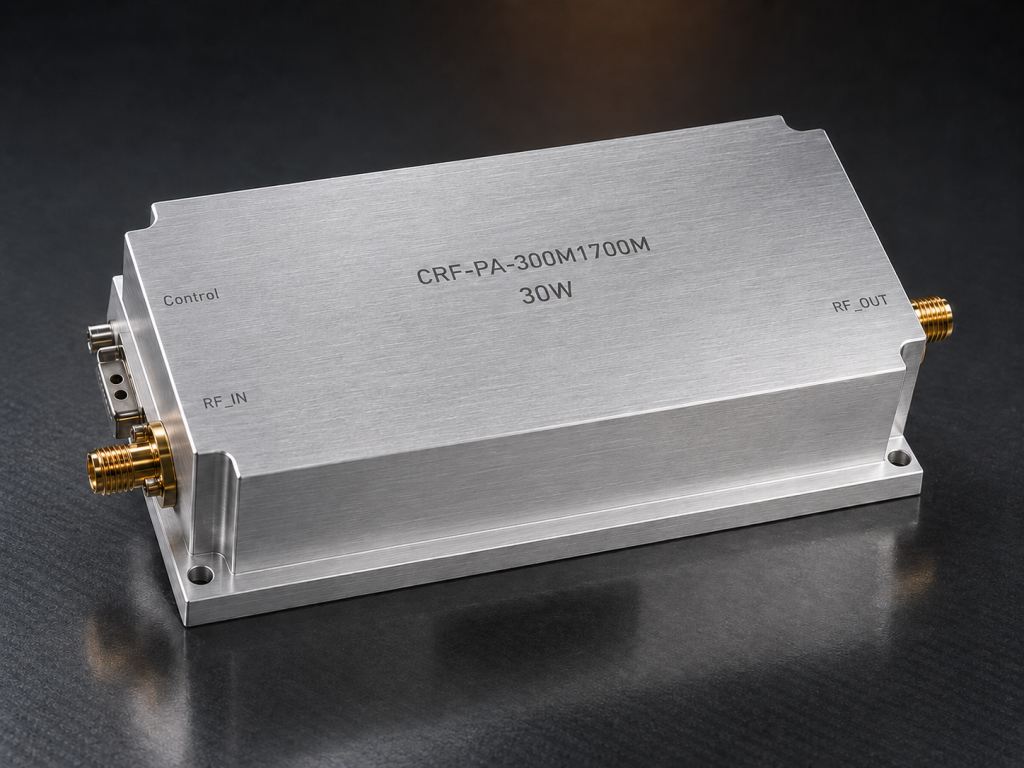
Non-Recurring Engineering fees are never simple drawing charges. They represent the mandatory validation investments necessary for preventing system integration disasters. Consider the CorelixRF CRF-PA-300M1700M-30W solid-state power amplifier. This broadband GaN platform operates from 300 MHz to 1700 MHz. It must deliver 30 W of continuous wave (CW) output power. It also supports a 200 MHz instantaneous bandwidth for OFDM-type signal amplification. Developing this module demands extensive computational electromagnetics. This is where it gets interesting. Refusing to fund NRE means the supplier will simply copy older unoptimized circuits.
Prototype Pricing: High-Density Testing
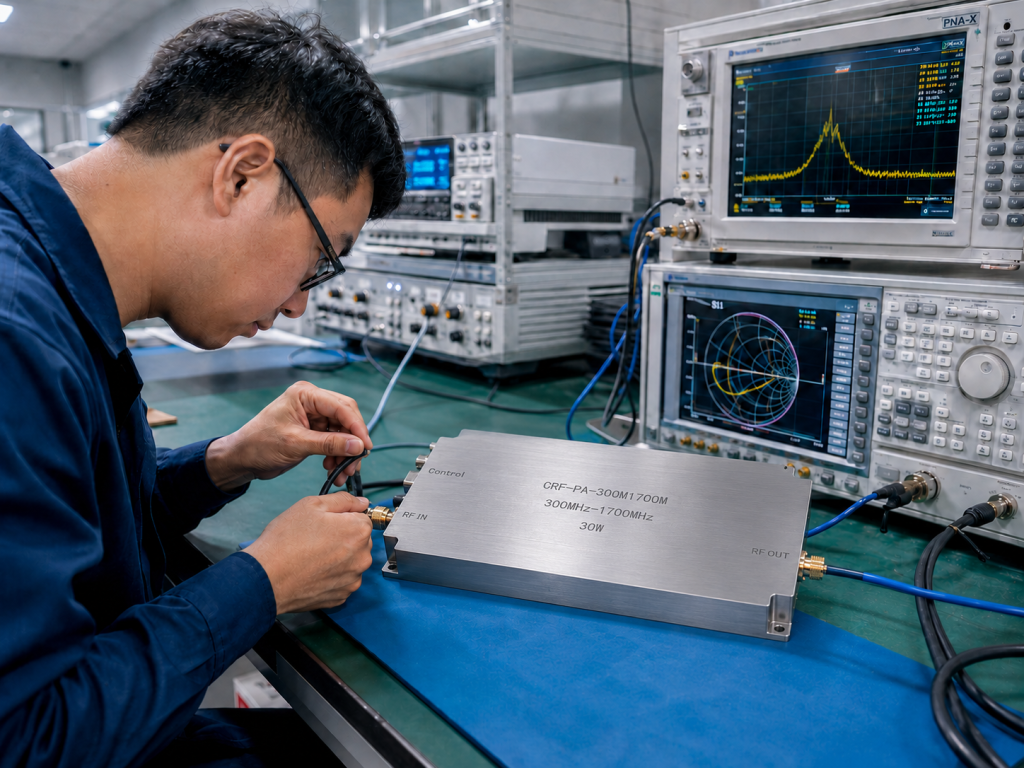
Prototype units carry a significantly higher price tag than mass production units. This phase involves extreme levels of manual engineering intervention. Technicians cannot amortize CNC machining costs across a small batch. The primary cost driver remains the sheer volume of bench testing hours required. Senior engineers must sit with network analyzers tuning discrete components. They must verify exact performance metrics across the entire frequency band. You are paying for the absolute certainty of real-world measurements.
Volume Pricing: Pure Bill of Materials
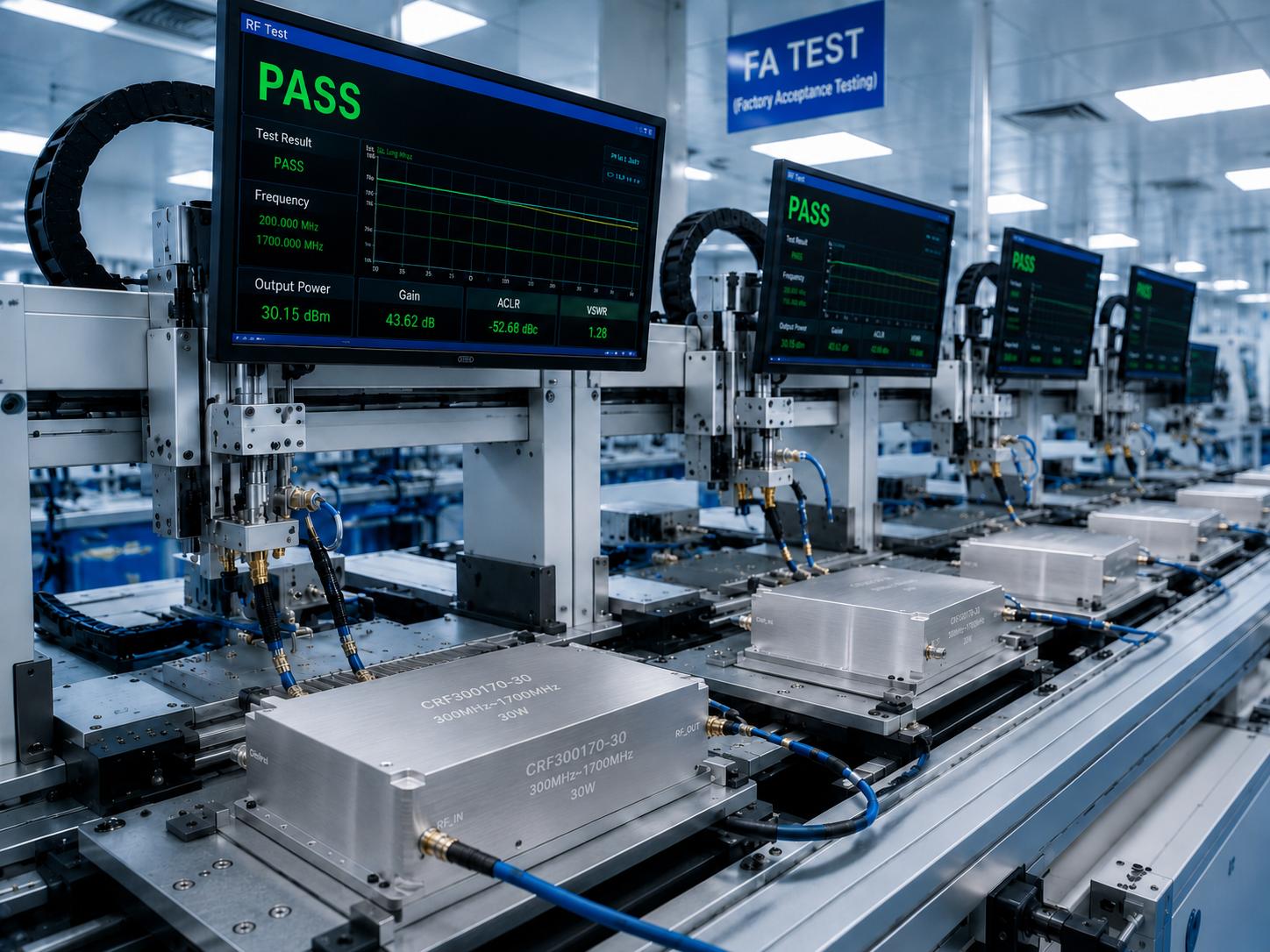
Volume pricing drops precipitously once initial development concludes. The NRE phase has already absorbed all fixture and design expenses. Automated factory acceptance testing (FAT) procedures replace manual bench tuning. The cost model now reflects pure bill of materials (BOM) alongside standardized assembly labor. This separation gives sourcing teams an incredibly accurate forecasting tool. You can project future outlays without worrying about hidden engineering surcharges.
| CorelixRF CRF-PA-300M1700M-30W Specifications | Parameter Value |
| Operating Frequency Range | 300–1700 MHz |
| Rated Output Power | 30 W CW |
| Instantaneous Bandwidth | 200 MHz |
| Small-Signal Gain | 36 dB to 46 dB |
| Mechanical Dimensions | 125×59×21.5 mm |
| Operating Voltage | +24 V to +32 V DC |
| RF Connectors | SMA-KFD46 |
3. Deep Dive into NRE: Preventing Integration Failures
Impedance Matching and Linearity Tuning
Engineers face immense challenges wrangling third-generation Gallium Nitride (GaN) transistors. They must perform meticulous impedance matching to ensure broadband stability. The small-signal gain must remain perfectly flat between 36 dB and 46 dB. Excessive in-band ripple will completely destroy complex modulation schemes. Funding NRE allows technicians to run exhaustive load-pull simulations. They can precisely map the Smith chart to identify optimal matching networks. This prevents the amplifier from oscillating wildly under mismatched antenna loads. Ready for the good part? Proper matching guarantees your module will survive harsh operational realities without degrading over time.
Thermal Management and Mechanical Constraints
High-power solid-state amplifiers generate massive amounts of waste heat. The CRF-PA-300M1700M-30W utilizes a compact 125×59×21.5 mm form factor weighing only 0.5 kg. Dissipating heat away from the GaN junctions within this tiny envelope is incredibly difficult. Engineers must design robust thermal conduction paths transferring thermal energy to an external heat sink. The design must guarantee safe operation across a -40°C to +60°C temperature range. It also requires integrating reliable over-temperature protection circuitry. The PA shuts down above 80°C and recovers automatically below 70°C.
Logic Timing and FAT Fixture Development
Modern RF systems demand rapid switching capabilities. The control interface relies on a D-Sub 9-Pin Female connector. Engineers must write precise logic sequences ensuring the PA enable/disable time stays under 10 µs. Generating specialized Factory Acceptance Test (FAT) fixtures requires dedicated hardware programming. These fixtures guarantee that every production unit meets the exact switching specifications without generating transient voltage spikes. NRE covers the creation of these vital automated testing tools.
| NRE Engineering Task | Core Objective | Risk if Unfunded |
| Electromagnetic Simulation | Verify unconditional stability | Severe oscillation under mismatch |
| Thermal Topology Design | Maintain safe junction temperatures | Catastrophic thermal runaway |
| Logic Interface Programming | Guarantee 10 µs switching speed | System timing failure |
| Automated FAT Fixture Creation | Eliminate manual measurement errors | Acceptance of defective units |
4. The Prototype Phase: Paying for Empirical Data
Manual Calibration on the Bench
The prototype stage represents the physical manifestation of theoretical designs. Skilled technicians apply nominal +28 V DC supply voltages checking quiescent currents. They manually adjust physical tuning stubs evaluating the 2.4 A typical operating current. This high-touch labor is incredibly expensive. You cannot bypass this phase if you want reliable hardware. The prototype price reflects the intense scrutiny applied to every individual circuit board. It acts as an insurance policy against mass-producing a flawed design.
Validating VSWR and Harmonic Distortion
Engineers connect the SMA-KFD46 RF input and output ports to high-end spectrum analyzers. They meticulously verify the input Voltage Standing Wave Ratio (VSWR) remains below the strict 1.8 limit. They must also measure harmonic distortion ensuring second and third harmonics stay below -10 dBc. Spurious emissions are heavily regulated and must remain below -60 dBc. You might be wondering. Why is this so crucial? Paying a premium for prototypes means buying actual physical proof that the engineering mathematics work perfectly.
| Prototype Parameter | Target Specification | Measurement Method |
| Input VSWR | < 1.8 | Vector Network Analyzer |
| Harmonic Distortion (2nd, 3rd) | -10 dBc | Spectrum Analyzer |
| Spurious Emissions | -60 dBc | Broadband Sweep |
| Noise Figure | 20 dB max | Noise Figure Meter |
| Operating Current | 2.4 A typ, 3 A max | Calibrated DC Power Supply |
5. Leveraging the NRE Offset Mechanism
Protecting Your Long-Term Budget
Savvy procurement leaders utilize an NRE offset mechanism maximizing commercial leverage. CorelixRF operates with complete transparency regarding development costs. Buyers can establish predefined volume thresholds during contract negotiations. When subsequent manufacturing orders hit specific quantities the initial NRE fee is credited back. This rebate applies directly against the incoming production invoices. You avoid paying hidden development premiums repeatedly. If costs remain consolidated you will pay for the engineering effort hundreds of times over a ten-year product lifecycle.
Defining Clear Accountability Boundaries
Separating costs establishes incredibly rigid accountability boundaries between vendor and buyer. The NRE deliverable package includes comprehensive 3D mechanical drawings. It provides detailed control protocol documentation for the D-Sub 9-Pin interface. Quality Assurance departments receive massive amounts of raw FAT data. These tangible assets give sourcing teams ultimate leverage during hardware acceptance. Here is the deal. You eliminate post-delivery disputes completely because the acceptance criteria are based entirely on hard empirical evidence.
| Production Volume Milestone | NRE Offset Percentage applied | Unit Price Impact |
| 1 to 10 Units (Prototype) | 0% | Benchmark Prototype Cost |
| 11 to 99 Units | 0% | Standard Low-Volume Price |
| 100 to 499 Units | 50% Rebate | Significantly Reduced Price |
| 500+ Units | 100% Rebate (Fully Amortized) | Pure BOM + Labor Cost |
6. Establishing Data-Driven FAT Standards
Refusing Parameter Inflation
Combining all phases into one arbitrary number violates microwave manufacturing fundamentals. It plants a ticking time bomb inside your supply chain. You must demand a transparent three-tier quotation structure immediately. Require specific engineering deliverables at every single project milestone. CorelixRF rejects parameter compromises entirely. We refuse to use deceptive marketing tactics hiding poor performance. All custom modules undergo severe environmental testing based on actual physical constraints. We manufacture under a strict ISO 9001 quality management system.
CorelixRF Quality Control Protocols
We design equipment surviving MIL-STD-810F Method 500.4 altitude tests. Our modules pass MIL-STD-810F Method 514.5/516.5 Proc I vibration and shock profiles. Every unit tolerates storage temperatures from -55°C to +85°C at 95% relative humidity. Do not rely on vague specifications. Request our standardized FAT and SAT acceptance testing frameworks. Equip your engineering team with precise evaluation criteria. Take control over your next critical hardware acquisition. Contact our sales engineers obtaining the technical review documentation required for your specific frequency and power needs. The bottom line is this. Data-driven procurement is the only path ensuring reliable field operations.
Final Thoughts
Procuring custom RF power amplifiers requires acknowledging the profound physical complexities involved. Reject consolidated single-unit pricing models hiding crucial development efforts. Embrace the transparent three-tier structure separating NRE fees from prototype and mass production costs. This strategy safeguards your project against parameter inflation while ensuring long-term budgetary predictability. Demand rigorous empirical testing data protecting your system integration phase. Download the CorelixRF engineering review templates today securing your supply chain.
FAQ
Q1: What is the primary risk of using a consolidated single price for custom RF power amplifiers?
The primary risk involves the supplier cutting critical engineering hours and environmental testing to maintain profit margins. This leads directly to inadequate design margins causing eventual system integration failures and poor reliability in the field.
Q2: How does an NRE offset mechanism work in B2B procurement?
An NRE offset mechanism allows buyers to recoup their initial engineering investment over time. Once mass production orders reach a predefined contractual threshold the original NRE fee is credited back against the unit price of the production hardware.
Q3: What specific engineering deliverables should be included in an NRE fee?
A proper NRE package must include detailed 3D mechanical models alongside comprehensive interface control documentation. It must also provide exact logic timing diagrams and the development of automated Factory Acceptance Test (FAT) fixtures.
Q4: Why are RF amplifier prototypes significantly more expensive than volume production units?
Prototypes require immense amounts of high-level engineering labor for manual bench tuning and calibration. Technicians must use vector network analyzers verifying every single parameter without the benefit of automated assembly lines or amortized machining costs.
Q5: What parameters must a Factory Acceptance Test (FAT) verify for a broadband PA?
A rigorous FAT protocol must verify small-signal gain flatness across the entire frequency band. It must confirm the input VSWR remains within limits while checking harmonic distortion spurious emissions and the exact PA enable/disable switching times under full operational loads.
Separate NRE from unit price before quotation
NRE, tooling, firmware/interface changes, documentation and recurring unit cost should be separated in the RFQ. This makes supplier comparison cleaner and avoids hiding engineering cost inside a misleading unit price.
Recommended next step: send the operating band, target output power, duty cycle, thermal or load condition, control interface, protection behavior and required FAT documents. CorelixRF can review this RF PA procurement and NRE separation requirement against standard amplifier platforms, RF front-end options and custom engineering constraints.