
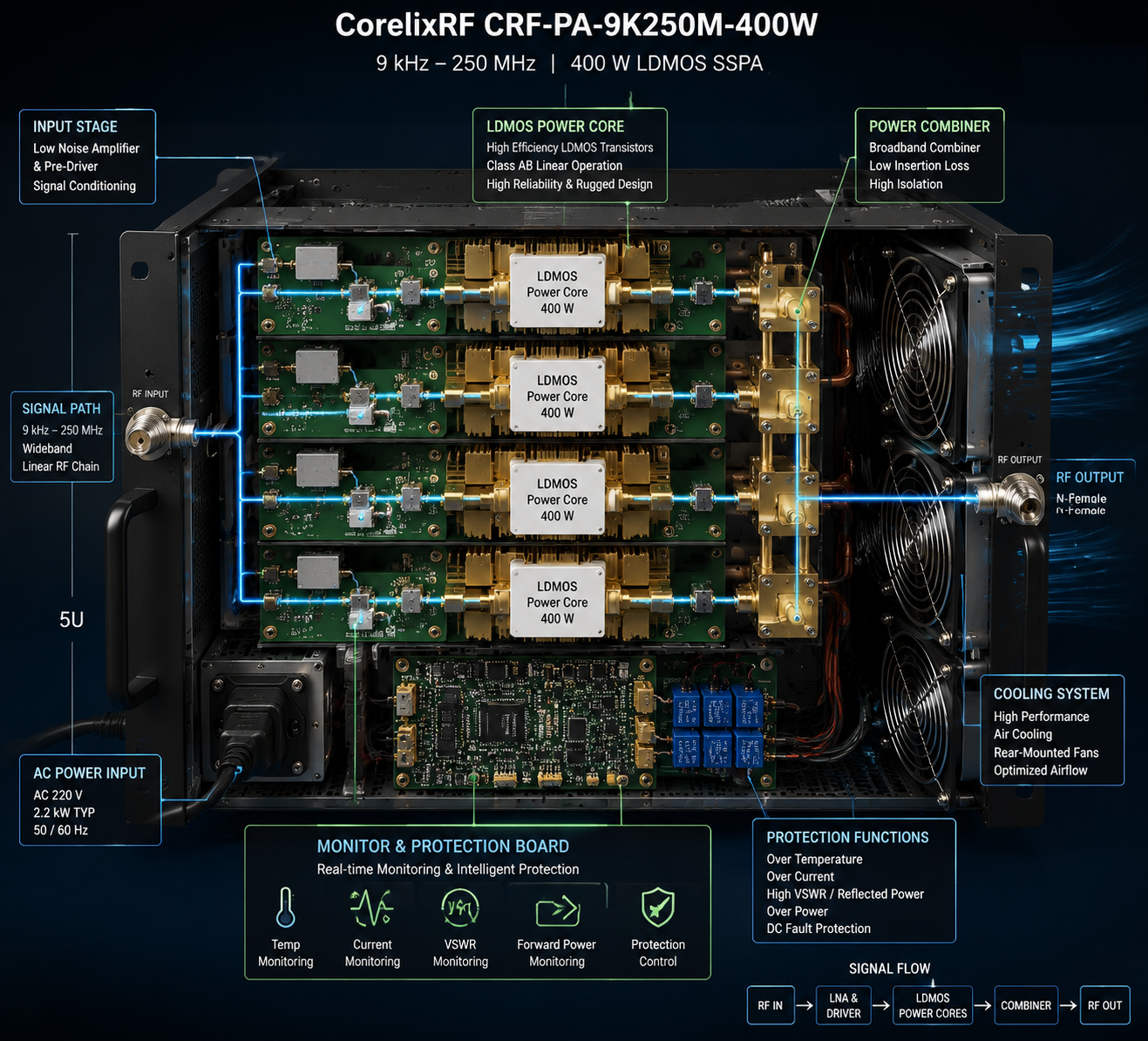
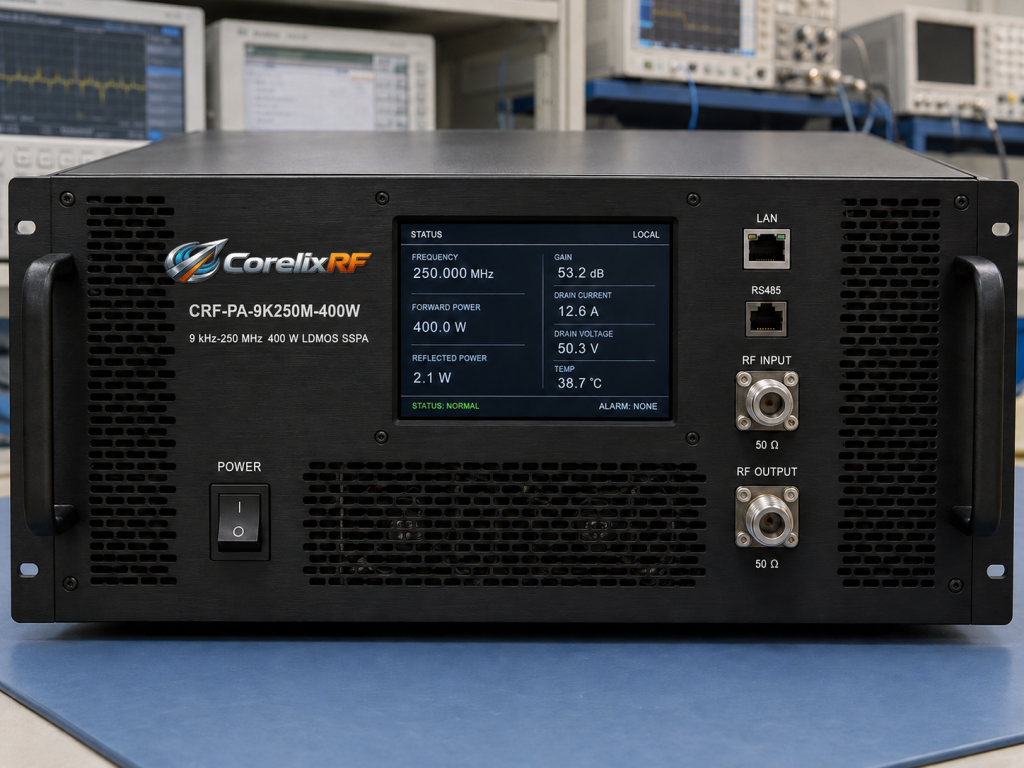
A 9 kHz-250 MHz 400 W EMC RF amplifier covers a range that many engineering teams treat as operationally awkward: low enough for long wavelengths, large fixtures, and heavy coupling hardware, but still demanding enough to require controlled RF power, monitoring, and protection. CorelixRF’s CRF-PA-9K250M-400W is specified as an LDMOS solid-state RF power amplifier covering 9 kHz to 250 MHz with 400 W rated output power, 57 dB minimum small-signal gain, air cooling, N-Female input/output, and RS485/LAN control.
For immunity labs, RF system integrators, and communication test teams, this EMC RF amplifier class can support broad low-frequency test coverage without switching multiple narrow systems. The integration challenge is to match the amplifier with the correct couplers, loads, antennas, injection clamps, calibration method, and safety process.
Why 9 kHz-250 MHz Coverage Matters
The 9 kHz to 250 MHz span reaches across conducted and lower radiated test use cases, communication equipment evaluation, and system-level RF interference testing. The CorelixRF source specification lists test and measurement instrumentation, communication systems, RF interference / EW system-level testing, and aerospace control systems as primary applications.
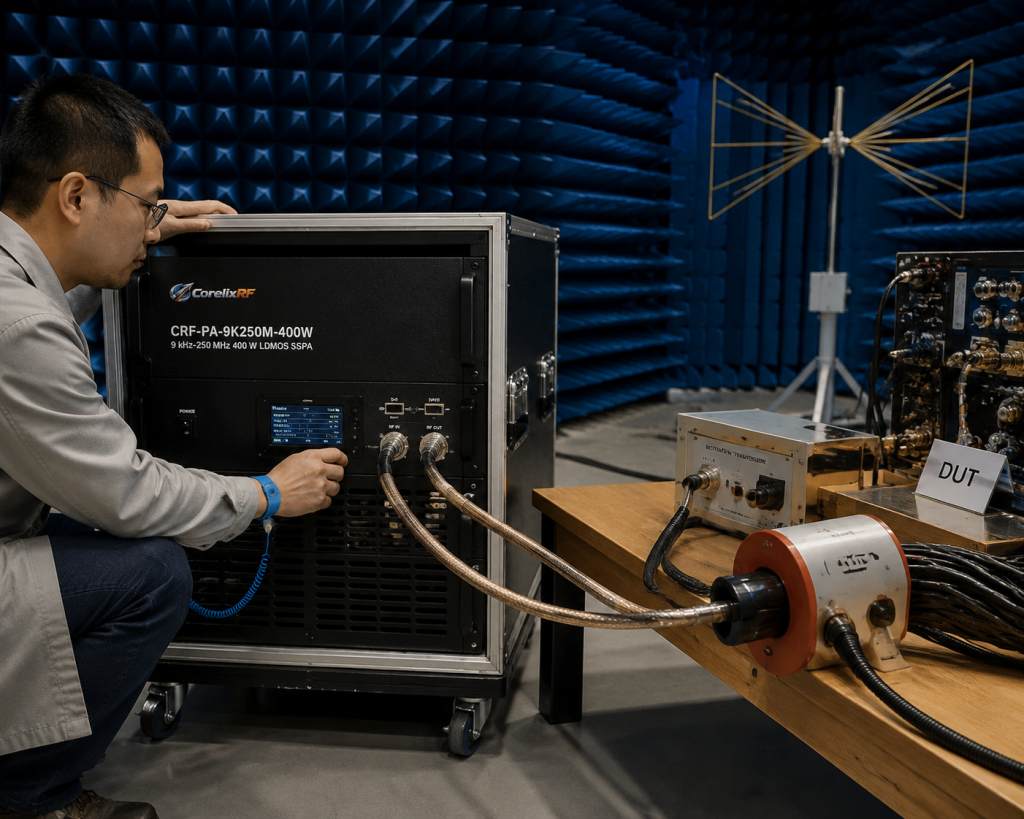
A low frequency EMC amplifier must be reviewed with the full test environment in mind. At these frequencies, fixture impedance, cable routing, ground strategy, antenna type, and room layout can have strong influence on delivered field or injected current. The amplifier can provide power, but the test method determines whether that power is applied in a controlled and repeatable way.
Electrical Specifications for System Design
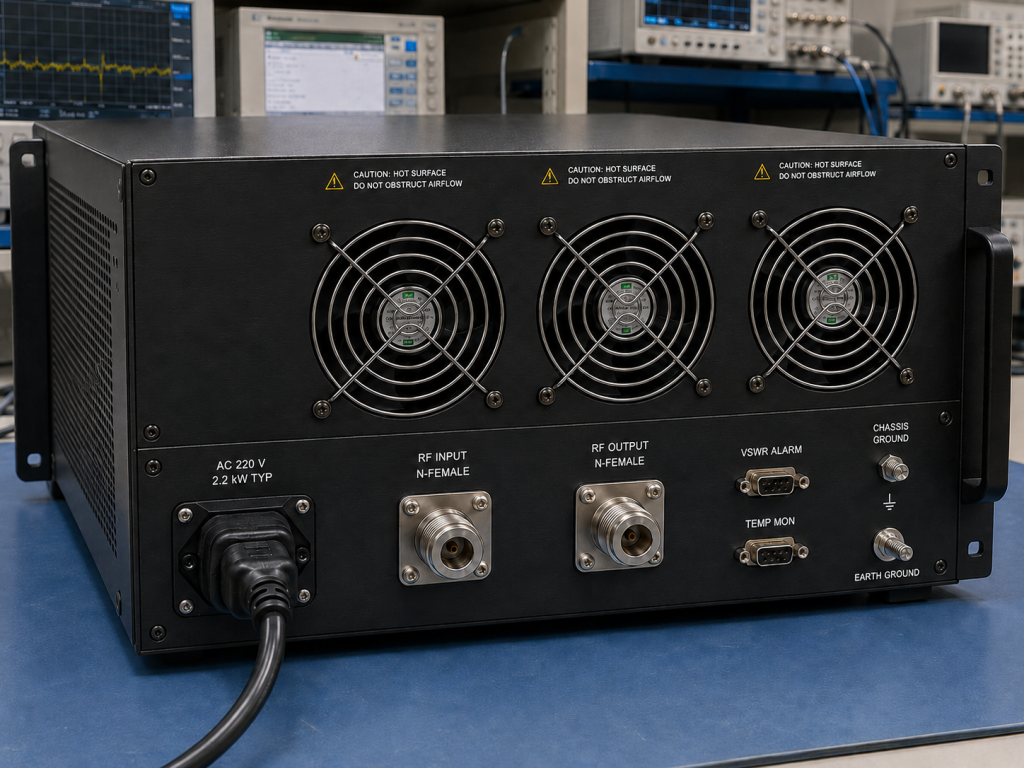
The referenced configuration lists 400 W rated output power, 57 dB minimum gain, -3 to +3 dB small-signal gain flatness, up to 20 dB gain control, 50 ohm input impedance with 2.0:1 input VSWR, 0 dBm maximum input power, -15 dBc harmonics, and -60 dBc spurious performance. It uses N-Female input and output connectors and AC 220 V power.
These values should be converted into a system-level power budget. Include cable loss, coupler insertion loss, transducer factor, mismatch uncertainty, and required test margin. If the test setup has multiple fixtures, define which fixtures will be used for formal acceptance and which are engineering-only accessories.
Rack, Cooling, and Power Planning
The CRF-PA-9K250M-400W is listed as a 19-inch 5U rack-mount unit with 40 kg typical weight, 2.2 kW typical power consumption, and air cooling. That makes rack planning important. Confirm floor or rack loading, AC capacity, airflow, service clearance, and heat removal from the room.
Air cooling is simpler than liquid cooling, but it still requires clean intake air and unobstructed exhaust. If the amplifier is installed in a shielded room, rack cabinet, or mobile enclosure, check whether recirculated hot air could reduce operating margin. Temperature monitoring should be visible to the operator or logged by the host controller.
Monitoring and Protection Features
The source data lists real-time temperature monitoring, real-time current monitoring, optional forward/reverse power monitoring, optional LAN remote monitoring, optional input power detection, and protection for over-temperature, over-current, over-voltage, and VSWR alarms. Those features help turn the amplifier into a managed subsystem.
For automated EMC sweeps, alarm handling should be deterministic. If the amplifier reports a VSWR alarm, the software should stop the RF source, record the frequency and level, and prompt inspection of the fixture or load. If over-temperature appears, the system should pause safely rather than continuing a sweep that cannot be completed within thermal limits.
EMC Test Integration Checklist
A practical checklist includes amplifier output power verification, gain flatness, gain control response, harmonic/spurious checks, remote RS485/LAN command verification, alarm reporting, cooling behavior, and load mismatch behavior within approved limits. For EMC use, also document the calibration chain and the exact transducers used during the test.
Because the amplifier covers a very wide low-frequency span, do not assume one fixture behaves the same across the entire band. Review each antenna, CDN, clamp, transformer, or injection accessory against frequency and power limits. A custom RF amplifier review can also clarify whether optional monitoring or control interfaces should be added for the intended lab automation system.
Buying Questions for Procurement Teams
Before procurement, ask for the final mechanical drawing, control protocol, available test data, monitoring options, and documentation support for the destination market and application. Provide the sweep range, required levels, load type, operating duration, expected VSWR, rack environment, and interface preferences. The more accurately the use case is described, the easier it is to match the amplifier configuration to the actual test process.
FAQ
What frequency range does this EMC amplifier cover?
The referenced CRF-PA-9K250M-400W covers 9 kHz to 250 MHz.
What output power is specified?
The source specification lists 400 W rated output power.
What technology is used?
The source data identifies this platform as an LDMOS SSPA.
What control interface is listed?
The referenced configuration lists RS485 / LAN control.