
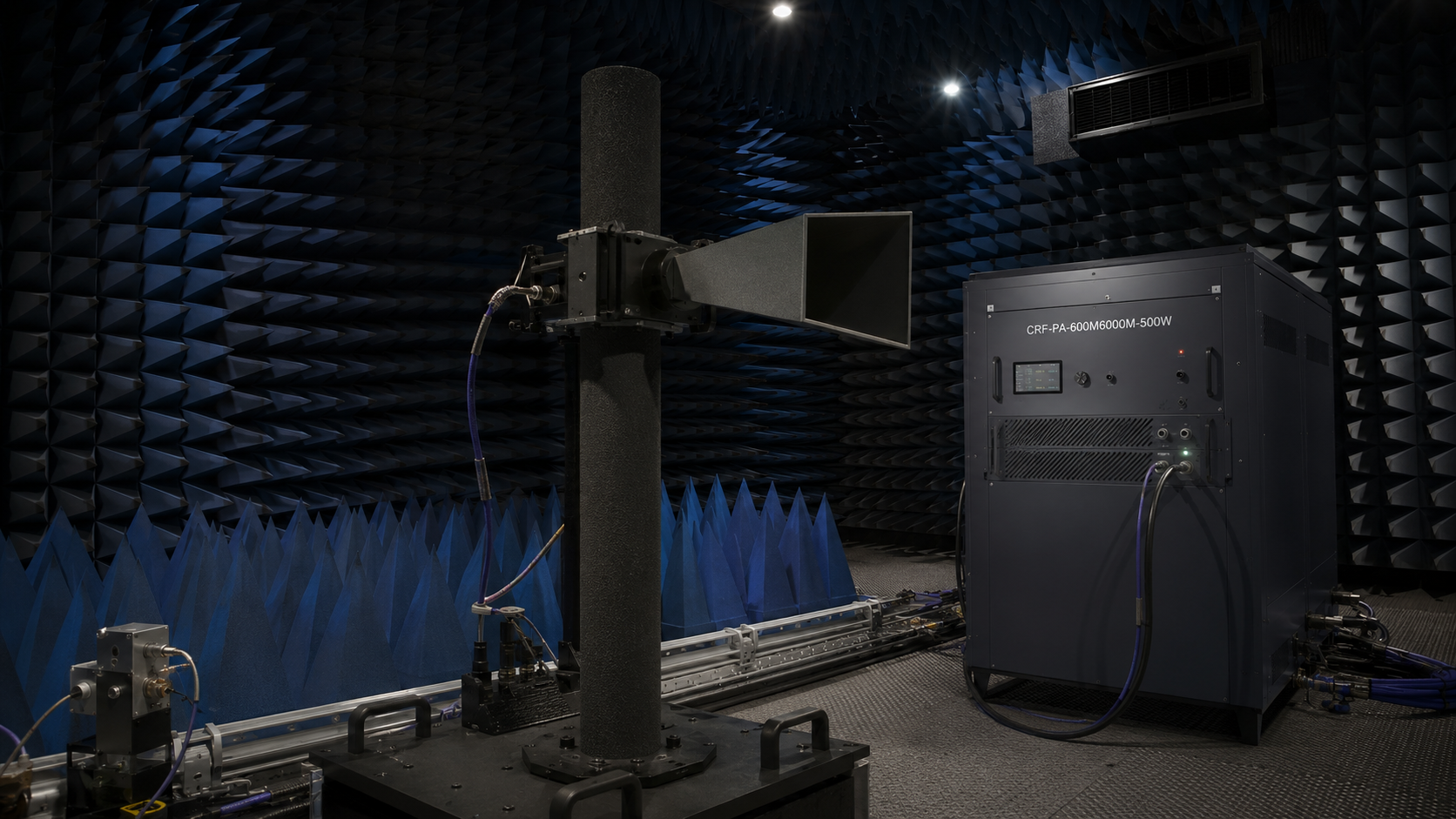
Relevant CorelixRF Products
| Product reference | Frequency range | Output power | Gain | Integration notes |
|---|---|---|---|---|
| CRF-PA-600M6000M-500W | 600-6000 MHz | 500 W | 60 dB min. | Cabinet, N-Female input, 7/16 output, RS485/LAN, liquid cooling |
Why EMC Labs Need a Different Amplifier Checklist
An 0.6-6 GHz EMC RF amplifier is usually evaluated inside a larger radiated immunity or RF susceptibility setup. The amplifier has to work with signal generators, directional couplers, field probes, antennas, chamber losses, interlocks, and test software. Because the test objective is repeatable field strength rather than only amplifier output power, selection should begin with the full test path.
CorelixRF source specifications list the CRF-PA-600M6000M-500W as a GaN solid-state RF power amplifier covering 600 MHz to 6000 MHz with 500 W rated output power and 60 dB minimum small-signal gain. The platform uses an N-Female input and 7/16 output, supports RS485/LAN control, operates from AC 380 V +/-10%, and is described as a liquid-cooled cabinet measuring 900 x 565 x 1300 mm. It includes temperature and current monitoring, optional forward/reverse power monitoring, optional LAN remote monitoring, and protection functions for over-temperature, over-drive, over-voltage, and VSWR alarm conditions.
Match the Amplifier to the Test Standard and Antenna Path
The first selection step is to map the required field levels, frequency points, dwell time, modulation, antenna factors, chamber loss, and margin. A 500 W broadband RF power amplifier may be more than enough in one chamber and insufficient in another because antenna gain and path loss dominate the final field strength. EMC teams should avoid choosing the amplifier from power alone. A better request includes the frequency span, antenna set, target field strength, distance, modulation, and expected test duration.
The 600 MHz to 6 GHz range is useful because many labs want one amplifier platform to cover multiple antenna bands. A single wideband amplifier can simplify cabling and automation, but engineers should still review gain flatness and correction tables. The source data lists gain flatness of -5 to +5 dB, so software leveling and calibration planning remain part of the system design.
Power, Gain, and Input Drive Discipline
The CRF-PA-600M6000M-500W specification lists 60 dB minimum small-signal gain and maximum input power of 0 dBm. That combination supports low drive requirements, but it also means drive control must be treated seriously. Overdrive risk can come from manual source settings, software mistakes, or switching transients. For a lab that runs automated sweeps, the amplifier should be sequenced with RF-off states, interlock checks, and conservative source-level limits.
The same review applies to harmonics and spurious output. The source specification lists harmonics to -10 dBc and spurious performance to -60 dBc. Depending on the test standard and measurement setup, external filtering, coupler placement, or monitoring may be required. The amplifier vendor should be given the application context so the project review can address the actual test path, not only the amplifier nameplate.
Cooling and Cabinet Planning
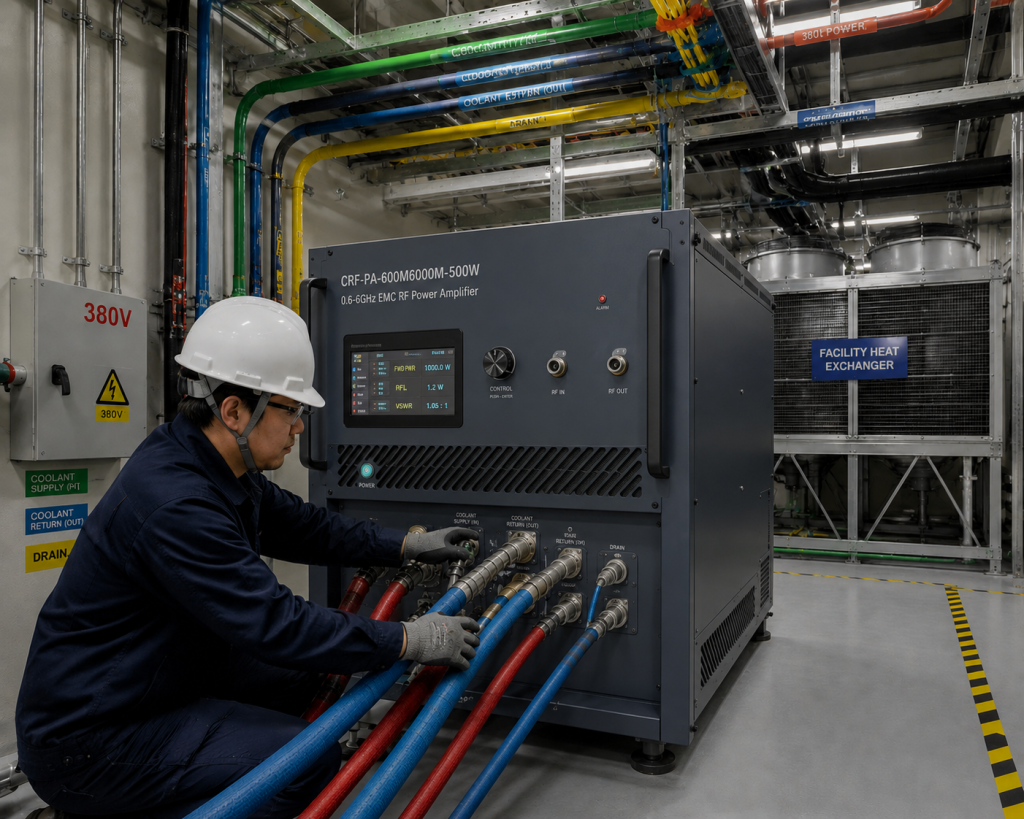
High-power EMC testing often runs long dwell times, which makes cooling a primary selection item. The CorelixRF source data identifies this 500 W platform as a liquid-cooled cabinet. Liquid cooling can help manage thermal load in a compact high-power setup, but the facility must be ready for coolant routing, service access, ambient temperature, cabinet placement, and maintenance procedures. The amplifier should not be squeezed into a chamber-side corner without airflow and service clearance.
A liquid-cooled GaN SSPA also needs practical operating rules. Who checks coolant status? How are alarms logged? What happens if a test script continues after a temperature alarm? A strong procurement package asks these questions before the amplifier is installed.
Controls, Monitoring, and Lab Automation
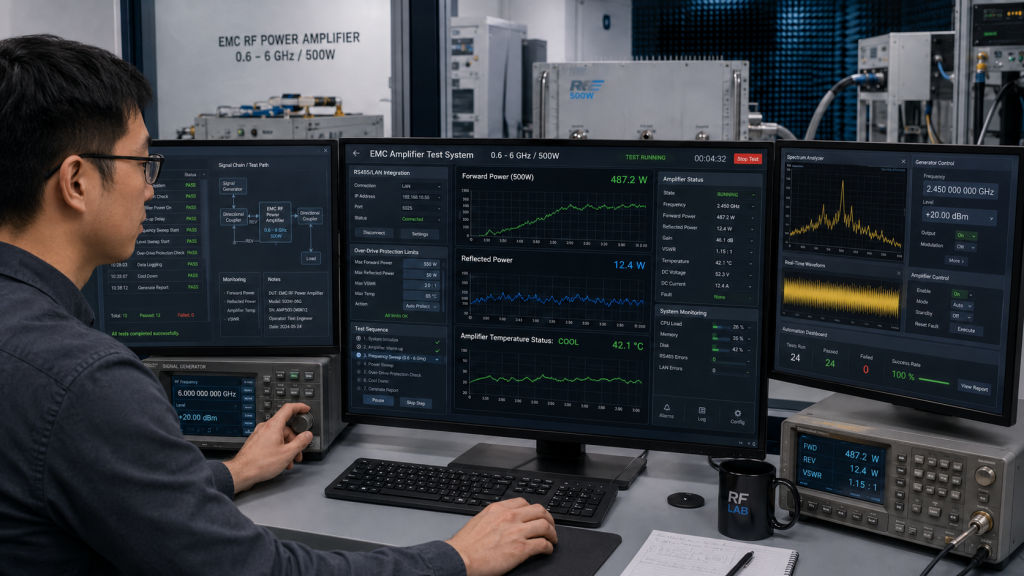
The listed RS485/LAN interface is useful for EMC labs because many tests are run from automation software. At minimum, engineers should review how to enable RF output, set gain, read alarm states, and record temperature/current conditions. If forward/reverse power monitoring is included in the final configuration, it can help diagnose antenna mismatch, cable problems, or chamber setup errors.
For CorelixRF programs that need lower-frequency product matching, the public 300-1700 MHz amplifier and 300-2700 MHz amplifier pages can be used as starting points. For broader or higher-frequency projects, the main RF amplifier product category is the safest internal destination while the exact project configuration is reviewed.
Application Fit
A 0.6-6 GHz EMC RF amplifier is a strong fit for radiated immunity, RF interference testing, communication system stress testing, and broadband lab platforms where repeatability matters. It is not enough to specify “500 W amplifier” in the request. Include the frequency plan, field target, modulation, duty cycle, chamber details, antenna list, and required control interface. That lets CorelixRF review whether the published platform, a related platform, or a custom configuration is the best match.
FAQ
What is the focus keyword for this article?
The focus keyword is 0.6-6 GHz EMC RF amplifier.
What CorelixRF model is referenced?
The article references CRF-PA-600M6000M-500W, a 600 MHz to 6 GHz, 500 W GaN SSPA platform.
Why does cooling matter in EMC testing?
Radiated immunity tests can require long dwell times and repeated sweeps, so the thermal system must support the expected operating profile.
Does the source specification list LAN control?
Yes. The source data lists RS485/LAN control and optional LAN remote monitoring.
Should the amplifier be selected by wattage alone?
No. Engineers should review chamber loss, antenna gain, target field strength, modulation, duty cycle, and calibration margin.