
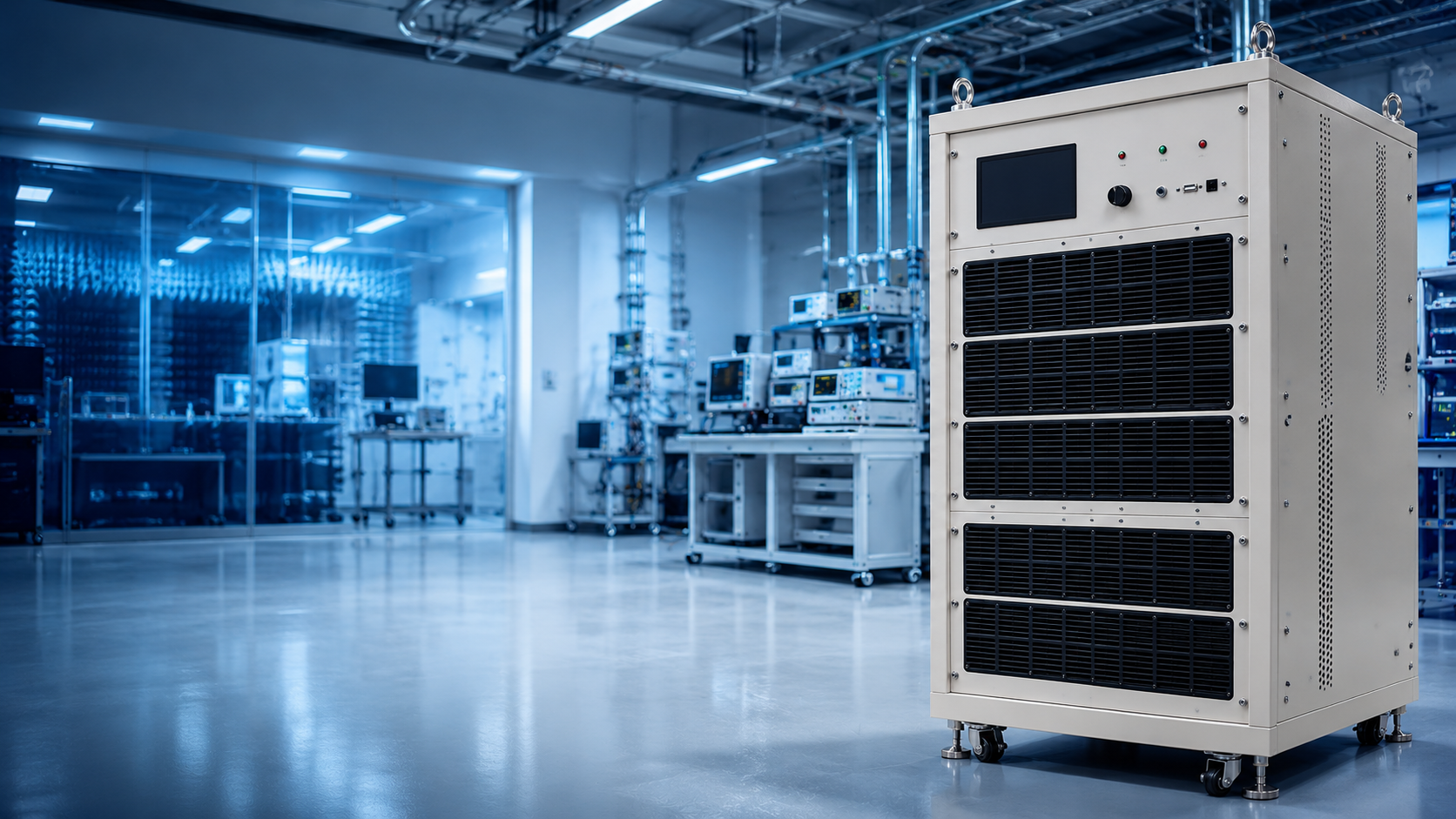
A 2.9-3.5 GHz 25 kW pulsed RF amplifier is not just an RF line item. It touches facility power, cooling water, waveguide routing, timing architecture, safety procedure, and acceptance testing. CorelixRF CRF-PA-2900M3500M-25000W is specified for 2,900-3,500 MHz operation with 25 kW rated peak output power, 200 us typical pulse width, 20% duty cycle, 74 dB minimum gain, N-Female input, WR284 output, RS485 / LAN control, AC 380 V three-phase power, and water cooling.
This article is written for engineering buyers who need to turn a high-power S-band requirement into a review-ready specification.
Why Pulse Conditions Define the Amplifier Choice
At 25 kW peak output, frequency and wattage are only the beginning. The duty cycle creates a large average power and thermal requirement, while the WR284 output, cabinet format, and 380 V supply affect the facility. The amplifier must be reviewed as an integrated system.
CorelixRF’s public article on how to specify a 25 kW pulsed RF amplifier emphasizes the same procurement point: peak power alone is not enough. Buyers need pulse, cooling, waveguide, timing, control, and documentation details before choosing a platform.
How Engineers Should Review This Pulsed RF Amplifier
Start with the pulse definition. The datasheet lists 200 us typical pulse width and 20% duty cycle. If the project changes either number, the thermal load, cooling loop, facility power, and protection response may change.
The 74 dB minimum gain and 5 dBm maximum input power require careful source control. Automated test systems should include interlocks, attenuation, measured input power, and clear enable logic.
Confirm peak power, pulse width, and duty cycle together
Confirm whether the full 2.9-3.5 GHz range is required. If the project only operates around a narrower S-band section, the acceptance plan should still specify measured output, spectrum, and protection behavior at the actual frequencies.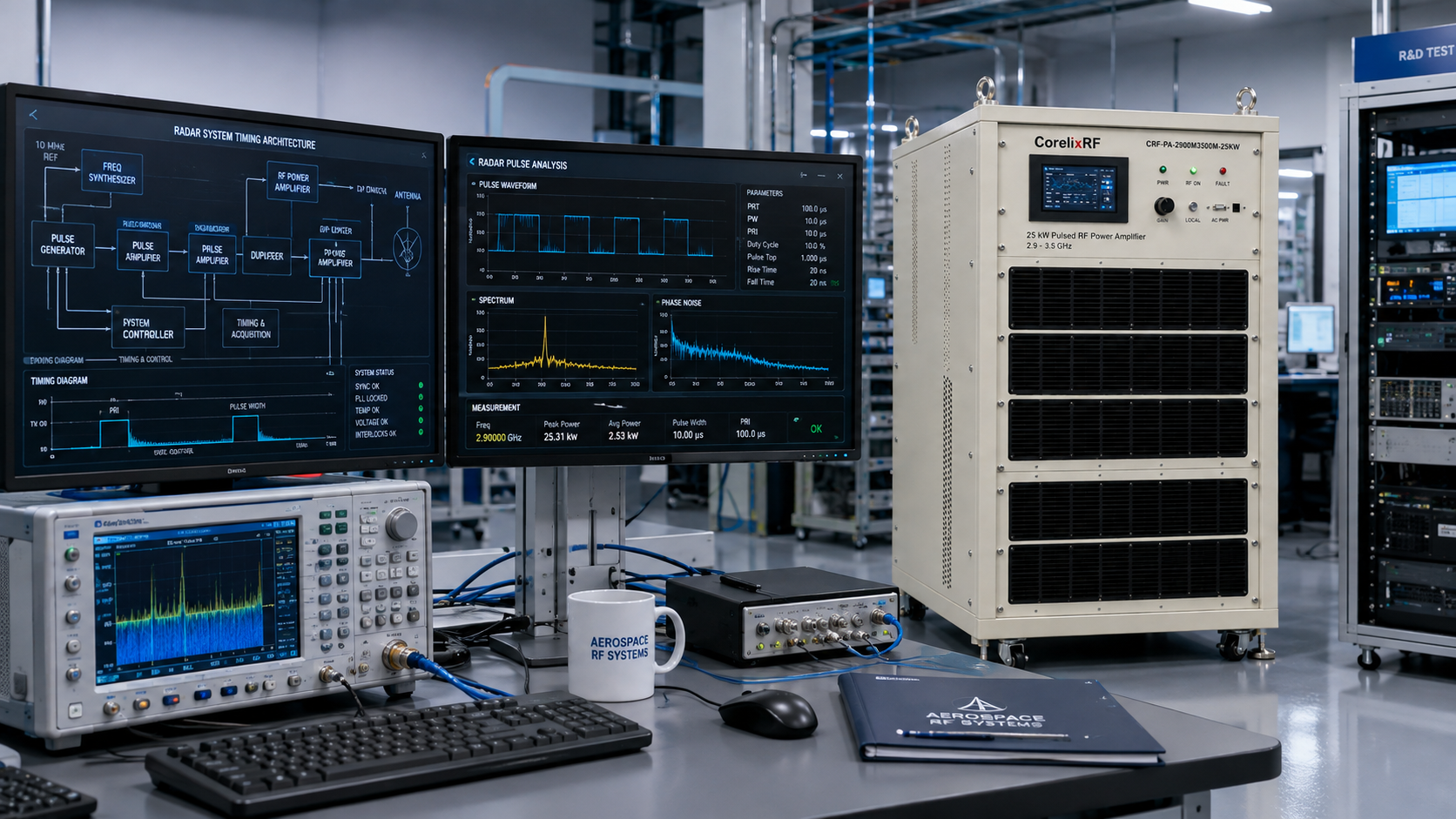
Review the RF interface and load path early
WR284 output means the downstream path is a waveguide system, not a generic coaxial output. Waveguide layout, flange alignment, load rating, bends, couplers, and calibration plane should be reviewed before cabinet placement is finalized.
Treat cooling and facility requirements as RF requirements
Water cooling and 22,000 W typical power consumption make facility readiness part of the RF specification. Cooling capacity, flow, inlet temperature, power distribution, cabinet movement, and service clearance should be confirmed before purchase approval.
Integration Notes for Test, Radar Simulation, and RF System Validation
This model can support high-power S-band laboratory validation and controlled system-level RF testing where facility planning and safety procedures are established. The article should avoid operational promises and keep claims tied to datasheet review.
For buyers still comparing smaller S-band platforms, CorelixRF’s pulsed amplifier platform page provides lower-power starting points before moving to cabinet-level peak power.
Control, monitoring, and protection planning
RS485 / LAN control should be integrated with status monitoring, alarms, enable logic, and data logging. Optional forward/reverse power monitoring and input detection should be considered for high-value test setups.
RFQ details to prepare before requesting a recommendation
Before asking for a quote, provide frequency range, target peak output power, pulse width, duty cycle, pulse repetition behavior, input drive level, connector preference, load VSWR, cooling method, control interface, monitoring requirements, mechanical envelope, and required acceptance documents. CorelixRF’s RF amplifier RFQ checklist is the practical place to turn these points into a review package.
Where This Model Fits in CorelixRF’s Pulsed Platform Path
CRF-PA-2900M3500M-25000W is a facility-level S-band pulsed amplifier. It is most relevant when the buyer already knows that cabinet power, water cooling, waveguide output, and 25 kW peak class are required.
Use CorelixRF Contact to request project review with pulse, cooling, facility, waveguide, control, and documentation requirements.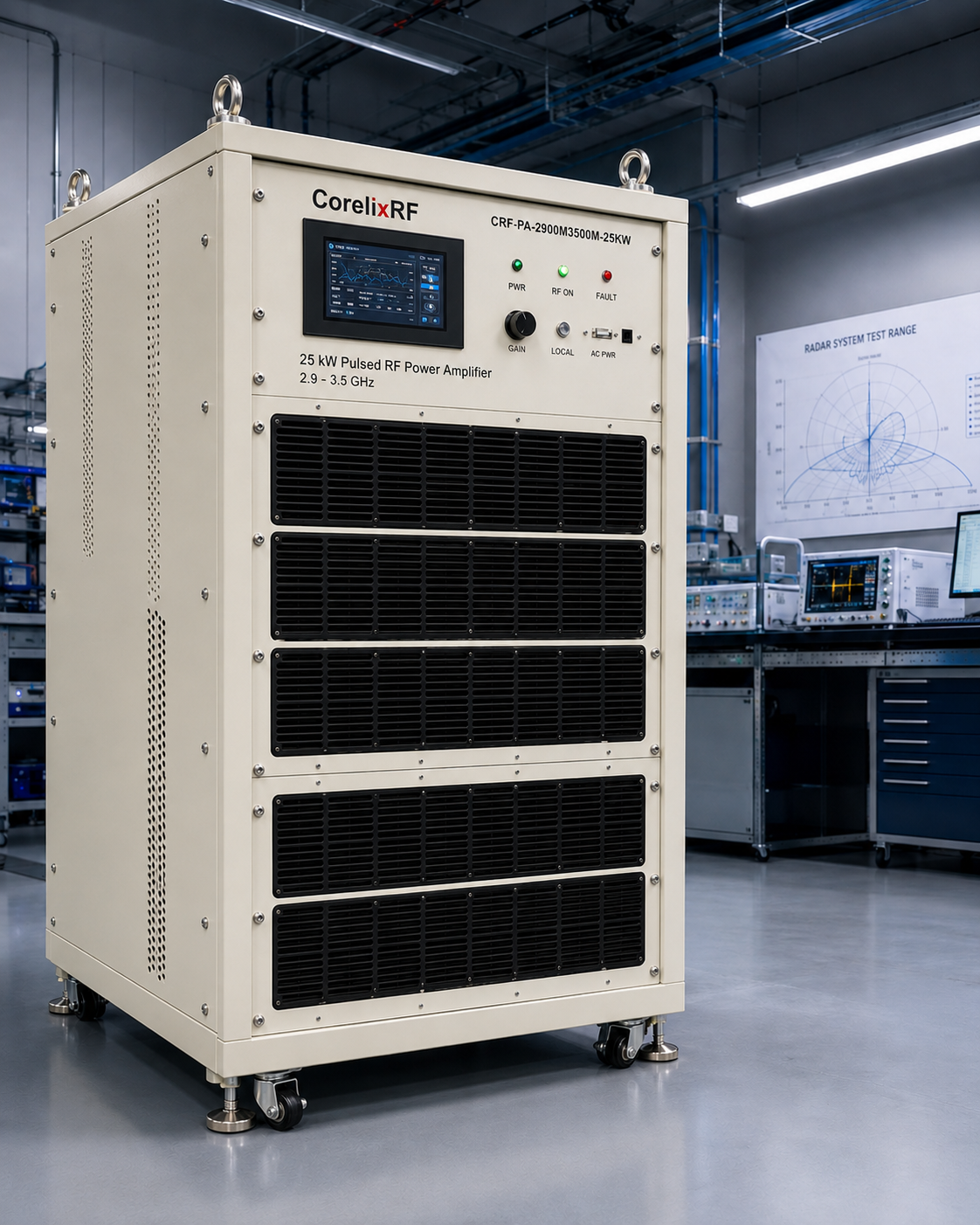
FAQ
Is CRF-PA-2900M3500M-25000W a pulsed RF power amplifier?
Yes. The local datasheet identifies it as a solid-state pulsed RF power amplifier and lists model-specific pulse width and duty cycle conditions.
Can the pulse width or duty cycle be changed?
Pulse conditions are project-sensitive. The datasheet values should be treated as the supplied configuration baseline; any different pulse width, duty cycle, timing behavior, or thermal margin should be reviewed with CorelixRF before quotation.
What information matters most for a pulsed amplifier RFQ?
Frequency, peak output power, pulse width, duty cycle, pulse repetition behavior, source drive level, load VSWR, cooling method, control interface, and acceptance test points matter more than a single wattage number.
Does this article claim stock, certification, or customer results?
No. It only uses the local CorelixRF datasheet and public CorelixRF platform direction. Stock, lead time, compliance documentation, and project test data must be confirmed directly by CorelixRF.
Where should buyers send requirements?
Use the CorelixRF Contact page and include frequency, pulse condition, power, cooling, interface, mechanical, and documentation requirements.