
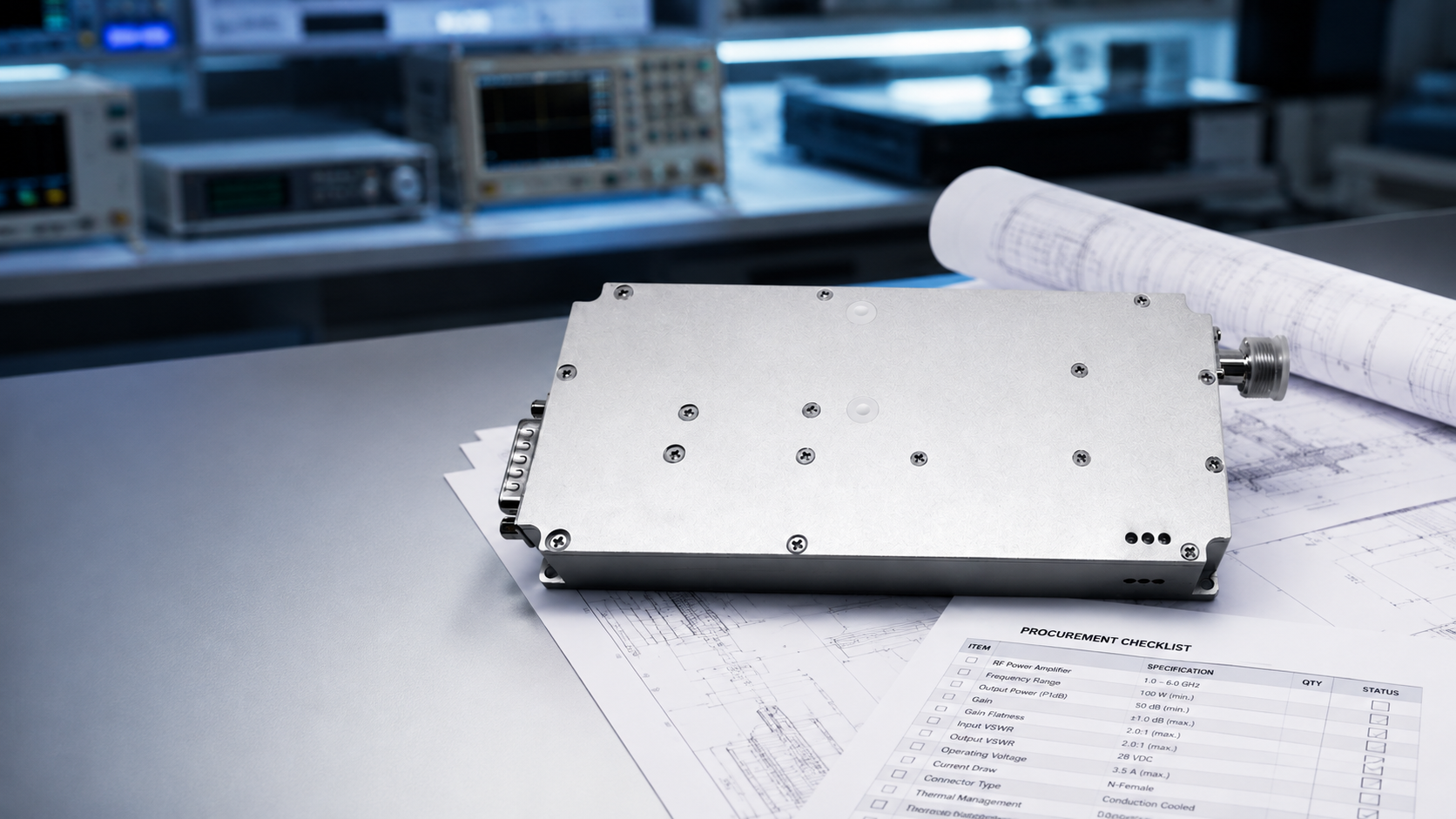
A quotation for the CorelixRF CRF-PA-20M1000M-100W-M needs to distinguish the amplifier module from the power supply, cooling assembly and RF accessories around it. The referenced configuration covers 20 MHz to 1 GHz with 100 W minimum rated RF output. Whether that is a useful purchase depends on the power required at the fixture and on which integration parts are included in the order. For the corresponding procurement or handoff decision, use Buying a 100 W RF Amplifier: Check Output Before You Order.
Define what the module quotation includes
| Item | Specified configuration | Question for the quotation |
|---|---|---|
| RF coverage / output | 20–1,000 MHz; 100 W minimum rated output | State the required frequencies, waveform and output reference plane. |
| RF ports / drive | N-F input and output; 0 dBm maximum input | Identify the mating cables, load and source-side attenuation. |
| DC supply | 36 V nominal; +28–40 V at the four-pin power interface | Request supply-current, startup and harness requirements. |
| Mechanical / cooling | 250 × 120 × 30 mm module; external heatsink with forced-air cooling | Confirm the complete cooled assembly, mounting and access envelope. |
The electrical values use a 50 Ω system, rated input supply and the standard production test configuration. The module dimensions do not include a guaranteed complete cooling-system envelope. Ask whether the heatsink, fan, mounting hardware, DC supply and control harness are supplied or must be provided by the integrator. List those parts explicitly in the quotation.
Put the required power at a named reference plane
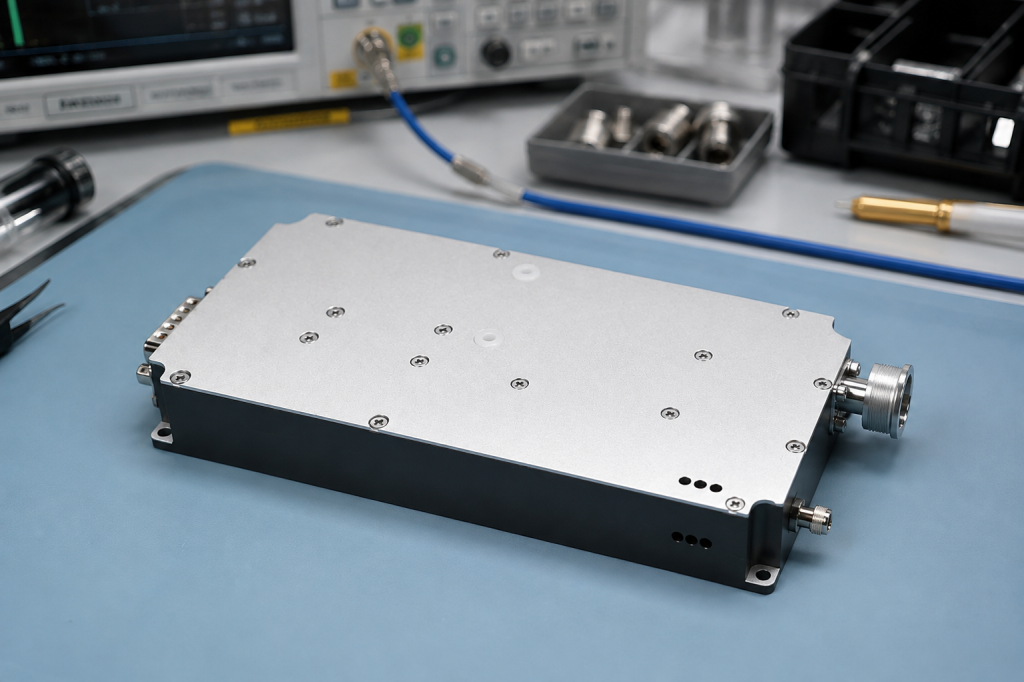
State whether 100 W is required at the amplifier output, after a cable, or at the fixture input. Cable, switch and coupler loss lowers downstream power; when working backward from a fixture requirement, add the path loss in dB to the required power in dBm. Include the frequency points where that loss is largest. This gives the supplier a requirement to compare with the module specification.
For a continuous or swept application, record dwell time, leveling approach, and the frequency step or sweep rate. These variables affect how useful a nominal power figure is in a real rack. The purchase file should name the frequency points that matter, rather than importing a generic requirement from another program.
The datasheet lists 50 dB minimum small-signal gain and −4 to +4 dB small-signal gain flatness. Neither establishes a constant linear 100 W output for every modulation. Provide the bandwidth, average output and distortion requirement for a modulated signal. A pulsed request also needs peak power, pulse width, repetition behavior and duty cycle; do not infer a pulse envelope from the rated-power entry.
Price the cooling and DC arrangement with the module
External heatsink forced-air cooling is a specified operating condition. Obtain the mounting and thermal requirements before choosing the heatsink or enclosing the module. The listed operating temperature is 0 to +50 °C; it is not a heatsink or junction-temperature limit. Describe the enclosure, inlet conditions and intended run duration so the installed cooling can be reviewed.
The four-pin power interface assigns pins 1/2 to +28–40 V DC and pins 3/4 to power ground, with nominal +36 V. The final harness still needs its connector view, cable requirements and current rating. The 100 W RF output value does not determine supply current by division by 36 V; DC input demand and losses are separate requirements.
Separate listed functions from ordered options
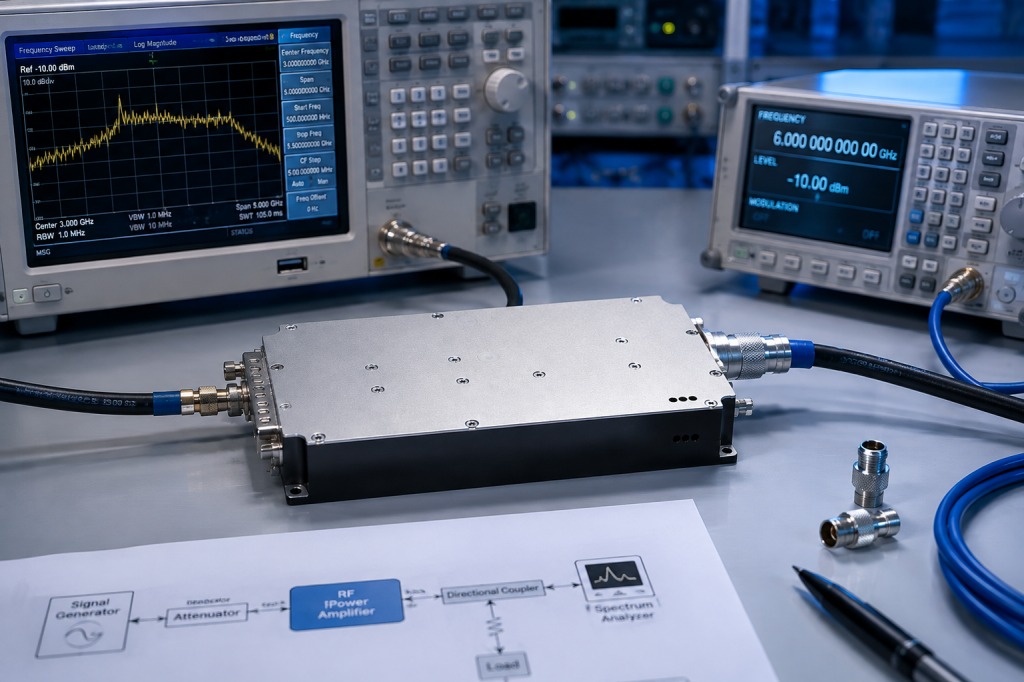
RS485 is listed for control, and the gain adjustment range is 20 dB typical. The interface page identifies DB9 control signals, including PTT and analog attenuation, but detector scaling and the full command protocol are not supplied. Request those documents before implementing remote control or assigning watts to a detector voltage.
Temperature/current monitoring is listed; the RF input/forward/reverse detection interface is optional. Over-temperature, over-drive, over-voltage and VSWR protection with alarms are listed, without numerical trip or reset details. Put the required monitoring outputs, alarm response and supplied documentation in the quotation instead of assuming every possible function is standard.
Request data that answers the purchase decision
Ask for results at the required frequencies with input level, output reference plane, waveform, supply, load, cooling and run duration recorded. Keep specification limits and measured results in separate fields. The guide to evaluating amplifier test data explains the broader evidence request; for this module, the output and thermal conditions must match the proposed cooled assembly.
Compare CorelixRF amplifier options if the required band or output definition does not fit. For a CRF-PA-20M1000M-100W-M quotation, send the fixture-plane requirement, path loss, waveform and run duration, then identify the supply, heatsink/fan and control items expected in the delivery. Ask for a clear configuration and attachment list before comparing prices.