
RF amplifier stages are best distinguished by the signal they receive and the task required by the next stage. The same word gain does not make a receiver front end, a driver, and a final power stage interchangeable.
Identify the input and the next stage
Record what signal arrives and what the next consumer needs in level, noise, distortion and interfaces. If the PA’s basic energy and signal task is unclear, start with what an RF power amplifier does; the role comparison below begins from the next-stage requirement.
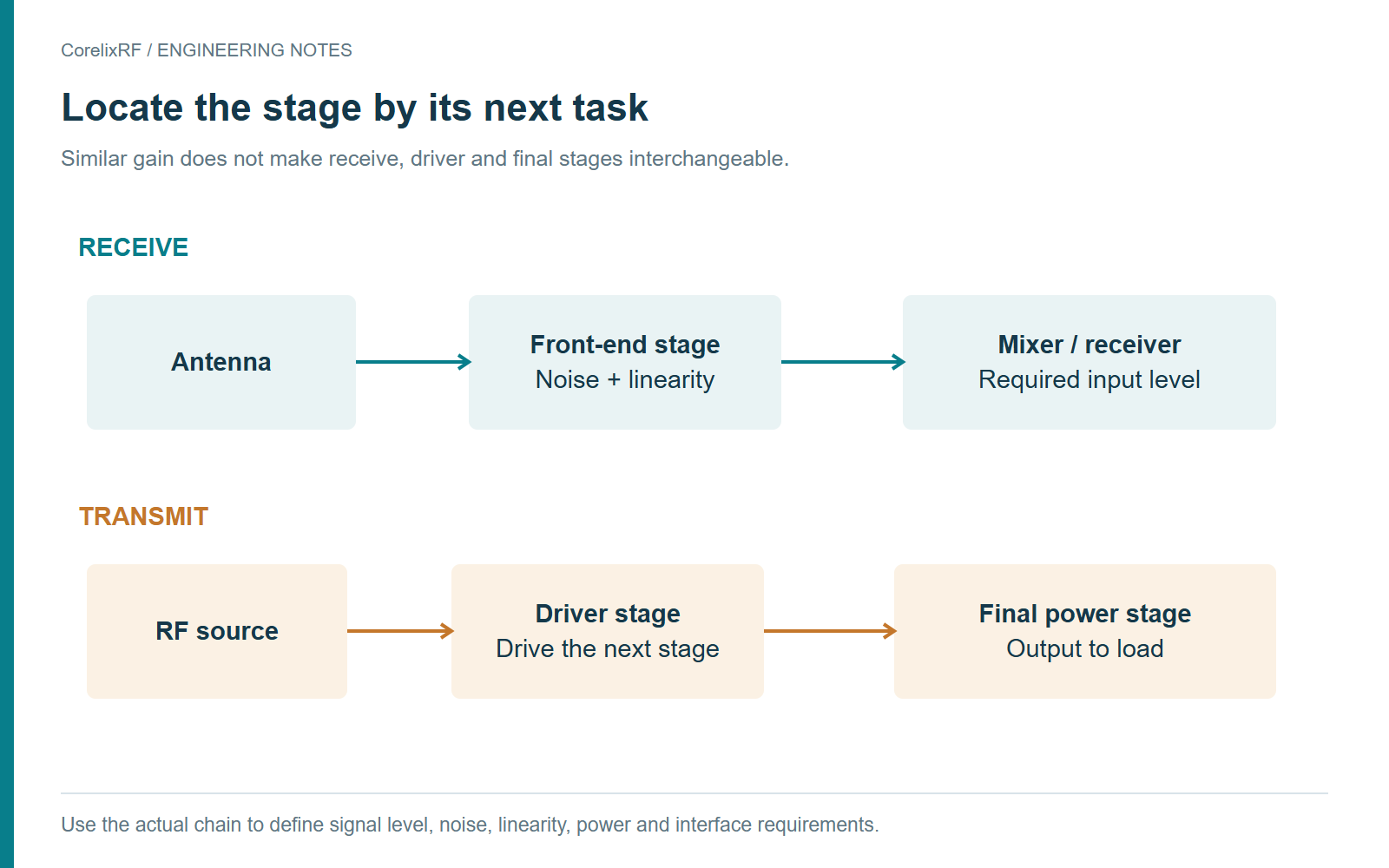
These roles are not mutually exclusive enclosure types. The same module may serve a different role in another configuration only if its documented noise, output, linearity and interfaces support that next-stage task.
Read the output label carefully
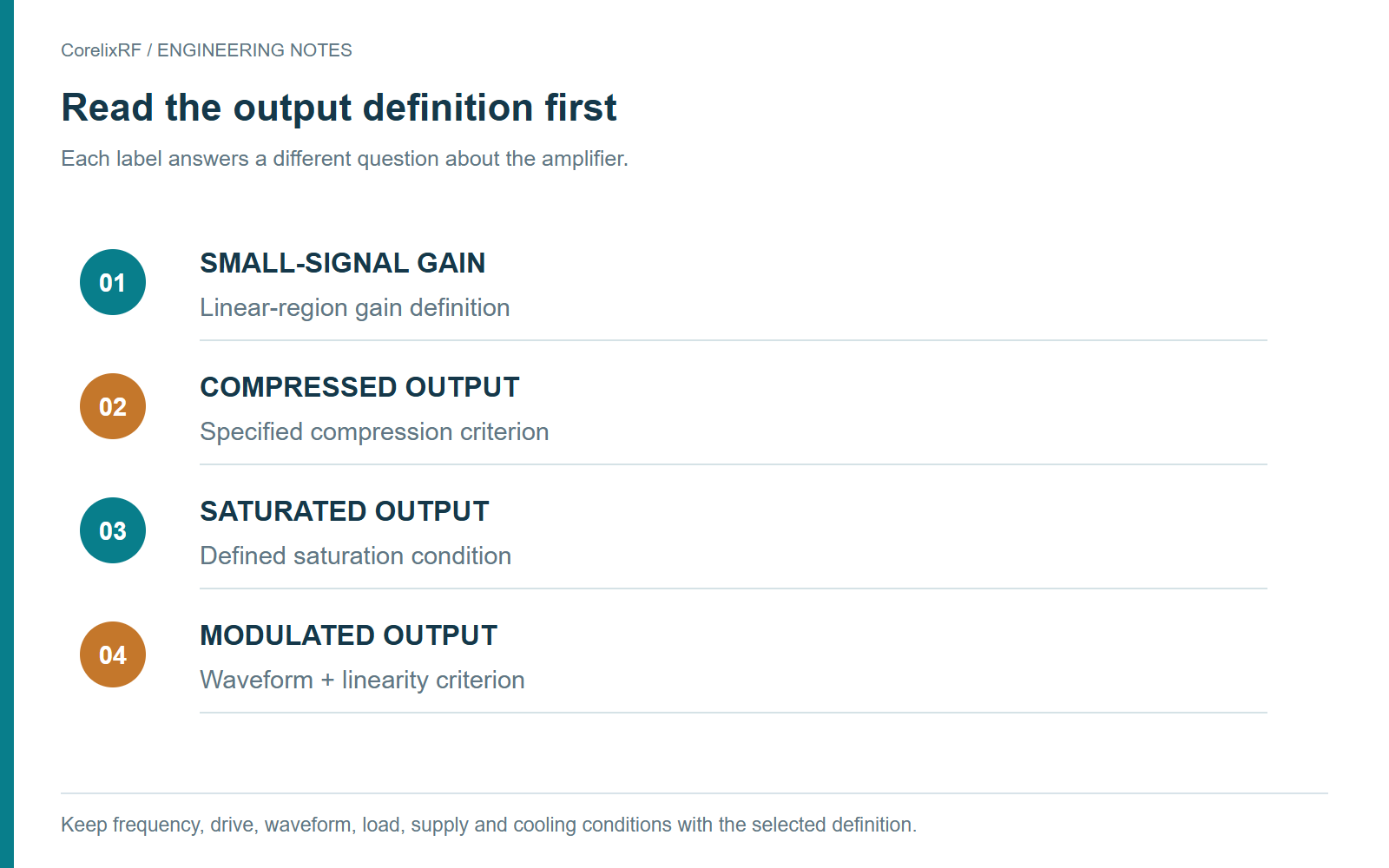
Small-signal gain, compressed output, saturated power, and acceptable modulated output describe different operating conditions. A maximum input rating is not the same as the drive needed for a required linear output. Preserve the metric and its conditions when comparing products.
The PA-versus-LNA comparison explains their different output and noise objectives. Interpret each specification at the actual stage rather than transferring one role’s limit to another.
Turn the function into a requirement
Write one sentence stating what the stage must receive and deliver, then attach frequency, waveform, gain, noise or linearity needs, supply, cooling, and interface constraints. Mark unknowns for resolution.
Identify the stage by its next task
Use the output consumer to clarify the amplifier role. Product names alone may not describe the system boundary.
| Stage | Primary question | Next information needed |
|---|---|---|
| Receiver front end | How much noise is added while amplifying the wanted input? | Use the receiver cascade budget for input loss, downstream noise and strong-signal conditions |
| Driver | Can the final stage receive the required drive? | Use the RF amplifier gain budget for interstage losses, required drive and permitted input |
| Final power stage | Can the load receive the required usable RF output? | Output definition, waveform, load, supply and cooling |
Use the applicable output definition and operating conditions for the final stage. Similar gain numbers across the three roles do not make their acceptance tasks interchangeable.
That functional brief is the input to a complete amplifier requirement. Choosing a family name alone does not complete selection or prove the behavior of the whole chain.
If the required role is a transmit power stage, continue to the RF power amplifier product categories with the completed brief. Receiver LNA requirements need a separately matched product; a transmit-amplifier category does not answer the noise requirement.
Describe the signal-chain function, source and load interfaces, and required level change for the amplifier stage.
Discuss Amplifier Stage Functions