
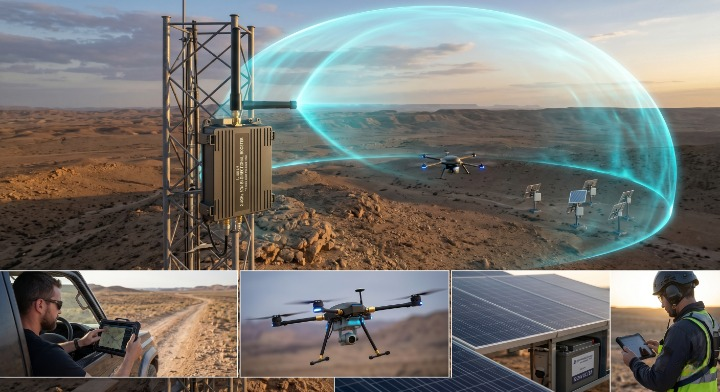
A 2.4GHz 50W bi-directional signal booster eliminates dead zones by actively amplifying both outgoing transmission and incoming reception data paths. You often face the frustration of dropped video feeds and sluggish IoT responses when your equipment lacks the raw power to penetrate thick walls or traverse vast industrial distances. This instability can lead to catastrophic mission failures or security breaches in critical environments. By integrating a high-power Anti-Drone Jammer Module with professional-grade amplification, you can finally reclaim control over your wireless spectrum and ensure seamless connectivity.
Turn wireless coverage gaps into an RF amplifier and antenna plan
For 2.4 GHz coverage gaps or booster-style RF links, CorelixRF can review amplifier output power, antenna selection, cable loss, duty cycle and integration risk before hardware selection.
Why is 2.4GHz Signal Strength Crucial Today?
Strong 2.4GHz signals are the primary requirement for maintaining the integrity of modern wireless infrastructure and long-range UAV communications. Without sufficient power, even a high-end Anti-Drone Jammer Module cannot effectively secure a perimeter against unauthorized intrusions. You need a robust RF link budget to ensure your data reaches its destination without interference.
The Backbone of Modern Wireless Infrastructure
This frequency band serves as the invisible foundation for everything from smart sensors to professional drone control links. You must prioritize signal stability to prevent the costly downtime associated with connectivity gaps.
Think about this:
- Reliability supports automated warehouse logistics.
- High gain ensures security cameras never lag.
- Range extension permits remote asset monitoring.
Here is the kicker: without a powerful booster, your infrastructure is only as strong as its weakest dead zone.
Overcoming Physical Obstacles in Industrial Sites
Concrete walls and metal shelving act as significant barriers that degrade your wireless signal quality rapidly. You can browse standard RF platforms to find solutions that punch through these heavy industrial obstructions.
Let’s face it:
- Dense materials absorb standard Wi-Fi energy.
- Multipath interference creates unpredictable signal drops.
- Distance attenuates low-power consumer signals.
Believe it or not, 50W of power provides the necessary energy to overcome the most challenging architectural shielding.
Key Takeaway: Maintaining 2.4GHz strength is essential for industrial reliability and professional drone operations where physical barriers otherwise cripple performance.
What Makes a Bi-Directional Booster Different?
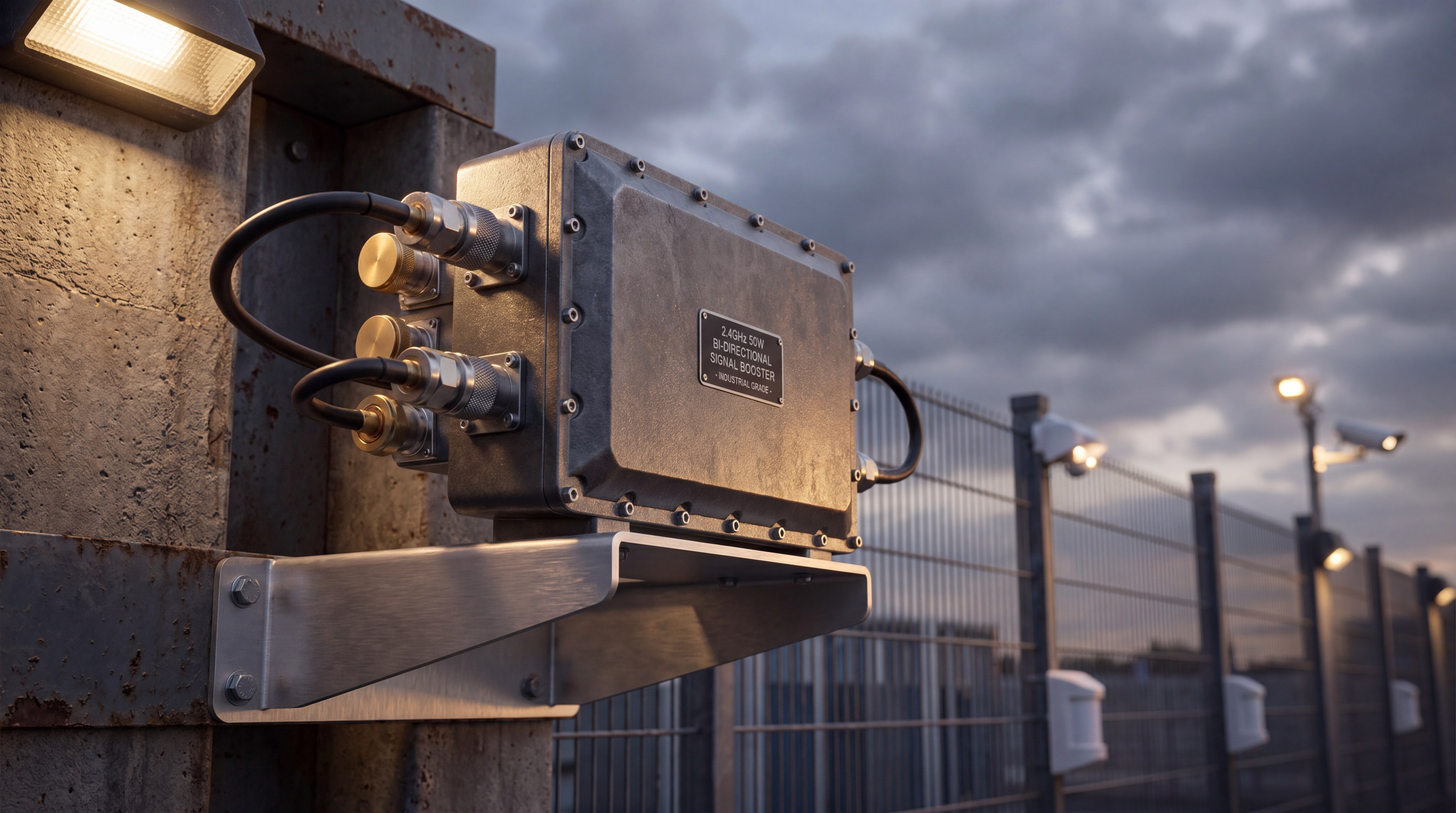
A bi-directional booster differs from standard amplifiers by strengthening the signal in both the transmit and receive directions simultaneously. This two-way enhancement is vital when using an Anti-Drone Jammer Module to both send disruption signals and maintain clear telemetry. By addressing both sides of the conversation, you eliminate the “shouting but not hearing” problem common in low-power systems.
Transmit vs. Receive: Why Both Matter?
Boosting only the transmission power allows your device to “speak” farther, but it doesn’t help it “hear” the returning data. You need 15dB of receiving gain to pull in weak signals from distant sensors or drones.
Think about it:
- TX gain extends your operational control range.
- RX gain improves the sensitivity of your receiver.
- Balanced gain prevents one-way communication failures.
The best part? This symmetry ensures that your high-definition video feeds remain crisp even at extreme distances.
Achieving Low-Latency Communication
Real-time applications demand near-instantaneous switching between sending and receiving modes to avoid data collisions. You must ensure your hardware can handle sub-microsecond switching speeds for high-speed digital links.
But wait, there’s more:
- Low latency is critical for FPV racing drones.
- Fast switching supports high-speed industrial IoT.
- Precision timing prevents packet loss during handoffs.
Here is the truth: bi-directional logic is the only way to maintain a truly responsive wireless environment.
| Feature | Bi-Directional Booster | Standard Amplifier |
|---|---|---|
| Signal Path | TX and RX (Two-Way) | TX Only (One-Way) |
| RX Gain | 15 dB | 0 dB |
| Application | Real-time Control/UAV | Simple Transmission |
This table demonstrates that bi-directional units provide a comprehensive solution for interactive data links.
Key Takeaway: Bi-directional technology ensures a complete communication loop by amplifying both transmission and reception for maximum responsiveness.
How Does 50W Power Solve Connectivity Gaps?
The 50W output power solves connectivity gaps by providing up to 60 times the strength of standard consumer-grade wireless hardware. This massive energy boost is often paired with an Anti-Drone Jammer Module to create an impenetrable wall of RF energy. You can rely on this power to bridge distances that were previously impossible to reach with standard antennas.
Understanding the 60X Power Gain Advantage
A 50W (47dBm) output provides a massive link budget increase compared to the typical 100mW found in home routers. You can explore high-gain antenna platforms to further focus this energy for specific point-to-point needs.
But that’s not all:
- Higher wattage overcomes environmental RF noise.
- Increased power allows for longer cable runs.
- Stronger signals penetrate dense foliage and trees.
The reality is that 50W changes the physics of your wireless range entirely.
Extending Range for Smart Security Systems
Large estates and commercial perimeters often suffer from cameras that drop off the network due to distance. You can use this booster to centralize your security hub while maintaining high-bitrate feeds from every corner of the property.
Here is the secret:
- Reliable feeds reduce false alarm triggers.
- Extended range covers remote gatehouse sensors.
- High power supports 4K wireless surveillance.
Think about it: a single 50W unit can replace dozens of weak mesh nodes in a large-scale deployment.
| Metric | Consumer Standard | 50W Booster |
|---|---|---|
| Power Output | 0.1 Watts | 50 Watts |
| Gain Advantage | Baseline | +24 dB (TX) |
| Max Distance | Limited to <100m | Multi-kilometer capable |
The comparison above highlights the massive leap in performance when moving to industrial-grade wattage.
Key Takeaway: 50W of power provides the raw energy needed to eliminate signal dropouts across vast distances and through dense materials.
Can This Unit Support an Anti-Drone Jammer Module?
Yes, this booster is specifically designed to work in tandem with an Anti-Drone Jammer Module for high-intensity signal neutralization. Because the 2.4GHz band is commonly used for drone control, the booster amplifies the jammer’s output to ground unauthorized aircraft. You can effectively secure restricted airspace by integrating these powerful RF components into a unified defense system.

Enhancing Anti-Drone Jammer Module Range?
A jammer is only effective if its signal is stronger than the pilot’s remote control at the drone’s location. You use the 24dB TX gain of the booster to project the disruption signal over several kilometers.
Keep this in mind:
- More power equals a larger “no-fly” radius.
- Gain stability ensures consistent jamming levels.
- High wattage overcomes drone frequency hopping.
Here is the kicker: without this amplification, a jammer module is limited to very short-range defense.
Integrating High-Power RF Components
Successful integration requires careful matching of input power and thermal dissipation between the module and the booster. You should consult custom RF integration experts to ensure your system components work in harmony.
Think about it:
- Proper input levels prevent signal distortion.
- Shielded housings stop internal interference.
- Coordinated power supplies prevent voltage sag.
The bottom line? A well-integrated system is the only way to achieve reliable airspace security.
| Component | Role in Security | Benefit |
|---|---|---|
| Jammer Module | Signal Generation | Defines the disruption pattern |
| 50W Booster | Signal Amplification | Projects the disruption range |
| SMA Interface | Connection Point | Ensures low-loss signal transfer |
This structural breakdown shows how the booster acts as the “muscles” for the jammer’s “brain.”
Key Takeaway: Supporting a jammer module with 50W of bi-directional power creates a high-performance defense link for critical airspace protection.
What are the Critical Technical Specifications?
The critical specifications include a frequency range of 2400-2500MHz and a maximum output power of 47dBm. These parameters ensure that the Anti-Drone Jammer Module operates within the most common wireless control band globally. You must verify these specs to confirm compatibility with your existing wireless controllers and specialized receivers.

Frequency Range and Gain Stability
Maintaining a steady 24dB of gain across the entire 2400MHz band is essential for digital data integrity. You can find detailed technical insights on frequency response in our professional RF blog.
Here is the kicker:
- Gain flatness prevents signal dropouts on specific channels.
- Wide frequency coverage supports all 2.4GHz Wi-Fi bands.
- Tight tolerances ensure predictable field performance.
Think about it: inconsistent gain can cause some devices to work perfectly while others fail completely.
Automatic Switching and Thermal Management
The unit features a switching speed of less than 1µs to handle the rapid-fire nature of modern digital packets. You also benefit from an aluminum chassis designed to keep the internal components cool during prolonged 50W operation.
Don’t miss this:
- Fast switching supports high-speed data protocols.
- Thermal protection prevents power throttling in heat.
- Wide voltage input (12-24V) offers installation flexibility.
The best part? This “plug-and-play” logic removes the need for manual configuration in the field.
| Parameter | Specification |
|---|---|
| Frequency Range | 2400 – 2500 MHz |
| Max Output (P1dB) | 47 dBm (50 Watts) |
| TX / RX Gain | 24 dB / 15 dB |
| Noise Figure | < 2.0 dB |
| Operating Voltage | 12 – 24 V DC |
Analysis: These specifications define a professional-grade unit capable of high-duty cycle operations in demanding environments.
Key Takeaway: Technical precision in frequency and thermal management ensures the booster remains reliable under extreme 50W stress.
How Does it Improve FPV and Drone Operations?
It improves FPV and drone operations by stabilizing the video downlink and extending the command link beyond the visual line of sight. When an Anti-Drone Jammer Module is not being used for defense, the booster serves as a range extender for your own authorized flight missions. You will experience fewer frame drops and more responsive control even when flying behind obstacles.
Stabilizing Beyond Visual Line of Sight Links
Flying at long distances (BVLOS) requires a signal that can stay above the noise floor miles away from the ground station. You need the 24dB TX gain to push your control signals to their absolute physical limit.
Here is the kicker:
- Stronger signals resist local Wi-Fi interference.
- Increased link margin allows for safer recoveries.
- Penetration power maintains links through tree lines.
Think about it: the difference between a successful landing and a lost drone is often just a few decibels of gain.
Improving Real-Time Video Feeds
Pixelated video and high latency are the enemies of precision FPV piloting. You can use the 15dB RX gain to pull in clear video packets from a drone that is barely visible on the horizon.
Let’s be honest:
- Higher gain reduces annoying video static.
- Stable links prevent dangerous “blackouts.”
- RX sensitivity helps locate drones during landing.
But wait, there’s more: a cleaner signal means your digital video system can maintain a higher bitrate for better clarity.
Key Takeaway: Two-way amplification transforms marginal drone links into reliable, high-bandwidth connections for professional UAV missions.
Why is the <2.0dB Noise Figure Significant?
A <2.0dB noise figure is significant because it allows the booster to amplify very weak signals without drowning them in internal electronic “hiss.” This sensitivity is critical when your Anti-Drone Jammer Module is receiving telemetry from a distant unit. You must have a low noise floor to maintain a high Signal-to-Noise Ratio (SNR), which is the primary factor in data speed.
Maintaining Signal Integrity in High-Noise Areas
In urban environments, the 2.4GHz band is crowded with interference from routers, microwaves, and Bluetooth devices. You need a clean amplification path to distinguish your critical data from the surrounding background noise.
The best part?
- Low noise preserves the original wave shape.
- Cleaner signals lead to fewer packet retransmissions.
- High SNR allows for faster data modulation schemes.
Think about it: amplifying noise is just as bad as having no signal at all.
| Noise Figure | Impact on Range | Signal Quality |
|---|---|---|
| < 2.0 dB (Excellent) | Maximum sensitivity | Crisp and clear |
| > 5.0 dB (Poor) | Reduced effective range | Garbled or pixelated |
Analysis: This low noise figure places the unit in the professional category, far exceeding standard consumer signal repeaters.
Key Takeaway: A low noise figure is the secret to high-sensitivity reception, allowing you to catch weak signals that other boosters would miss.
Where Can This Booster Be Deployed Effectively?
This booster can be deployed effectively in large-scale agricultural operations, remote industrial sites, and high-security perimeters. It is an ideal companion for a high-power Anti-Drone Jammer Module in facilities that require constant protection from aerial threats. You can easily install these units in areas where traditional mesh networking is too expensive or physically impossible to implement.
Large-Scale Property Wireless Coverage
Ranches and large industrial yards often have massive dead zones where cellular and Wi-Fi signals simply cannot reach. You can use a 50W booster and a directional antenna to create a “wireless bridge” that covers several acres from a single point.
Here is the kicker:
- One unit can replace ten standard repeaters.
- High power reaches the furthest corners of the property.
- Simplified wiring reduces installation labor costs.
Let’s face it: keeping a whole facility connected with one central hub is the ultimate efficiency goal.
Point-to-Point Industrial Connectivity
Many industrial tasks require a dedicated high-speed link between two fixed buildings or towers. You can browse our technical resources to learn how to align these boosters for multi-kilometer point-to-point links.
Think about it:
- Dedicated links avoid public network congestion.
- High-power paths are more resistant to weather.
- Low-latency links support remote machinery control.
Here is the secret: a 50W bi-directional link is essentially a private, long-range wireless fiber cable.
Key Takeaway: From remote farms to high-security labs, 50W boosters provide the range and reliability required for mission-critical industrial connectivity.
What Safety Precautions Ensure Unit Longevity?
To ensure longevity, you must always connect a 2.4GHz antenna before applying DC power to the booster. Failure to do so can cause internal energy reflection that destroys the Anti-Drone Jammer Module and the booster’s power stage. You must also ensure your power supply can handle the high current demands of a 50W transmission.
Proper Antenna Connection Protocols
The most common cause of amplifier failure is running the unit into an “open” circuit without a load. You must use high-quality cables and ensure all SMA connectors are finger-tight before turning on the switch.
Listen carefully:
- Check your VSWR ratings periodically.
- Never disconnect the antenna while the unit is powered.
- Use lightning arrestors for outdoor installations.
The best part? Following these simple steps can extend the life of your booster by several years.
Power Supply Requirements for 50W Systems
A 50W output requires a significant amount of input current to maintain stability and avoid overheating. You should use a regulated DC power source capable of delivering at least 5 to 8 amps continuously.
Think about it:
- Voltage drops can cause signal distortion.
- Undersized wires will heat up and waste power.
- Clean power prevents electronic noise in your signal.
Here is the truth: your booster is only as good as the electricity you feed it.
| Safety Check | Requirement | Purpose |
|---|---|---|
| Antenna Load | Connect Before Power | Prevent internal RF damage |
| Power Supply | 12-24V / 5A+ | Ensure stable 50W output |
| Cooling | Clear Airflow | Prevent thermal shutdown |
Analysis: Rigorous adherence to these power and connection rules is the only way to protect your significant investment in RF hardware.
Key Takeaway: Longevity is guaranteed through a “load-first” power-up sequence and a stable, high-current power supply.
Is This the Right Solution for Your RF Project?
This booster is the right solution if you are dealing with extreme distances or high-interference environments that consumer hardware cannot handle. If you are building a defense system with an Anti-Drone Jammer Module, the 50W output is the industry standard for effective protection. You should evaluate your specific range requirements and environmental noise to see if this professional-grade power is necessary.

Is 50W Overkill for Your Application?
If you only need to cover a small three-bedroom apartment, a 50W unit is likely more power than you need. However, for industrial yards, farms, or drone ground stations, this level of power is the only way to guarantee a “zero dead zone” environment.
Think about it:
- 50W is for “challenging” RF environments.
- It is designed for multi-kilometer links.
- It is the preferred choice for security integrators.
Here is the kicker: having too much power is rarely a problem, but having too little always is.
Consulting with RF Engineering Experts
Every environment has unique RF characteristics like reflection and absorption. You should contact us today to discuss your specific frequency, power, and installation needs with our engineering team.
Let’s face it:
- Expert advice prevents expensive purchasing errors.
- Custom configurations solve unique site problems.
- Professional support ensures regulatory compliance.
The bottom line? Success in the wireless world depends on matching the right hardware to the real-world conditions of your project.
| Application | Recommended Power | Result |
|---|---|---|
| Indoor Office | 0.5W – 2W | Clean local coverage |
| Large Warehouse | 5W – 10W | Full floor penetration |
| Industrial / Drone | 50W | Long-range reliability |
Analysis: For users demanding the absolute maximum in range and obstacle penetration, the 50W bi-directional booster is the definitive choice.
Key Takeaway: For professional UAV, industrial, and high-security projects, the 50W bi-directional booster provides the uncompromising performance needed to eliminate dead zones forever.
Frequently Asked Questions
Can I use this booster with a 5GHz Wi-Fi network?
No, this unit is specifically tuned for the 2.4GHz band (2400-2500MHz) and will not amplify 5GHz signals.
What’s the best antenna to use for maximum range?
A high-gain directional Yagi or panel antenna is best for long-distance point-to-point links.
Can I power this from a car battery?
Yes, the wide 12-24V DC input range makes it compatible with standard vehicle electrical systems.
Is 50W safe for indoor residential use?
It is generally considered too powerful for a small home and is intended for large-scale properties or outdoor drone stations.
Can I connect two jammers to one booster?
You should use a proper RF combiner if attempting to amplify multiple signals to avoid damaging the internal modules.