
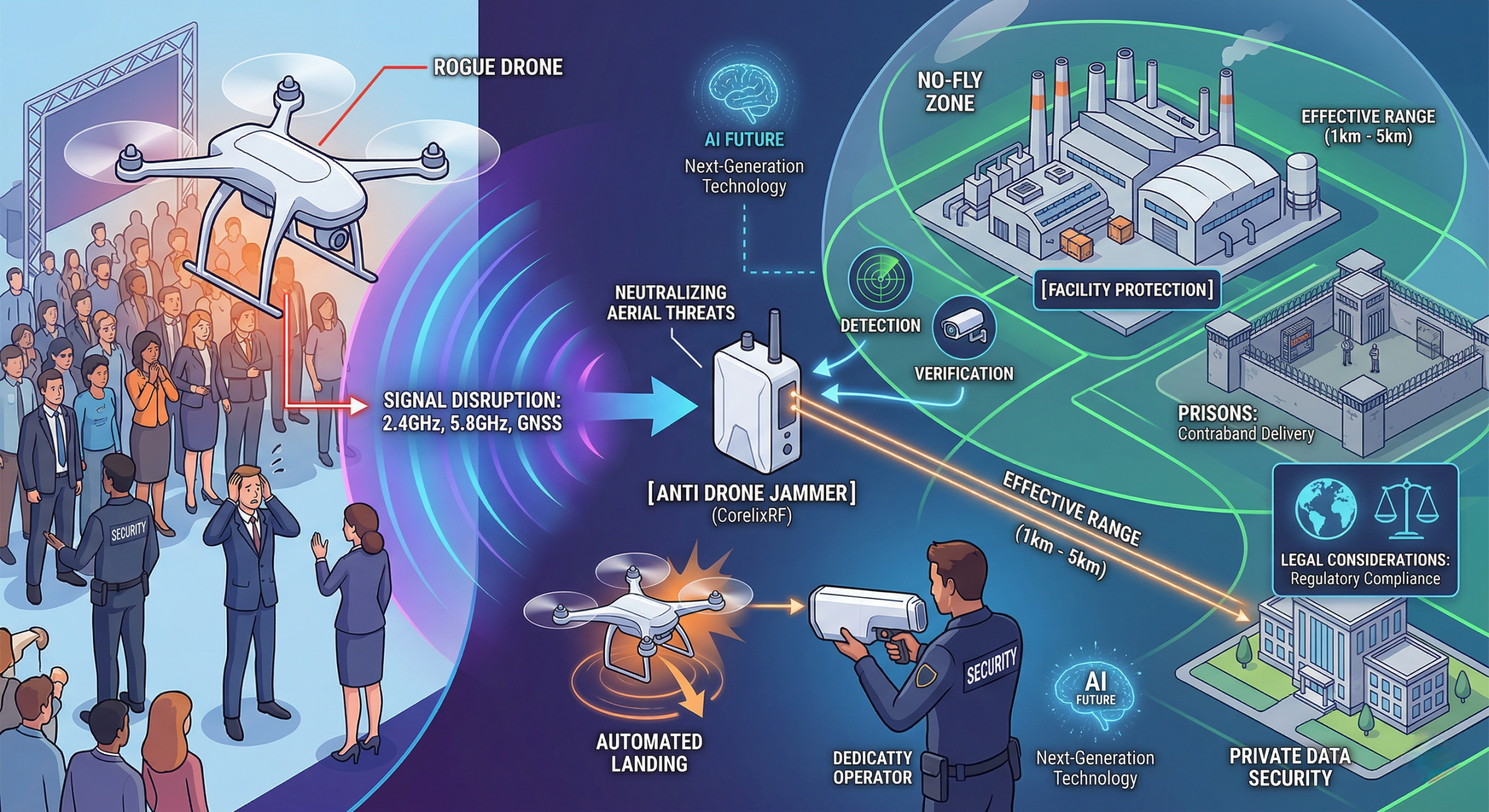
An anti drone jammer works by disrupting the radio frequency and GNSS signals that unauthorized drones rely on for navigation and control, effectively neutralizing potential aerial threats before they can cause harm. As commercial drones become more accessible, many facility managers face the nightmare of unauthorized surveillance or physical intrusion from above. Imagine a high-profile outdoor event where a rogue drone suddenly appears, hovering over the crowd and creating a sense of panic while your security team stands by helplessly. This is where we step in with a robust defense strategy because a reliable anti drone jammer provides the immediate, non-kinetic solution needed to regain control of your airspace and protect your assets. Our expertise in RF technology ensures that your organization remains one step ahead of evolving drone capabilities through field-tested and proven signal disruption methods.
1. Why is anti drone jammer technology essential for facility protection?
An anti drone jammer is essential because it provides a non-destructive way to stop unauthorized drones from entering sensitive areas or capturing private data. Without these tools, security teams often have no way to prevent a drone from flying over fences or into restricted airspace. Here’s the deal.
How does it impact your daily operations?
Protecting your perimeter requires more than just cameras; it needs an active defense against remote-controlled intruders. Utilizing a high-quality signal disruptor ensures that you can maintain a “no-fly zone” without damaging the drone or surrounding property.
- Preventing unauthorized aerial photography or video recording.
- Stopping the delivery of contraband or dangerous payloads.
- Securing the privacy of executives and high-net-worth individuals.
Key Takeaway: Implementing a signal jammer gives your security team the power to neutralize aerial threats silently and effectively.
| Facility Type | Primary Drone Risk | Recommended Protection |
| Data Centers | Wireless Data Theft | Multi-band RF Jammer |
| Stadiums | Public Safety Hazards | Long-range Directional Jammer |
| Prisons | Contraband Delivery | Omnidirectional Perimeter Jammer |
2. How does an anti drone jammer disrupt unauthorized flight?
An anti drone jammer functions by emitting electromagnetic noise at the same frequencies used by drones, which “drowns out” the legitimate commands from the pilot’s remote. This interference forces the drone into a fail-safe mode, such as landing immediately or returning to its starting point. You might be wondering.
Can it target specific drone models?
Modern defense systems are designed to cover the most common frequency bands, including 2.4GHz, 5.8GHz, and GPS/GLONASS signals. This broad spectrum approach ensures that whether the drone is a hobbyist model or a custom-built unit, it will lose its connection to the operator.
- Frequency hopping detection and targeted disruption.
- GNSS signal interference to prevent autonomous waypoint navigation.
- Control link interruption to sever the operator’s manual pilot abilities.
Key Takeaway: Understanding the science of signal disruption allows you to choose a system that covers all likely drone communication channels.
| Signal Type | Frequency Band | Drone Behavior After Jamming |
| Remote Control | 2.4 GHz / 5.8 GHz | Loss of control, hover, or landing |
| GPS / Navigation | 1.5 GHz | Drift, loss of orientation |
| Video Feed | 5.8 GHz | Operator loses visual contact |
3. What are the main types of anti drone jammer systems?
An anti drone jammer typically comes in three formats: handheld “guns,” fixed-site installations, and mobile units mounted on vehicles. Choosing the right type depends on whether you need to protect a moving convoy or a static high-value asset. Wait, there’s more.
Which format fits your security profile best?
Handheld units offer flexibility for guards on patrol, while fixed systems provide 24/7 automated protection for large campuses. For organizations that operate in varying locations, mobile units provide a deployable shield that moves with the mission.
- Handheld “Rifle” jammers for visual-line-of-sight engagement.
- Fixed omnidirectional antennas for consistent perimeter coverage.
- Vehicle-integrated systems for VIP protection and military convoys.
Key Takeaway: Selecting the hardware format based on your operational mobility ensures you aren’t caught off guard when a threat appears.
| Jammer Type | Portability | Range | Best For |
| Handheld Gun | High | 1km – 2km | Rapid Response Teams |
| Fixed Station | None | 3km – 5km | Permanent Infrastructure |
| Mobile Unit | Medium | 2km – 4km | Event Security / Convoys |
4. Can an anti drone jammer integrated with detection systems perform better?
An anti drone jammer is significantly more effective when paired with radar, RF sensors, or thermal cameras that provide early warning of an approaching drone. Detection systems allow the jammer to be activated only when a threat is present, reducing unnecessary RF emissions and power consumption. Ready for the good part?
How does integration improve response times?
Integrated systems remove the need for human eyes to be on the sky at all times, as the sensors can automatically trigger the jammer the moment a drone is identified. This creates a seamless “detect-and-defeat” workflow that minimizes the risk of human error during a security breach.
- Radar for long-distance tracking and altitude data.
- RF scanning to identify the specific make and model of the drone.
- Optical/Thermal cameras for visual confirmation of the payload.
Key Takeaway: Automation through integration ensures that your airspace is protected even when your staff is occupied with other duties.
| System Component | Role in Defense | Benefit of Integration |
| RF Sensor | Identification | Know the threat before it arrives |
| Optical Camera | Verification | Avoid jamming friendly birds or planes |
| Signal Jammer | Neutralization | Immediate mitigation of the threat |
A layered approach using both detection and jamming provides the highest level of security for critical infrastructure.
5. What is the effective range of a standard anti drone jammer?
The range of an anti drone jammer varies depending on the power output and the environment, but most professional-grade units can disrupt signals from 1 to 5 kilometers away. Environmental factors like heavy rain, urban buildings, and competing radio signals can influence these distances during operation. This is where it gets interesting.
How do you maximize the effective distance?
Placing jammers at higher elevations and ensuring a clear line of sight to the horizon will significantly improve the disruption radius. Higher power outputs also allow the signal to penetrate through interference in congested urban environments where many drones operate.
- Directional antennas focus energy to reach much further.
- Omnidirectional antennas provide a 360-degree protective bubble but with shorter range.
- High-gain amplifiers can extend the reach for critical defense applications.
Key Takeaway: Range planning is vital to ensure that a drone is neutralized before its cameras can capture sensitive information.
| Frequency | Typical Range (km) | Penetration Ability |
| 2.4 GHz | 1.5 – 2.0 | Moderate |
| 5.8 GHz | 1.0 – 1.5 | Low |
| GNSS/GPS | 2.0 – 3.0 | High |
6. Is an anti drone jammer safe for use in public environments?
A professional anti drone jammer is designed to target specific frequencies, minimizing the risk to civilian communications like Wi-Fi or cellular networks when used correctly. However, it is essential to follow local regulations and ensure that the jamming signal does not interfere with emergency services or aircraft. But here’s the kicker.
How do you avoid collateral signal interference?
Using directional jammers allows security personnel to point the interference only at the threat, leaving the surrounding radio environment untouched. Modern smart jammers can also pulse their signals to maintain effectiveness while reducing the overall electromagnetic footprint in a crowded area.
- Precision frequency targeting to avoid 4G/5G interference.
- Directional shielding to protect friendly communications behind the unit.
- Low-power “soft-kill” modes for close-range urban use.
Key Takeaway: Responsible use of jamming technology protects your airspace without disrupting the vital communications of your neighbors.
| Feature | Safety Benefit | Operational Impact |
| Directional Beam | Targets only the drone | Zero interference for civilians |
| Power Control | Reduces RF noise | Efficient battery usage |
| Band Selection | Avoids critical bands | Emergency services stay online |
7. How do environmental factors affect anti drone jammer performance?
An anti drone jammer faces challenges from physical obstacles like thick concrete walls, dense foliage, and heavy precipitation which can weaken the signal. Understanding these variables is necessary for placing your equipment in locations where it will be most effective regardless of the weather. What’s the real story?
Can weather stop your defense system?
While rain and snow scatter radio waves, high-quality jammers compensate by using higher gain antennas and increased power density. In urban areas, signal reflection off buildings can actually help by creating a more complex interference field for the rogue drone to navigate.
- Moisture in the air can reduce the range of 5.8GHz signals.
- Physical barriers require multiple jammer nodes for total coverage.
- Temperature extremes can affect battery life and hardware stability.
Key Takeaway: A site survey helps identify “dead zones” where a drone might hide, allowing you to optimize jammer placement.
| Condition | Impact on RF | Solution |
| Dense Fog | Minor signal loss | Increase power output |
| Concrete Walls | High signal blockage | Use multiple antennas |
| Heavy Rain | Range reduction | Focus directional beams |
8. What are the legal considerations for using an anti drone jammer?
In many regions, using an anti drone jammer is restricted to government agencies, military, or critical infrastructure providers due to strict radio frequency laws. You must consult with legal experts and regulatory bodies to ensure your organization has the proper authorization to deploy these devices. Think about this.
Who is typically authorized to operate this equipment?
Airports, power plants, and high-security government buildings are often granted exceptions to use signal disruption technology to prevent catastrophic events. Private companies may need to work with licensed security firms or obtain special permits to utilize high-power RF disruption tools legally.
- National aviation authority guidelines on signal interference.
- Local telecommunications regulations regarding RF emissions.
- Liability considerations for potential drone damage during landing.
Key Takeaway: Following the legal framework ensures your security operations remain compliant while providing the necessary protection.
| Region | Regulatory Body | General Policy |
| USA | FCC / FAA | Strictly controlled, mostly government |
| EU | EASA / National Agencies | Varies by member state |
| International | ITU | Global frequency standards |
9. How to select the right anti drone jammer for your needs?
To select the right anti drone jammer, you must evaluate your specific threat profile, the size of the area you need to protect, and your available budget. A small warehouse requires a different solution than a sprawling international airport or a mobile VIP detail. Check this out.
What are the most important specs to look for?
Focus on frequency coverage, battery life (for mobile units), and ease of integration with your existing security software. A system that is too complex for your team to operate during a high-stress event will fail when you need it most.
- Multi-band capability (2.4, 5.8, GPS, 433MHz, 915MHz).
- User-friendly interface for rapid deployment by security guards.
- Durability and ingress protection (IP) ratings for outdoor use.
Key Takeaway: Investing in the right technology today prevents costly security breaches and provides peace of mind for your stakeholders.
| Requirement | Recommended Feature | Why it Matters |
| High Mobility | Light-weight Handheld | Quick reaction to threats |
| Large Area | High-gain Fixed Array | Covers entire perimeter |
| Stealth Use | Low-profile Housing | Maintains a discreet presence |
10. What is the future of anti drone jammer technology?
The next generation of the anti drone jammer will likely feature artificial intelligence to identify and jam only the specific packets of data used by a threat, leaving other signals completely untouched. This surgical approach will make jamming more efficient and less likely to cause collateral interference in dense cities. The best is yet to come.
How will AI change the defense landscape?
AI-driven jammers will be able to learn from new drone models in real-time, adapting their disruption patterns to overcome even the most advanced frequency-hopping encryption. This evolution will ensure that anti-drone technology remains effective as drones become more autonomous and “smarter” in their flight paths.
- Cognitive radio for automated frequency management.
- Swarm defense capabilities to target multiple drones simultaneously.
- Integration with 5G networks for remote monitoring and control.
Key Takeaway: Staying informed about future trends helps you invest in “future-proof” technology that will grow with your security needs.
| Innovation | Expected Benefit | Readiness |
| AI Signal ID | Precision jamming | Emerging |
| Swarm Defense | Multi-target capability | In Development |
| Satellite Link | Global remote control | Conceptual |
Summary of Airspace Security
Securing your airspace requires a proactive approach that combines detection, identification, and a powerful anti drone jammer to mitigate modern threats effectively. Throughout this discussion, we have highlighted how signal disruption works, the importance of range and environment, and the necessity of legal compliance. By integrating these tools into your security framework, you can protect your facility from surveillance, physical harm, and unauthorized intrusion. If you are ready to take the next step in securing your perimeter, contact us today for a professional consultation. We are dedicated to providing the most advanced RF solutions to ensure your operations remain safe and uninterrupted. Our commitment is to lead the industry in developing reliable, field-tested technologies that empower security professionals worldwide to face the challenges of tomorrow with confidence.
FAQ
Q1: Can I use an anti drone jammer on any drone?
Yes, professional jammers target the standard frequencies used by almost all commercial and custom drones, including 2.4GHz and 5.8GHz. However, specialized military-grade drones might require more powerful or specific frequency bands to disrupt.
Q2: How do I know if a drone is being jammed successfully?
Generally, a jammed drone will either hover in place, begin an automated landing sequence, or attempt to return to its home point. If you have integrated cameras, you will see the drone stop its forward progress or lose its stable flight path.
Q3: Can an anti drone jammer interfere with my office Wi-Fi?
Possibly, if the jammer is omnidirectional and high-powered. To prevent this, you should use directional jammers that point away from your building toward the threat, or select jammers with precise frequency control.
Q4: What’s the best way to deploy jammers for a large outdoor event?
The most effective strategy is a “layered” approach using fixed omnidirectional jammers for a general bubble and handheld directional units for security teams to target specific threats. This ensures 360-degree coverage with the ability to focus power when needed.
Q5: How do I know if I am legally allowed to buy a jammer?
Regulations vary significantly by country and specific industry. You should contact your local telecommunications or aviation authority to determine the licensing requirements for your specific location and use case before purchasing.
Authorized RF engineering and compliance review
For regulated RF systems, this page should be used as an engineering and compliance review path, not as a public deployment checklist. CorelixRF starts with authorization status, operating region, frequency plan, output limit, antenna interface, safety controls, thermal limits and acceptance documents.
- RFQ checklist – send the data buyers usually forget, including band, power, duty cycle, interface and test standard
- delivery documentation – check what documents can support incoming inspection, FAT review and long-term maintenance
- quality and certification review – review the quality and compliance evidence before the project moves into procurement
- RF front-end platform – compare the RF chain as a system instead of selecting one isolated module
- RF configurator – turn frequency, power, thermal and interface requirements into a first configuration brief
- case studies – review similar engineering paths before sending an RFQ
- engineering contact – send the application notes, block diagram or target specification to engineering sales
This keeps the discussion inside lawful, authorized RF programs while still giving procurement teams a clear way to request amplifier, antenna, SDR source, documentation and factory review.
Authorized C-UAS RF System Review Path
For authorized facility C-UAS programs, compare RF front-end platform planning with suitable RF power amplifier platforms and RF antenna options before sending requirements through the RF inquiry form. CorelixRF can review band, power, antenna/load condition, cooling, controls and compliance evidence before quotation.