
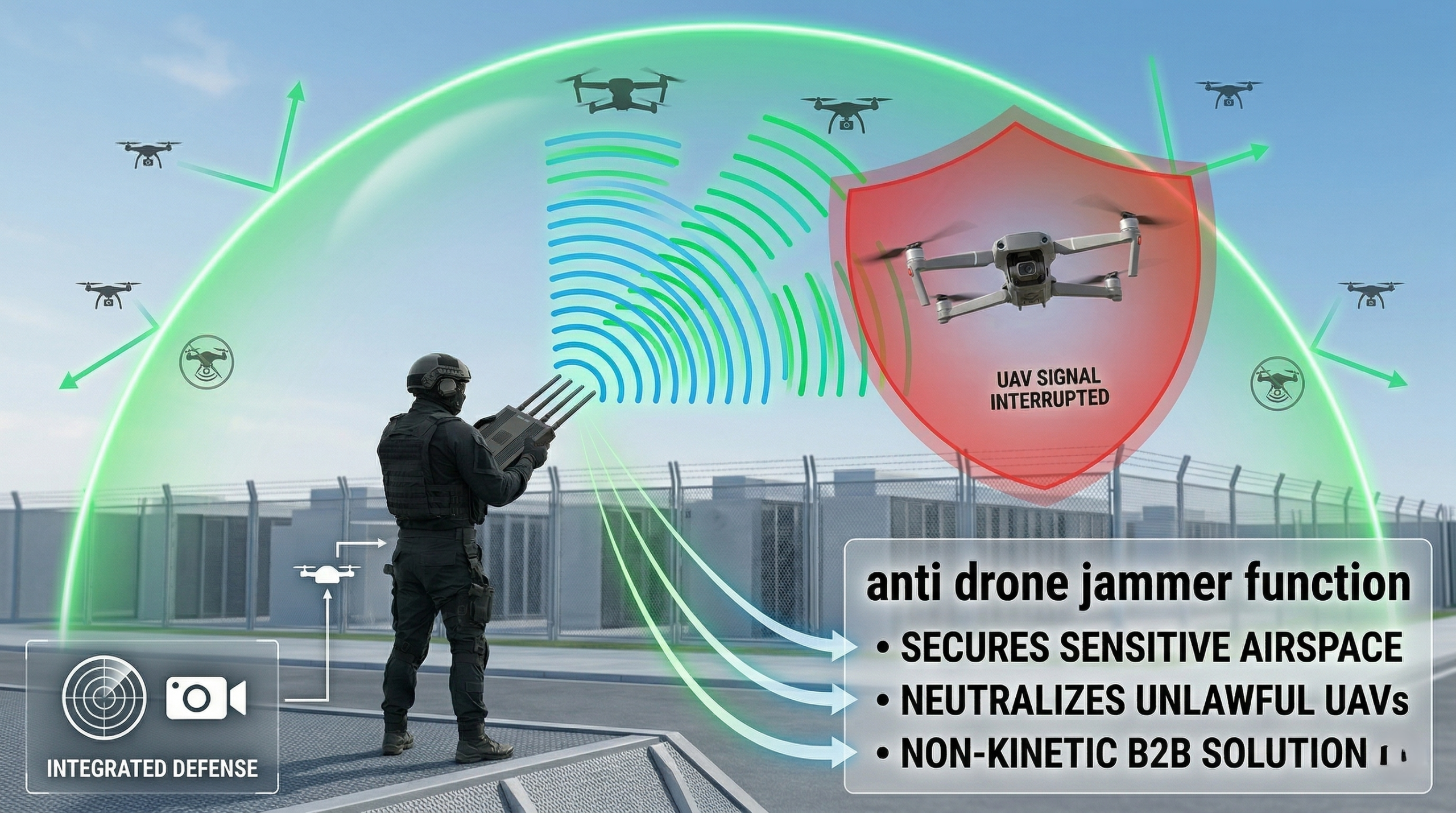
An anti drone jammer is a sophisticated electronic countermeasure device designed to disrupt the communication links between a remote-controlled unmanned aerial vehicle and its operator by emitting powerful radio frequency signals. This technology serves as a critical defense mechanism for protecting sensitive airspace, ensuring privacy, and preventing unauthorized aerial surveillance in various high-security environments. By overwhelming the drone’s receiving sensors with noise, these systems force the aircraft into safety modes like landing or returning to a pre-set home location.
Imagine you are managing security for a high-profile outdoor summit where world leaders are gathered to discuss global policy. Suddenly, an unidentified drone appears on the horizon, hovering silently above the crowd and potentially carrying unauthorized recording equipment or worse. The tension in the security booth spikes because standard perimeter fences cannot stop a threat coming from the sky, leaving your event vulnerable to a massive privacy breach or a kinetic strike. Here’s the deal: modern security requires more than physical barriers; it requires electronic dominance. By deploying a professional anti drone jammer, you can instantly neutralize these aerial intruders and regain control of your surroundings, ensuring that your secure zone remains truly private and protected from sophisticated digital threats.
1. How does an anti drone jammer disrupt unauthorized flight?
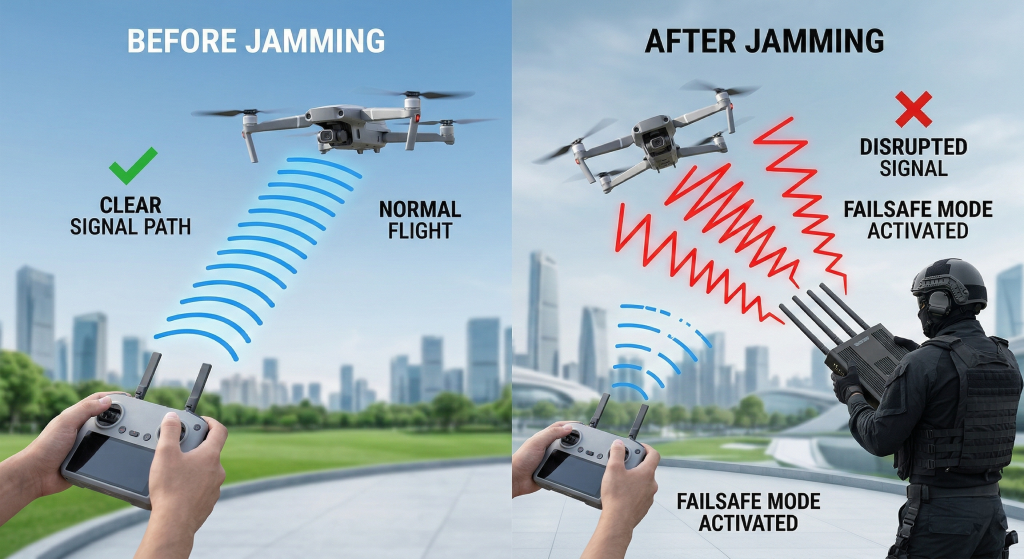
An anti drone jammer works by transmitting high-power electromagnetic signals at the same frequencies used by the drone for control and navigation, effectively “drowning out” the legitimate commands from the pilot. When the drone’s receiver is bombarded with this interference, it loses the ability to distinguish between the noise and the operator’s instructions. But wait, there’s more. This disruption isn’t just about stopping movement; it severs the vital data link that provides the pilot with a live video feed, rendering the drone “blind” in mid-air.
Why is signal interference effective?
Does signal interference actually stop all types of drones? Yes, because almost every commercial UAV relies on the 2.4GHz or 5.8GHz bands to receive flight coordinates and send back telemetry data. By saturating these specific bands, the anti drone jammer creates an electronic shield that no standard signal can penetrate.
- Frequency saturation blocks the 2.4GHz control band.
- 5.8GHz video transmission is immediately severed.
- The drone enters a “signal lost” failsafe mode.
You might be wondering if the drone will simply crash out of the sky once the link is broken. In reality, most modern drones are programmed to hover in place or execute an automated return-to-home sequence when they encounter this level of electromagnetic interference.
What role does the internal oscillator play?
How does the device generate such precise interference? The heart of the jammer is a voltage-controlled oscillator that produces a wave tuned specifically to the target’s frequency range, which is then amplified and broadcast via high-gain antennas.
- Oscillators generate the base “jamming” wave.
- Power amplifiers increase the signal’s effective range.
- Directional antennas focus the energy toward the target.
This is where it gets interesting… Higher-end systems can sweep across multiple frequencies simultaneously, ensuring that even drones with frequency-hopping capabilities cannot escape the electronic net.
Key Takeaway: Understanding the disruption process allows security teams to deploy jammers effectively, ensuring that the drone is neutralized without causing unnecessary physical damage to the surrounding area.
| Component | Function | Impact on Drone |
| Oscillator | Signal Generation | Overwhelms Receiver |
| Amplifier | Range Extension | Increases Buffer Zone |
| Antenna | Directional Focus | Pinpoints Target UAV |
These hardware components work in perfect harmony to ensure that no unauthorized signal reaches the drone’s flight controller.
2. Why is GPS spoofing a critical feature of an anti drone jammer?
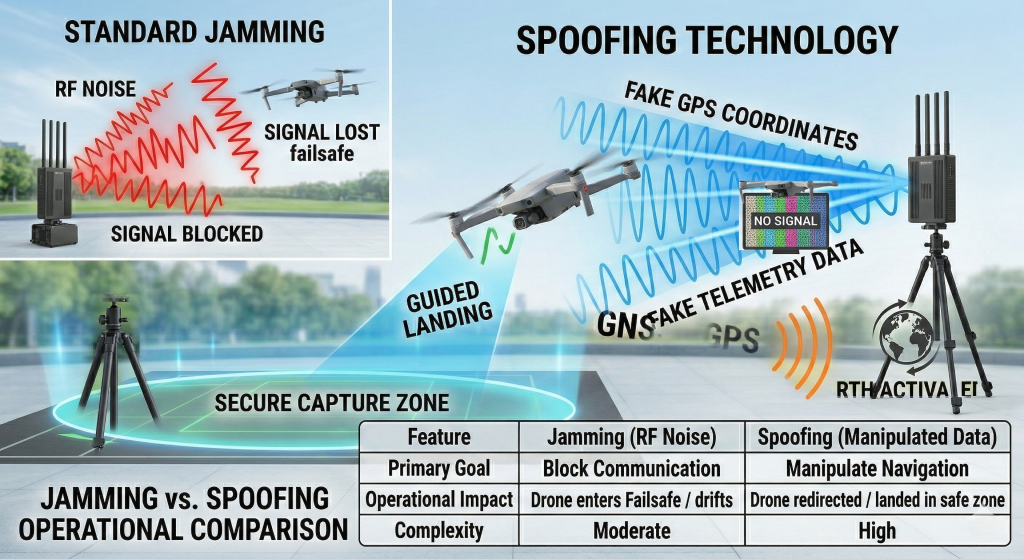
An anti drone jammer utilizes GPS spoofing to provide the drone with false geographical coordinates, tricking the aircraft’s onboard navigation system into believing it is in a different location. While standard jamming simply blocks signals, spoofing takes control of the drone’s perception of reality. Ready for the good part? By manipulating the GPS data, you can actually lead a drone away from a sensitive area or force it to land in a designated “catch zone” away from the public.
How does spoofing differ from standard jamming?
Can spoofing be more effective than simple signal blocking? While jamming creates a “blind spot,” spoofing sends a stronger, fake signal that the drone’s GPS receiver accepts as legitimate, allowing for more precise control over the flight path.
- Jamming creates noise to block communication.
- Spoofing provides fake coordinates to the navigation.
- Spoofing can bypass “Return to Home” safety features.
The real story is that spoofing requires much more technical precision than jamming because the fake signal must perfectly mimic the timing and structure of real satellite data to be accepted by the drone.
Is spoofing necessary for all security scenarios?
Why would a facility choose spoofing over simple frequency disruption? In areas like airports or dense urban centers, simply jamming a drone might cause it to hover dangerously; spoofing allows security to move the drone to a safe, controlled environment.
- Allows for “soft” landings in safe zones.
- Reduces the risk of mid-air collisions.
- Enables the capture of the drone for forensic analysis.
It’s no secret that as drones become more autonomous and rely less on pilot input, spoofing will become the primary method for neutralizing advanced threats that navigate via pre-programmed GPS waypoints.
Key Takeaway: Spoofing offers a more surgical approach to drone defense, providing the ability to not just stop a drone, but to actively manage where it goes once it is intercepted.
| Feature | Jamming | Spoofing |
| Primary Goal | Block Communication | Manipulate Navigation |
| Complexity | Moderate | High |
| Result | Hover/Land/RTH | Redirect/Captive Landing |
This comparison highlights why sophisticated operators often combine both techniques for a comprehensive defense strategy.
3. Which frequency bands are targeted by an anti drone jammer?
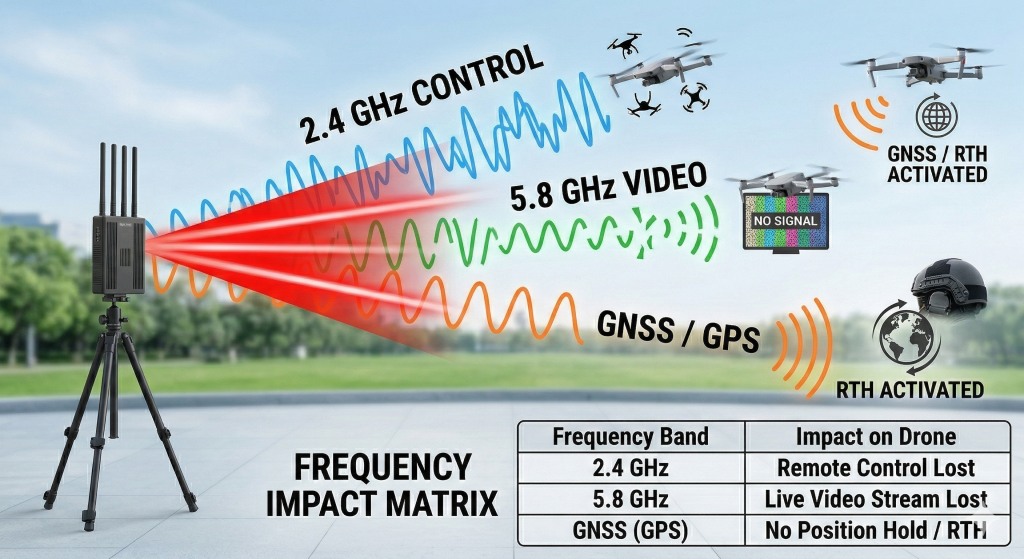
An anti drone jammer typically targets the 2.4 GHz, 5.8 GHz, and GNSS (Global Navigation Satellite System) bands, as these are the universal standards for drone control and positioning. By focusing on these specific slices of the electromagnetic spectrum, the device ensures maximum compatibility with a wide range of drone brands. Here’s the deal: as drone technology evolves, modern jammers are being updated to include 433 MHz and 900 MHz bands to stop custom-built or long-range industrial drones.
Why are 2.4 GHz and 5.8 GHz the primary targets?
What makes these two frequencies so important? These bands are part of the ISM (Industrial, Scientific, and Medical) radio bands, which allow for high-speed data transmission required for real-time HD video and low-latency flight control.
- 2.4 GHz provides long-range control stability.
- 5.8 GHz supports high-bandwidth video downlink.
- Both are standard for DJI, Autel, and Parrot drones.
You might be wondering if targeting these bands will interfere with local Wi-Fi. While there is a risk of localized disruption, professional anti drone jammer systems use directional antennas to minimize “collateral” interference to nearby civilian infrastructure.
What happens when GNSS bands are blocked?
Can a drone fly without its satellite connection? While some drones can fly via optical flow sensors, most will lose their ability to maintain a stable hover and will begin to drift with the wind when the GNSS (GPS/GLONASS/Galileo) bands are jammed.
- Loss of “Position Hold” functionality.
- Inability to use automated waypoint missions.
- Drifting becomes a major safety concern for the pilot.
This is where it gets interesting… Some high-end jammers now include specialized bands for the 1.2 GHz range to ensure that even military-grade or secondary GPS signals are successfully blocked during an incursion.
Key Takeaway: By understanding the frequency landscape, operators can select jammers that offer the specific coverage needed for the types of drones most likely to enter their restricted airspace.
| Frequency Band | Primary Usage | Jamming Impact |
| 2.4 GHz | Remote Control / Telemetry | Pilot loses control of aircraft |
| 5.8 GHz | FPV Video Feed | Live video stream goes black |
| 1.5 GHz (GNSS) | Positioning / Navigation | Drone loses location awareness |
Targeting these specific bands is the most efficient way to neutralize commercial drone threats instantly.
4. How does the effective range of an anti drone jammer vary?
The effective range of an anti drone jammer is primarily determined by its output power and antenna gain, typically spanning anywhere from 500 meters to over 5 kilometers for stationary units. It is not a fixed number because environmental factors like terrain and existing radio noise play a massive role in signal propagation. But wait, there’s more. The distance between the drone and its pilot also dictates how much power the jammer must emit to “break” the connection.
How does the distance to the pilot affect jamming?
Is it harder to jam a drone that is close to its operator? Absolutely, because the signal from the remote control is much stronger when the drone is nearby, requiring the anti drone jammer to work much harder to overcome that “clean” signal.
- Proximity to pilot increases signal signal-to-noise ratio.
- Distant drones are easier to disconnect with low power.
- Jammers must be more powerful than the pilot’s transmitter.
The real story is that tactical success often depends on the jammer being closer to the drone than the pilot is, or having a significantly higher “Effective Isotropic Radiated Power” (EIRP).
Do weather and terrain limit the range?
Can you use a jammer effectively in a forest or during a storm? Physical obstacles like trees, buildings, and heavy rain can absorb or reflect radio waves, significantly shortening the effective “kill distance” of the device.
- Rain and fog can attenuate high-frequency signals.
- Buildings create “shadow zones” where the signal can’t reach.
- Line-of-sight is usually required for optimal performance.
What’s the catch? Even the most powerful jammer can be rendered useless if the drone is flying behind a concrete structure that blocks the jamming beam, allowing the drone to maintain its connection to the pilot.
Key Takeaway: Range is a dynamic variable; security personnel must perform site surveys to understand how their specific environment will influence the performance of their drone defense systems.
| Jammer Type | Average Range | Best Use Case |
| Handheld “Rifle” | 500m – 1.5km | Mobile Security / Event Protection |
| Stationary Omni | 1km – 3km | Facility Perimeter Defense |
| High-Power Array | 5km+ | Border Control / Military Bases |
Evaluating these range profiles helps in choosing the right equipment for specific geographical needs.
5. What are the different types of anti drone jammer designs?
Anti drone jammer systems come in three primary form factors: handheld “rifles,” stationary omnidirectional units, and vehicle-mounted arrays. Each design is tailored for a specific operational context, balancing portability against raw power and coverage area. Ready for the good part? While rifles are perfect for reactive security, stationary units provide 24/7 autonomous protection for critical infrastructure like power plants and prisons.
When should you use a handheld jammer?
Are “drone guns” the best option for every situation? These devices are highly effective for rapid response because they allow the operator to visually track and target a specific drone, concentrating all the jamming energy in one direction.
- Lightweight and portable for foot patrols.
- Highly directional to avoid civilian interference.
- Fast deployment for sudden aerial threats.
This is where it gets interesting… Some modern handheld units are now designed to look like standard security equipment to avoid causing public panic during sensitive events.
How do stationary systems provide automated defense?
Can a jammer work without a human operator? Stationary systems are often integrated with radar or RF sensors that detect an incoming drone and automatically activate the anti drone jammer to neutralize the threat before it reaches the perimeter.
- Provides 360-degree “dome” protection.
- Can operate continuously without fatigue.
- Integrates with existing security software suites.
You might be wondering if these systems are always “on.” Actually, to save power and reduce radio pollution, they usually remain in a standby mode until a detection sensor triggers the jamming sequence.
Key Takeaway: Selecting the right form factor depends on whether your security posture is proactive (stationary) or reactive (handheld), ensuring the defense matches the threat profile.
| Design Type | Portability | Power Level | Operation |
| Handheld Rifle | High | Medium | Manual Aiming |
| Fixed Omni-Unit | None | High | Automated/Sensor-led |
| Vehicle Mount | Moderate | Very High | Mobile Convoy Defense |
Choosing the appropriate design ensures that the equipment fits the workflow of your security personnel perfectly.
6. Are there legal restrictions for using an anti drone jammer?
Using an anti drone jammer is strictly regulated in most countries, with many jurisdictions limiting their use to military, law enforcement, and critical infrastructure operators. In the United States, for example, the FCC generally prohibits the operation of jamming equipment by private citizens because it can interfere with essential communications. But here’s the kicker… even authorized users must follow strict guidelines to ensure they don’t accidentally block emergency services or cellular networks.
Who is legally allowed to operate these devices?
Can a private business buy a jammer to protect its office? In most regions, private use is illegal; however, government agencies and specifically licensed security firms may be granted exemptions for high-security tasks.
- Military and national defense forces.
- Federal law enforcement agencies.
- State-sanctioned prison security teams.
The real story is that laws are slowly evolving as the “drone threat” increases, but for now, unauthorized use can lead to massive fines or even imprisonment.
What are the risks of unauthorized jamming?
What’s the worst that could happen if you use a jammer illegally? Beyond legal trouble, an uncalibrated anti drone jammer can disrupt air traffic control, hinder medical response teams, and block 911 calls in the surrounding area.
- Interference with legal aircraft communications.
- Disruption of public safety radio networks.
- Potential for dangerous “blind” drone crashes.
It’s no secret that the primary concern for regulators is the “spillover” effect, where the jamming signal travels further than intended and disrupts legitimate radio users miles away.
Key Takeaway: Always consult with legal counsel and local telecommunications authorities before purchasing or deploying jamming technology to ensure full regulatory compliance.
| Jurisdiction | Private Use | Authorized Use | Penalty for Misuse |
| USA (FCC) | Prohibited | Federal/Gov only | High fines / Seizure |
| EU (Various) | Restricted | Security/Military | Criminal charges |
| Middle East | Regulated | Government/Law Enforcement | Severe legal action |
Navigating the legal landscape is just as important as choosing the right technical specifications for your device.
7. How do you integrate an anti drone jammer with detection systems?
Integrating an anti drone jammer with a detection system like radar or RF sensors creates a “closed-loop” defense that can identify, track, and neutralize threats without human intervention. This synergy is essential for modern security because a jammer alone is useless if you don’t know where the drone is located. This is where it gets interesting… By using AI-driven software, the system can distinguish between a friendly bird and a hostile drone, only activating the jammer when a genuine threat is confirmed.
Why is detection the first step in drone defense?
Can you just leave a jammer running all the time? No, because constant jamming is illegal and power-intensive; detection systems like Aeroscope or thermal cameras act as the “eyes” that tell the jammer when to fire.
- Radar detects physical objects in the air.
- RF scanners identify the drone’s signature.
- Acoustic sensors listen for the unique hum of propellers.
You might be wondering how fast this happens. In a professional anti drone jammer setup, the time from detection to neutralization can be less than five seconds, giving the intruder no time to react.
What are the benefits of a multi-layered defense?
Does having multiple sensors make a difference? A multi-layered approach ensures that even if one sensor fails—like a camera in heavy fog—the radar or RF scanner will still pick up the intruder.
- Reduces false alarms from birds or wind.
- Increases the probability of early detection.
- Allows for automated “slew-to-cue” jamming.
Ready for the good part? These integrated systems can also record the drone’s unique ID and the pilot’s location, providing valuable evidence for law enforcement after the incident is over.
Key Takeaway: A jammer is only as good as the system that triggers it; investing in high-quality detection is the only way to ensure 100% protection against surprise incursions.
| Sensor Type | Detection Method | Strengths |
| Radar | Echo Reflection | Long range / All weather |
| RF Scanner | Frequency Analysis | Identifies drone model/ID |
| EO/IR Camera | Visual/Thermal | Confirms threat visually |
Combining these sensors with a jammer provides the most robust aerial defense possible for any high-value asset.
8. What maintenance does a professional anti drone jammer require?
Maintaining an anti drone jammer involves regular firmware updates, battery health checks, and antenna calibrations to ensure the device remains effective against the latest UAV communication protocols. Because drone manufacturers frequently update their software to resist interference, your jammer must be equally adaptable. But wait, there’s more. Physical components like cooling fans and weather-resistant seals must be inspected, especially for stationary units exposed to harsh outdoor environments.
Why are firmware updates so important?
Can a jammer become obsolete? Yes, because new drones might use “frequency hopping” or encrypted signals that an old anti drone jammer isn’t programmed to handle without a digital update.
- Adds support for new drone frequencies.
- Improves signal efficiency and power consumption.
- Fixes bugs in the spoofing algorithms.
The real story is that a jammer with outdated software is about as effective as a paperweight against a modern, high-end industrial drone.
How do you protect the hardware from the elements?
Does the sun or rain damage the internal electronics? High-power jammers generate significant heat, so ensuring that the cooling vents are clear and the thermal paste on the amplifiers is intact is vital for long-term reliability.
- Check for corrosion on antenna connectors.
- Ensure the battery holds a full charge for portable units.
- Test the cooling fans for any mechanical obstructions.
What’s the catch? Neglecting physical maintenance can lead to internal “thermal throttling,” where the device automatically lowers its power output to prevent melting, drastically reducing your protection range.
Key Takeaway: Treat your jammer like a high-performance computer; regular software and hardware “check-ups” are mandatory to ensure it performs when a real threat appears.
| Maintenance Task | Frequency | Impact on Performance |
| Firmware Update | Monthly | Counters new drone tech |
| Antenna Calibration | Quarterly | Ensures max signal range |
| Battery Stress Test | Bi-Annually | Prevents failure during use |
Consistent maintenance is the only way to guarantee that your investment remains a viable defense tool over time.
9. How can an anti drone jammer protect public privacy?
An anti drone jammer protects privacy by preventing unauthorized drones from hovering over private property and capturing high-resolution video or audio of individuals without their consent. In an age where consumer drones are equipped with 4K zoom lenses, the traditional “privacy fence” is no longer enough. Here’s the deal: by deploying a localized anti drone jammer, homeowners or corporate offices can create a “digital no-fly zone” that shields their private lives from prying eyes.
Is aerial surveillance a growing threat to privacy?
How much can a drone actually see? Professional-grade consumer drones can read a newspaper from a hundred feet away, making them perfect tools for corporate espionage or stalking.
- Zoom lenses bypass physical boundary walls.
- Silent motors allow for “stealth” spying.
- Livestreaming capabilities spread data instantly.
You might be wondering why you can’t just call the police. By the time authorities arrive, the drone is usually gone and the footage is already uploaded to a server; a jammer provides an immediate solution.
Can jammers be used for VIP protection?
Why do celebrities use this technology? For high-profile individuals, preventing paparazzi drones from ruining a private wedding or event is a matter of both personal sanity and physical security.
- Prevents intrusive photos of private events.
- Stops drones from following moving convoys.
- Ensures secret locations remain truly hidden.
This is where it gets interesting… Some jammers are integrated into umbrellas or portable cases to provide a mobile “privacy bubble” for VIPs as they move through public spaces.
Key Takeaway: Privacy is no longer just about locking your doors; it’s about controlling the airspace above you to ensure your digital and physical boundaries remain unbreached.
| Privacy Threat | Traditional Solution | Jammer Solution |
| Aerial Photography | Curtains/Fences | Signal Disruption |
| Audio Recording | Soundproofing | Remote Link Severing |
| Stalking | Security Guards | Instant Forced Landing |
The jammer represents the modern evolution of the privacy fence, adapted for the 21st-century aerial landscape.
10. Can an anti drone jammer stop swarm attacks?
An anti drone jammer can potentially stop a swarm attack by using wide-angle or omnidirectional antennas to flood a large area with interference, affecting every drone within the “kill zone” simultaneously. Traditional defense systems that target one drone at a time are easily overwhelmed by a swarm. Ready for the good part? High-output “barrage jammers” are specifically designed to handle multiple targets by saturating all common control frequencies across a 360-degree radius.
Why is a swarm harder to defend against?
Does a single jammer work against ten drones? A swarm can approach from multiple angles, meaning a directional anti drone jammer might only stop the drones it is pointed at while the others complete their mission.
- Multiple targets saturate human reaction time.
- Swarms can “self-heal” if one drone is lost.
- Autonomous swarms don’t always rely on a pilot.
The real story is that stopping a swarm requires an automated, high-power system that creates a total exclusion zone rather than a focused beam.
Are there jammers designed for military-grade swarms?
How do soldiers stop coordinated drone attacks? Military units use vehicle-mounted electronic warfare suites that emit massive amounts of wide-spectrum noise to disrupt even the most advanced mesh-networking drones.
- Electronic “blanketing” of the entire battlefield.
- Disruption of inter-drone communication links.
- Forced “collision” mode for uncoordinated drones.
But wait, there’s more. Some advanced systems can even “hijack” the swarm’s communication protocol, turning the drones against each other or forcing the entire group to land at once.
Key Takeaway: As swarm technology becomes more accessible, upgrading to omnidirectional and automated jamming systems is the only way to ensure your facility isn’t vulnerable to numbers-based aerial threats.
| Attack Type | Difficulty | Jammer Requirement |
| Single Pilot Drone | Low | Handheld / Directional |
| Coordinated Swarm | High | Omnidirectional / High Power |
| Autonomous Swarm | Very High | Wide-Spectrum / Spoofing |
Understanding the nature of the attack allows you to scale your jamming capabilities to meet the specific level of threat complexity.
Throughout this article, we have addressed the critical questions surrounding the operation, legality, and deployment of drone defense technology. We’ve explored how signal disruption and GPS spoofing work, the importance of frequency targeting, and why professional maintenance and integration are vital for success. Whether you are protecting a high-profile event or a critical piece of infrastructure, the right jamming solution provides the necessary electronic shield to keep the skies above you safe and secure. For tailored advice on securing your facility against aerial threats or to view our professional product lineup, please contact us today and let our team of experts help you build a comprehensive defense strategy. We are committed to empowering our clients with the tools they need to maintain total sovereignty over their airspace in an increasingly autonomous world.
FAQ Section
Q1: Can I use an anti drone jammer to protect my house from neighbors?
In most countries, the answer is no. Federal regulations usually prohibit private individuals from operating jamming devices because they interfere with public communications; you should check local laws or consider non-electronic deterrents first.
Q2: How does a jammer handle a drone that doesn’t use GPS?
Most jammers also target the 2.4 GHz and 5.8 GHz control frequencies. Even if a drone flies without GPS, losing its connection to the remote control will usually trigger a safety hover or a controlled descent.
Q3: What’s the best way to choose between a handheld and a stationary jammer?
Handheld units are best if you need to be mobile and target drones from different spots. Stationary systems are the better choice if you need to protect a fixed perimeter 24/7 without needing a person to aim the device.
Q4: How do I know if a drone is being jammed or if it’s just a glitch?
A jammed drone typically stops moving instantly, loses its video feed, and either hovers perfectly still or starts drifting. If it were a glitch, the drone might behave erratically, spinning or falling, which is different from the “frozen” state caused by a jammer.
Q5: Can an anti drone jammer affect my smartphone or Wi-Fi?
Yes, it can. Because drones use the same 2.4 GHz and 5.8 GHz bands as Wi-Fi and some mobile data, using a jammer nearby will likely cause temporary signal drops for your household electronics until the jammer is turned off.
Authorized RF engineering and compliance review
For regulated RF systems, this page should be used as an engineering and compliance review path, not as a public deployment checklist. CorelixRF starts with authorization status, operating region, frequency plan, output limit, antenna interface, safety controls, thermal limits and acceptance documents.
- RFQ checklist – send the data buyers usually forget, including band, power, duty cycle, interface and test standard
- delivery documentation – check what documents can support incoming inspection, FAT review and long-term maintenance
- quality and certification review – review the quality and compliance evidence before the project moves into procurement
- RF front-end platform – compare the RF chain as a system instead of selecting one isolated module
- RF configurator – turn frequency, power, thermal and interface requirements into a first configuration brief
- case studies – review similar engineering paths before sending an RFQ
- engineering contact – send the application notes, block diagram or target specification to engineering sales
This keeps the discussion inside lawful, authorized RF programs while still giving procurement teams a clear way to request amplifier, antenna, SDR source, documentation and factory review.
Complex Airspace RF Function Review Path
For authorized security, test or integration programs, use this article as a compliance-first planning reference rather than an operating instruction. The practical next step is to review the RF chain as an engineered system: source, amplifier, antenna, control interface, load condition, thermal margin and acceptance evidence.
- Review RF front-end platform architecture when the project combines signal source, amplifier, antenna and control logic.
- Compare RF power amplifier platforms for band, output power, duty cycle, cooling and protection behavior.
- Match RF antenna platforms to coverage pattern, gain, connector, VSWR and installation limits.
- Prepare an RFQ checklist before requesting datasheets, test data or a factory engineering review.
Send your RF system requirements to CorelixRF engineering for a compliance-aware review path.