
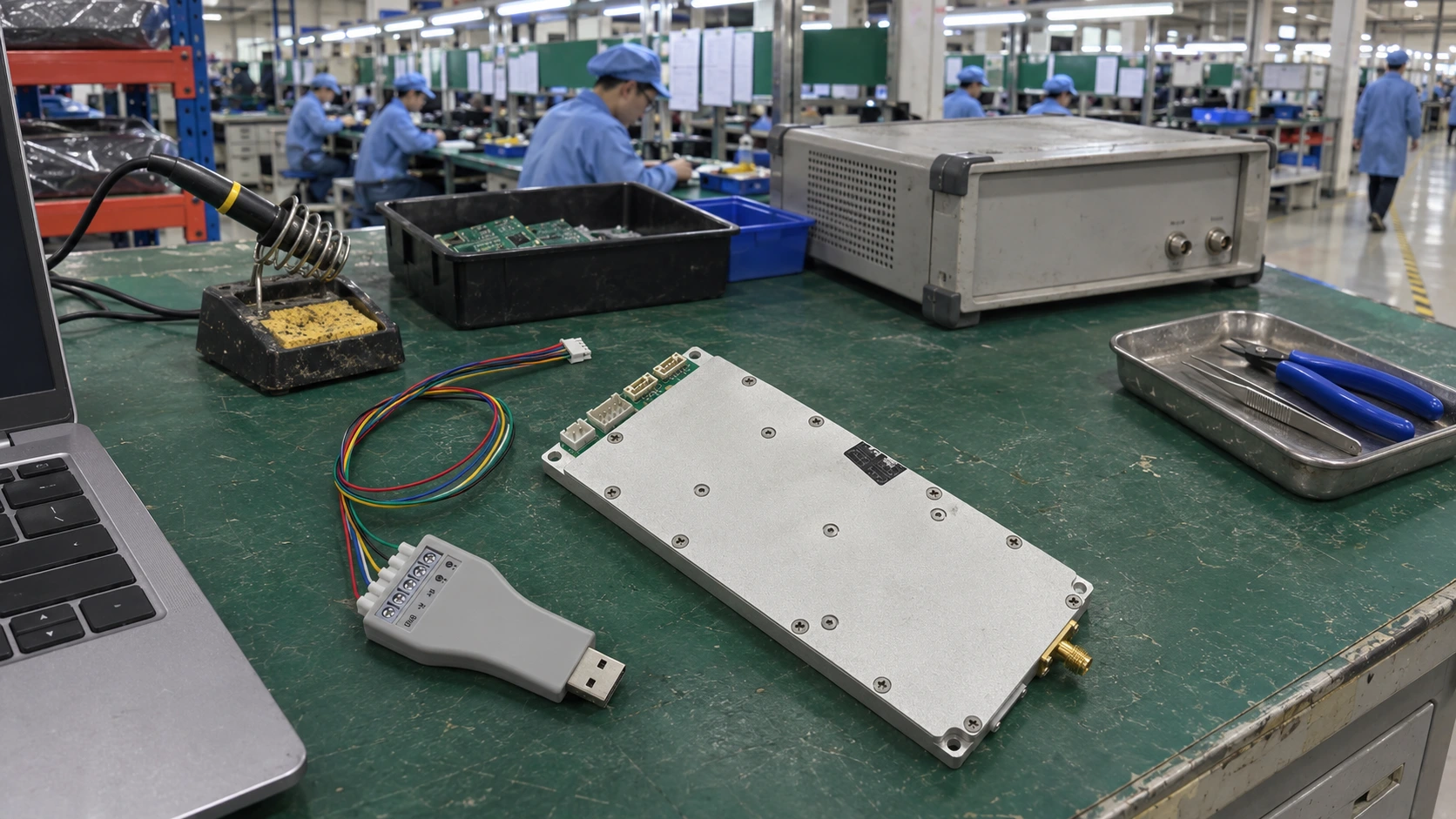
Choose signal generator sweep dwell around a valid measurement window, rather than the time a command takes to return. Establish when the source meets your frequency and level requirements, then place the complete acquisition inside that interval, with the receiver and measurement path ready.
If you shorten the waiting time in an automated sweep and the readings become inconsistent, check that timing relationship before replacing the source. A faster sequence is useful only when it still produces readings you can use. The immediate question is whether the source, the observation method and the sampling interval meet the same requirement.
1. Define “Ready to Measure” at the Source Output
A returned command, a qualified RF output and a completed acquisition describe different events. Keep them separate in the test requirement:
- Command response: if the protocol provides a reply, interpret it according to the delivered protocol. Do not assume it certifies an RF condition.
- Source eligibility: the frequency and amplitude meet the agreed criteria at the declared source-output plane for the required interval.
- Valid acquisition: the receiver and path are ready, and the complete measurement uses that eligible interval.
Start with the condition your measurement needs. A status message can support only its documented meaning; it does not replace evidence that the required frequency and level conditions hold.
2. Compare Frequency and Amplitude Settling Under the Same Conditions
A frequency switching time figure is useful only when you know where its timing starts and ends. Before comparing signal generator settling time, put the transition and acceptance conditions alongside the number.
| What to match | Why it belongs in the comparison |
|---|---|
| Start and end frequency, output level and signal mode | The comparison needs to describe the transition your project actually uses. |
| Frequency and amplitude criteria, with a required interval | Frequency settling time and amplitude settling time must be judged against stated conditions, not a first crossing alone. |
| Timing reference and measurement capability | The event reference, receiver/path response and observation resolution must support the conclusion. |
Keep units explicit. A level stated in dBm is an absolute power level; a level difference stated in dB is a different quantity. If frequency error is expressed in Hz or ppm, state the corresponding basis. There is no universal tolerance or waiting time supplied by this article.
The measurement method also matters. A scalar power reading alone does not establish frequency settling. Use an observation method capable of resolving the required behavior, with suitable input limits, corrections and time resolution. Associate source and receiver information with a validated common time reference; unrelated timestamps cannot simply be combined.
3. Worked Example: Does a 4 ms Acquisition Fit?
Illustrative Example — not measured product data
Assume an unmodulated carrier observed in a conducted source-output setup. Every time below uses the same validated reference, in milliseconds. Let the command reference be 0 ms. If the hypothetical protocol provides a reply, it is observed at 1 ms; that reply is not the RF acceptance condition.
Assume the frequency criterion is met from 4 ms, the receiver and path are ready from 6 ms, and the amplitude criterion is met from 7 ms. These conditions remain satisfied until the next change at 12 ms. The measurement method requires a complete 4 ms acquisition.
For this simplified example, applicable input limits, corrections, timing resolution, trigger correlation and required guard or uncertainty treatment have already been satisfied in defining the usable interval. The stated eligibility times are not merely raw first-threshold crossings. These are assumptions to make the interval comparison clear, not suggested equipment settings.
| Acquisition plan | Interval check | Conclusion within this example |
|---|---|---|
| A: start at 4 ms | 4 + 4 = 8 ms. The acquisition begins before both receiver readiness and the amplitude criterion. | The complete acquisition does not meet the stated conditions. Ending after the source becomes eligible does not repair its initial invalid interval. |
| B: start at 7 ms | 7 + 4 = 11 ms. The full 7–11 ms acquisition fits inside the common 7–12 ms usable interval. | Eligible only under every stated premise. This is an interval result, not a source-speed measurement. |
| C: keep B, but move the next change to 10 ms | The acquisition still ends at 11 ms, crossing the revised 10 ms boundary. | The original usable interval is now shortened. The same acquisition no longer fits. |
The common interval in B is 12 − 7 = 5 ms. Its remaining 1 ms after acquisition is only an arithmetic remainder, not a recommended guard time. Do not shorten the method’s required acquisition just to force it into a smaller window.
This example does not establish a product’s settling time, a universal point period or a full-system acceptance result. It does not extend to pulsed or modulated signals. If the time reference, continued compliance or acquisition evidence cannot be established in a real test, leave the result unverified.
4. Shorten Sweep Dwell Where the Evidence Allows It
Once the mismatch is clear, choose the next action around it. Do not assume that a different control interface, or a shorter signal generator sweep dwell time setting, will solve the RF timing question.
| Possible next action | What must be established first |
|---|---|
| Align the acquisition with the eligible interval | The required interval and complete measurement duration are supported by the actual method and evidence. |
| Review a documented control or trigger mode | The exact configuration supports that function, and its timing definition suits the required signal generator trigger timing. |
| Assess another source | Timing evidence uses comparable transitions, tolerances and acquisition requirements. |
Check how the actual device defines dwell and point-to-point timing. There is no universal sum of internal delays to apply to every source, and interface bitrate is not an RF settling specification. List sweep, hardware trigger and ready functions are options to verify, rather than capabilities to assume.
If a source feeds a high-power test path, keep the wider ATE sweep-anomaly review separate. A qualified interval at the source output does not close the amplifier, switching-path or receiver acceptance questions.
5. Match the Timing Requirement to a Reference Source
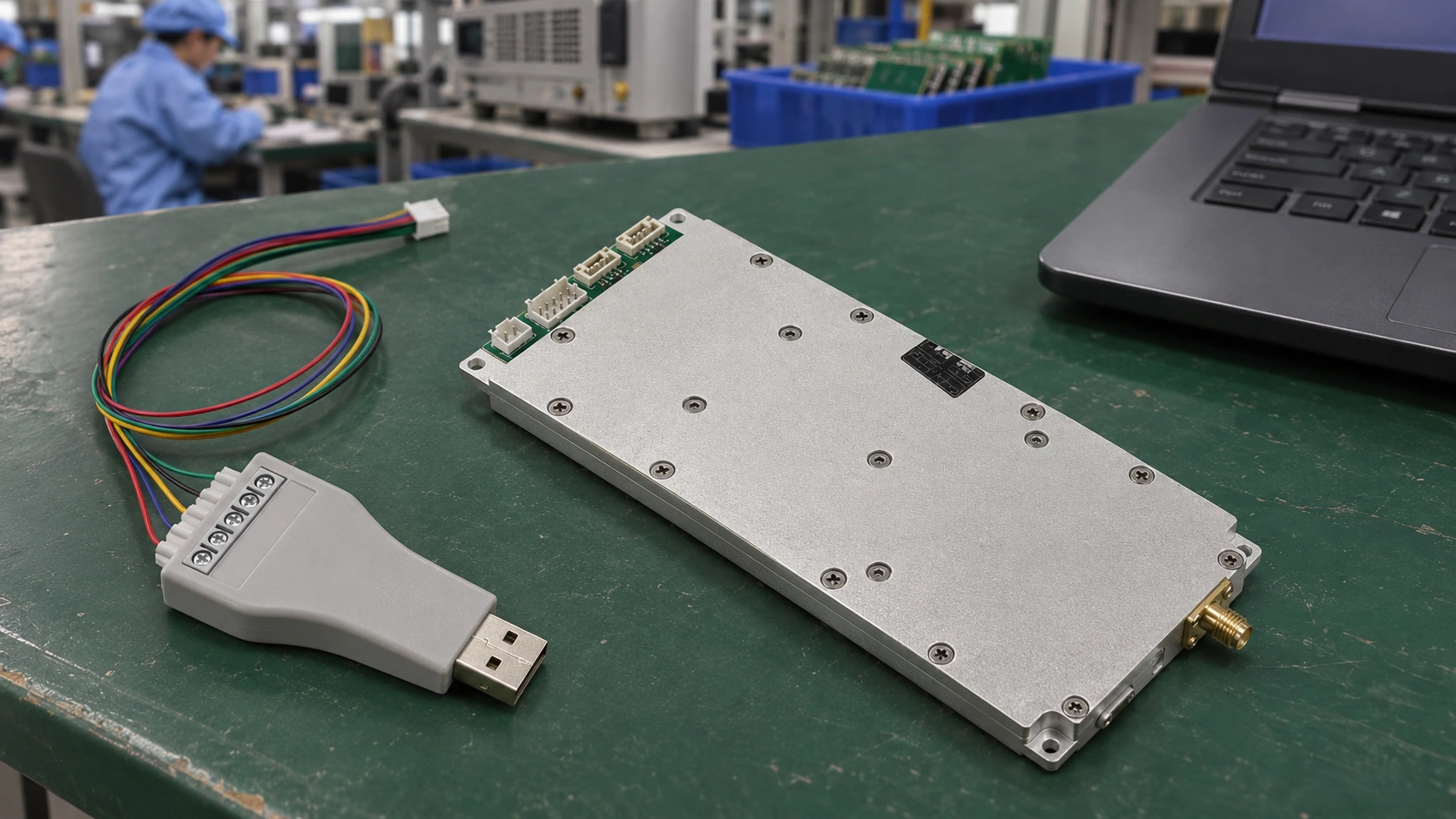
For an RF signal generator module evaluation, CorelixRF can supply the CRF-SDR-100M6000M-200M and help review configuration and documentation requirements. Use that reference model to start a specific discussion about the transitions and acquisition window your equipment needs.
Before comparing RF source settling time figures, establish which delivered configuration and protocol the information applies to. Ask what starts the timing record, which frequency and level conditions it covers, and which supported function the host would use.
The reference model is a starting point for that review. It is not a promise of a particular switching speed, supported list/trigger mode, software interface or complete test-system performance. Keep an unconfirmed function or timing value as an open requirement until the applicable evidence supports it.
6. Start with Three Inputs, Not a Completed Test File
You do not need a finished timing report to start the configuration discussion. Send what you already know:
- The transition: typical start/end frequencies and output levels, with the signal mode.
- The acceptable error: the frequency and amplitude criteria your measurement needs.
- The test arrangement: your host/control and acquisition method, plus the point cadence you are trying to achieve.
If an item is undecided, say so. Add timing traces and protocol details as the discussion becomes more specific.
Discuss your source timing and configuration requirements with CorelixRF. Keep the required behavior separate from a claim about what a particular configuration already does.
Optional: keep an eight-field transition record for the detailed review
| Field | What to retain |
|---|---|
| Configuration | Exact source, delivered options/firmware and applicable documentation. |
| Transition | Start/end frequency and level, plus the actual signal mode. |
| Criteria | Frequency and amplitude tolerances, units and required valid duration. |
| Time reference | Defined event, clock/trigger correlation and observable timestamps. |
| Source window | Qualified interval and time-resolved evidence, not only a first crossing. |
| Acquisition | Receiver/path readiness and the complete acquisition interval. |
| Limits | Resolution, corrections, measurement limits and the agreed guard/uncertainty treatment. |
| Disposition | Supported conclusion, missing evidence and the next responsible action. |