
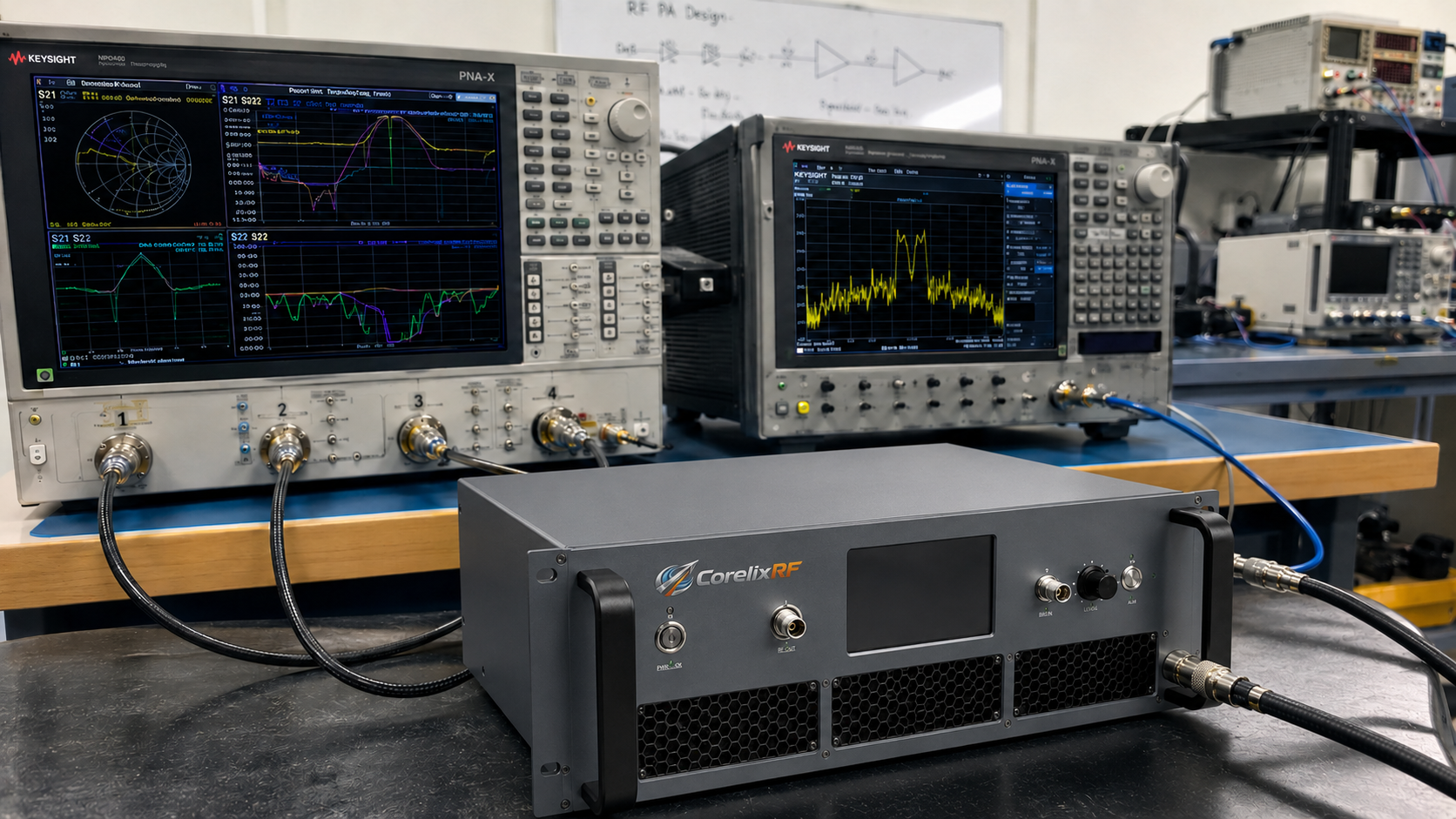
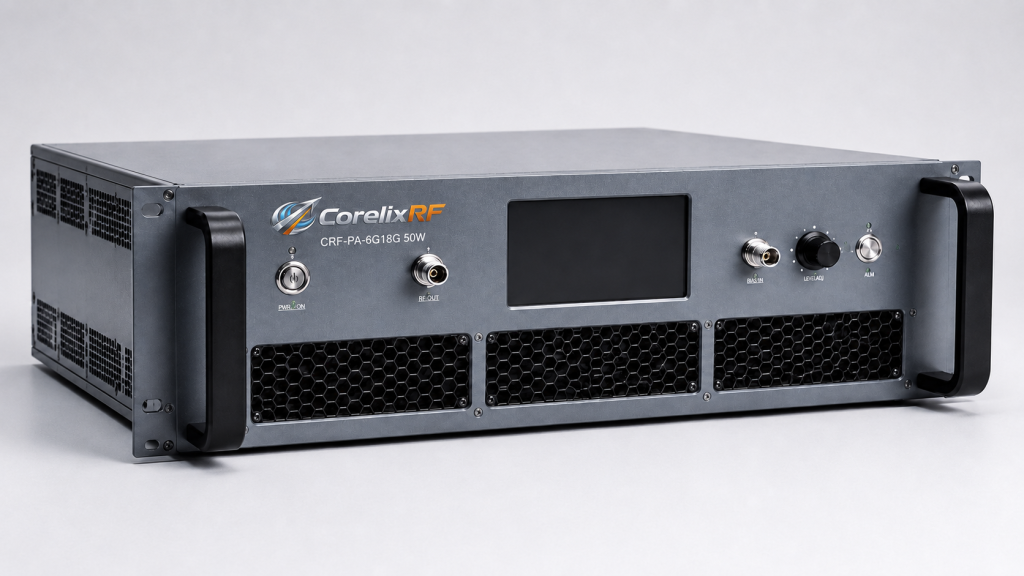
A 6–18 GHz amplifier must support the required RF path at every relevant test frequency. The CorelixRF CRF-PA-6000M18000M-50W combines a published 50 W minimum output with a 19-inch 3U air-cooled enclosure. Selection depends on the output definition, waveform and installed load; the power label alone cannot establish chamber field strength or successful EMC acceptance.
Check usable output across the required band
Start from the calibrated test requirement and losses between the amplifier and antenna reference planes. Include the modulation, dwell and required spectral limits. Ask for output and compression behavior at the frequency points that constrain the test. Minimum small-signal gain helps assess drive needs at low signal levels, but it cannot predict the complete high-power transfer curve.
| Item | Published rack configuration |
|---|---|
| Frequency / output | 6–18 GHz / 50 W minimum |
| Small-signal gain / flatness | 47 dB minimum / −4 to +4 dB |
| Maximum RF input | 0 dBm |
| Harmonics | −15 dBc typical; −8 dBc maximum |
| RF input / output | N-Female / N-Female |
| Supply / enclosure | AC 220 V ±10%, 50/60 Hz / 19-inch 3U |
The electrical table uses a 50 Ω system, rated AC supply and the standard production-test configuration. Its output entry does not establish P1dB or usable linear output for every waveform. Preserve the distinction between typical and maximum harmonic entries when comparing a spectral requirement. Obtain results for the intended operating point and any required filtering; neither a nominal 50 W label nor a typical harmonic value proves compliance.
Evaluate the complete N-type load path
Verify the actual connector specification and every mating cable, switch and load across the full frequency range and power profile. The N-Female entry does not establish the rating of a generic N-type accessory. Measure path loss and return loss where they affect available power. Maintain strain relief and repeatable connections during calibration and use.
VSWR protection and alarms are listed, without a numerical survival envelope or output-foldback curve. Request permitted mismatch, phase/frequency conditions, trip behavior and recovery. A reflected-power fraction calculated from VSWR does not predict the amplifier’s actual delivered power after its protection responds. Avoid treating a reflection calculation as a full-reflection survival test.
Fit cooling and host control to the rack
Air cooling and a 0 to +50°C operating ambient are listed. Confirm airflow direction, rack clearance, room heat removal and the permitted run profile for the final unit. The sheet does not specify redundant fans, a fan-failure operating mode or a 24/72-hour burn-in requirement. Assess thermal stability using agreed duration and limits rather than importing those features from another chassis.
RS485/LAN is listed for control. Temperature/current monitoring is listed, while forward/reverse power monitoring and LAN remote monitoring are optional. Confirm fitted functions, protocol, startup state and communication-loss behavior before writing the host driver. An interface name alone does not establish software compatibility, calibrated power readback or an automatic source-shutdown interlock. For the related system or selection decision, see Replacing an EMC RF Amplifier Without Losing System Compatibility.
Compare records from the intended configuration
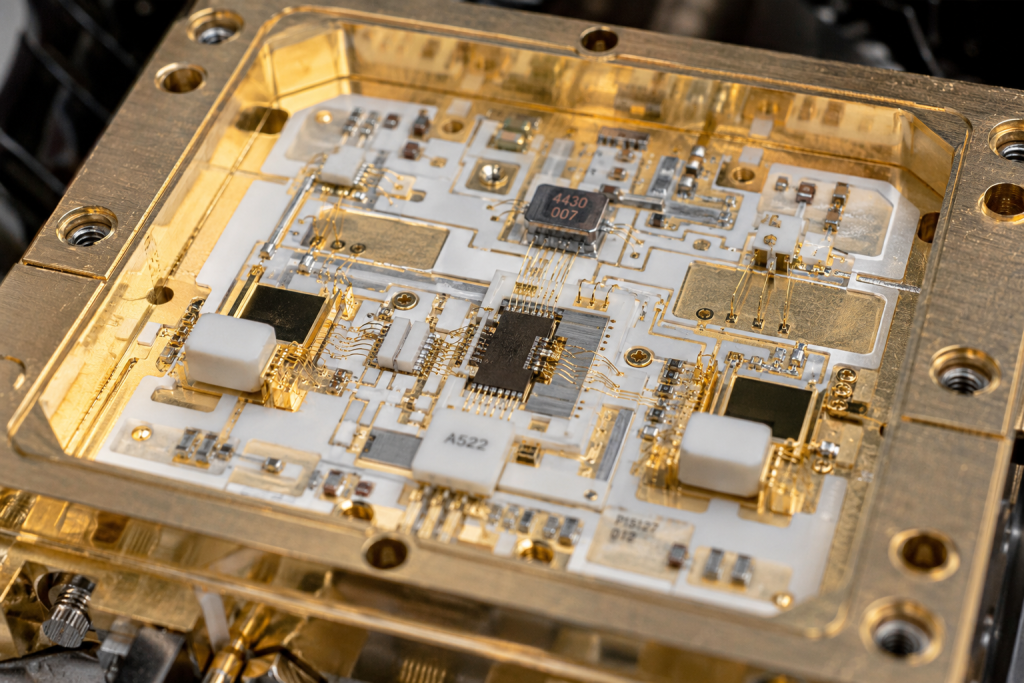
Retain corrected output-versus-frequency, drive/linearity results, spectral measurements and thermal trends with the waveform, load and instrument setup. Keep protection checks within an agreed permitted test envelope. The RF amplifier measurement guide explains how these records complement each other. A small-signal VNA trace cannot replace high-power output, harmonic or fault-response measurements.
Compare EMC amplifier configurations using the same required output and distortion conditions. To review a 6–18 GHz 50W rack requirement, send the calibrated power need, waveform, source limits, antenna/load data, rack airflow and required remote channels. Include the spectral limit and acceptance records the laboratory needs.