
An RF amplifier test-report comparison begins by aligning identity, reference planes, and operating conditions before interpreting a numerical difference. A difference is not resolved by selecting the more favorable value. Build a comparison that preserves the original figures, identifies incompatible conditions, and separates missing information from a confirmed defect.
Establish identity before comparing performance
Record model, suffix, hardware revision, serial number or batch, test date, and report revision. Similar model names do not establish that two files refer to the same configuration. Where identity is absent, describe the result as a comparison of documents rather than a verified comparison of one DUT.
Keep the raw files unchanged and reference their filenames and versions in the comparison record. A corrected report should explain the correction and preserve the original, not silently replace it.
Align the measurement boundaries
Identify input/output planes and frequency-specific cable, adapter, coupler and attenuation corrections. The gain and noise reference-plane review explains why an instrument result and a DUT result can cover different hardware. Do not apply a correction from another path configuration.
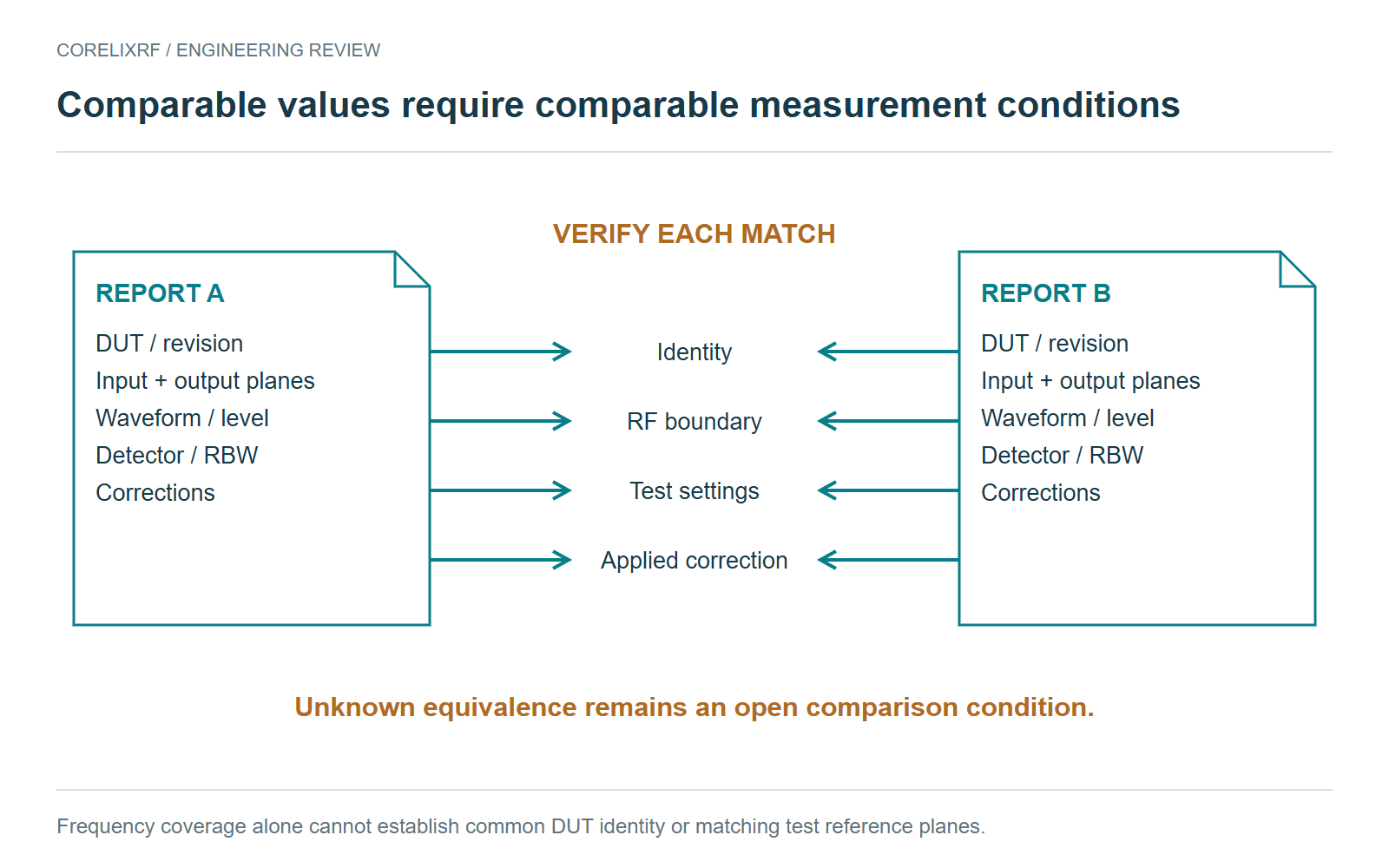
For spurious data, align examined frequency, carrier reference, dBc definition, bandwidth, detector and operating state. The RF amplifier specification guide separates the quantities being compared; a matching unit label alone does not align measurement settings.
Work in order: establish object and revision, align overlapping frequencies and planes, make only valid unit conversions, then classify the remaining difference. Converting the same power between dBm and watts is arithmetic; reconciling different carrier references or measurement bandwidths requires setup evidence.
Preserve a real unresolved discrepancy
The supplied 6–18 GHz report and raw spurious export contain an unresolved summary-versus-sweep difference. Keep its original figures and identification issues in the ledger below instead of choosing the more favorable source.
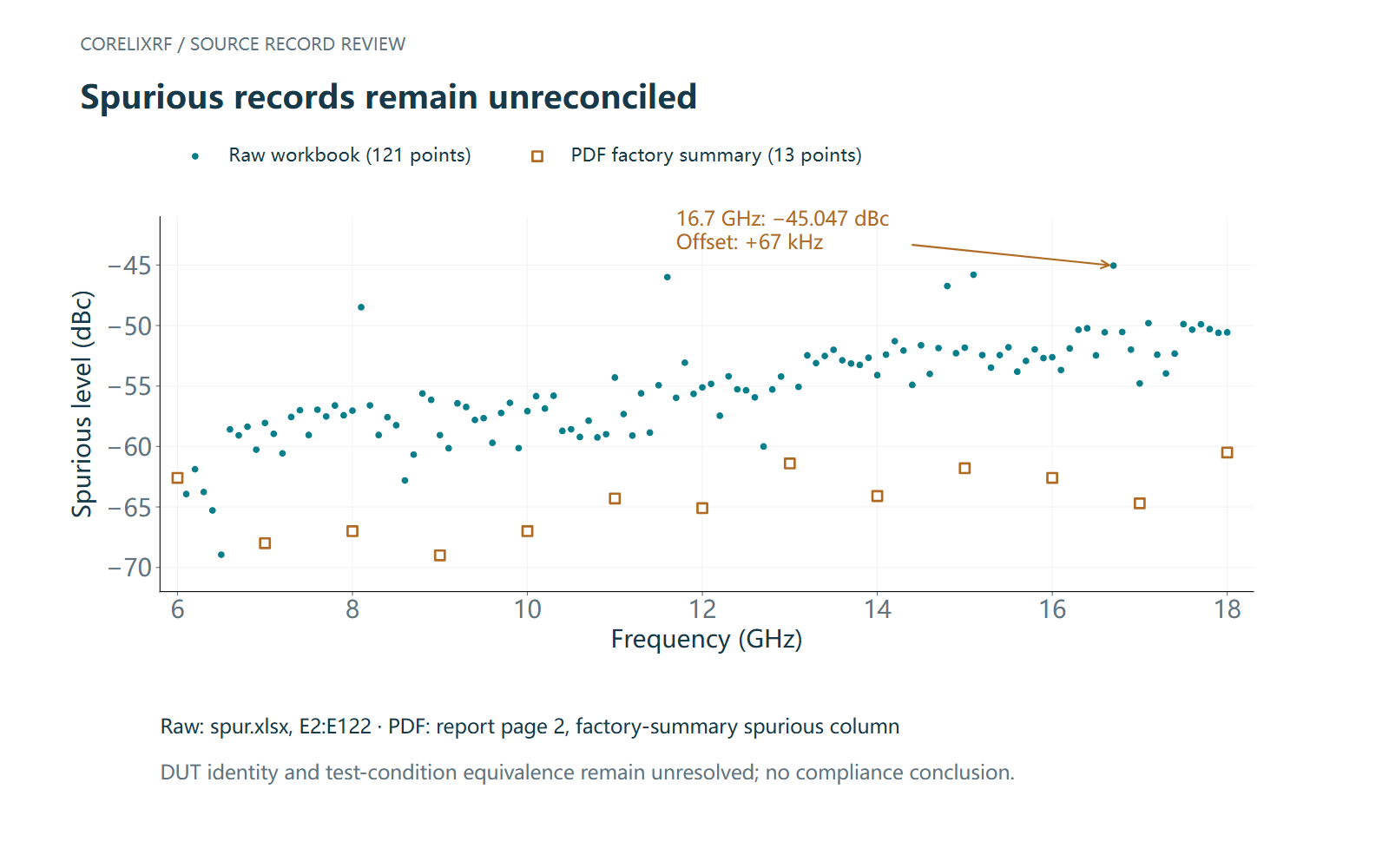
Request matching DUT identity, setup and report aggregation to resolve this entry. Until then it supports neither a blanket failure conclusion nor a compliance claim.
Use a discrepancy ledger
For each disputed item, record the value in each source, units, applicable conditions, whether the items are directly comparable, and the next evidence needed. Separate arithmetic errors, missing conditions, version mismatches, and results that remain contradictory after alignment.
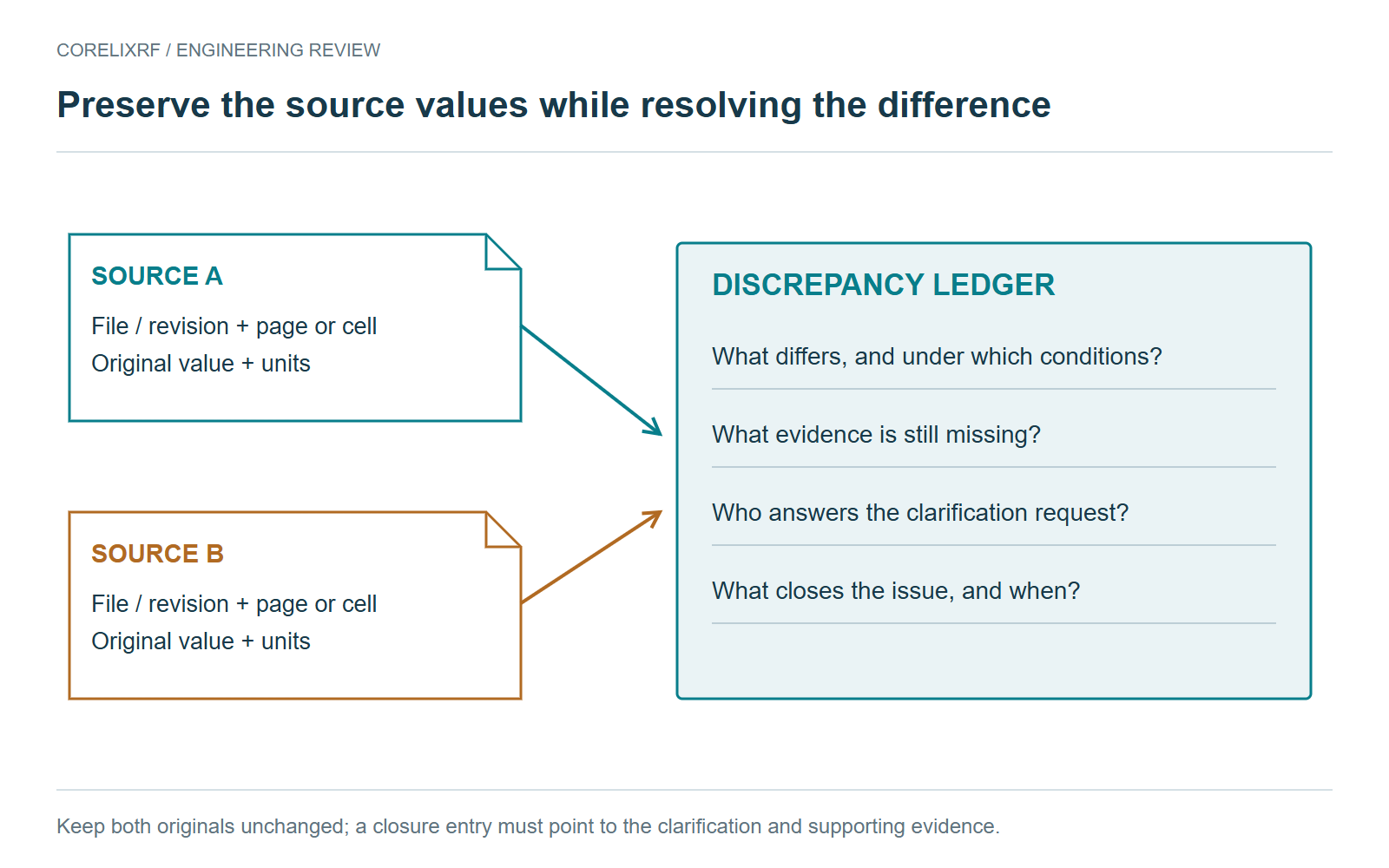
If repeat testing is required, agree the setup and acceptance criterion before the run. Do not convert a newly obtained typical result into a guaranteed specification. Close the entry only when the reason for the difference and the authorized disposition are documented.
This work begins after data have been received. The earlier buyer test-data request defines what to ask for; this page defines how to reconcile what arrived. Use the RF power amplifier platforms page to compare the product family, then request the exact configuration and evidence required by this review.
Example ledger for the supplied 6–18 GHz files
The PDF report CRF-TR-PA600018000-100-20260813 and the raw exports provide a useful document comparison. The PDF filename includes 100W-M, while its identification table lists CRF-PA-6000M18000M-100W. Preserve both labels until the configuration is identified.
| Item | What the files show | Disposition |
|---|---|---|
| Unit identity | PDF unit ID / serial number: not provided | Do not declare a verified same-unit comparison |
| Dates | Report issue date: 2026-08-13; test date: not provided | Do not use the issue date as the measurement date |
| Spurious summary | PDF factory-summary worst value: approximately −60.5 dBc | Retain as the report summary, with its own frequency coverage |
| Raw spurious sweep | spur.xlsx: 121 points; −45.047 dBc at 16,700 MHz, reported offset +67 kHz | Retain as the raw entry; reconcile setup and aggregation before closing the difference |
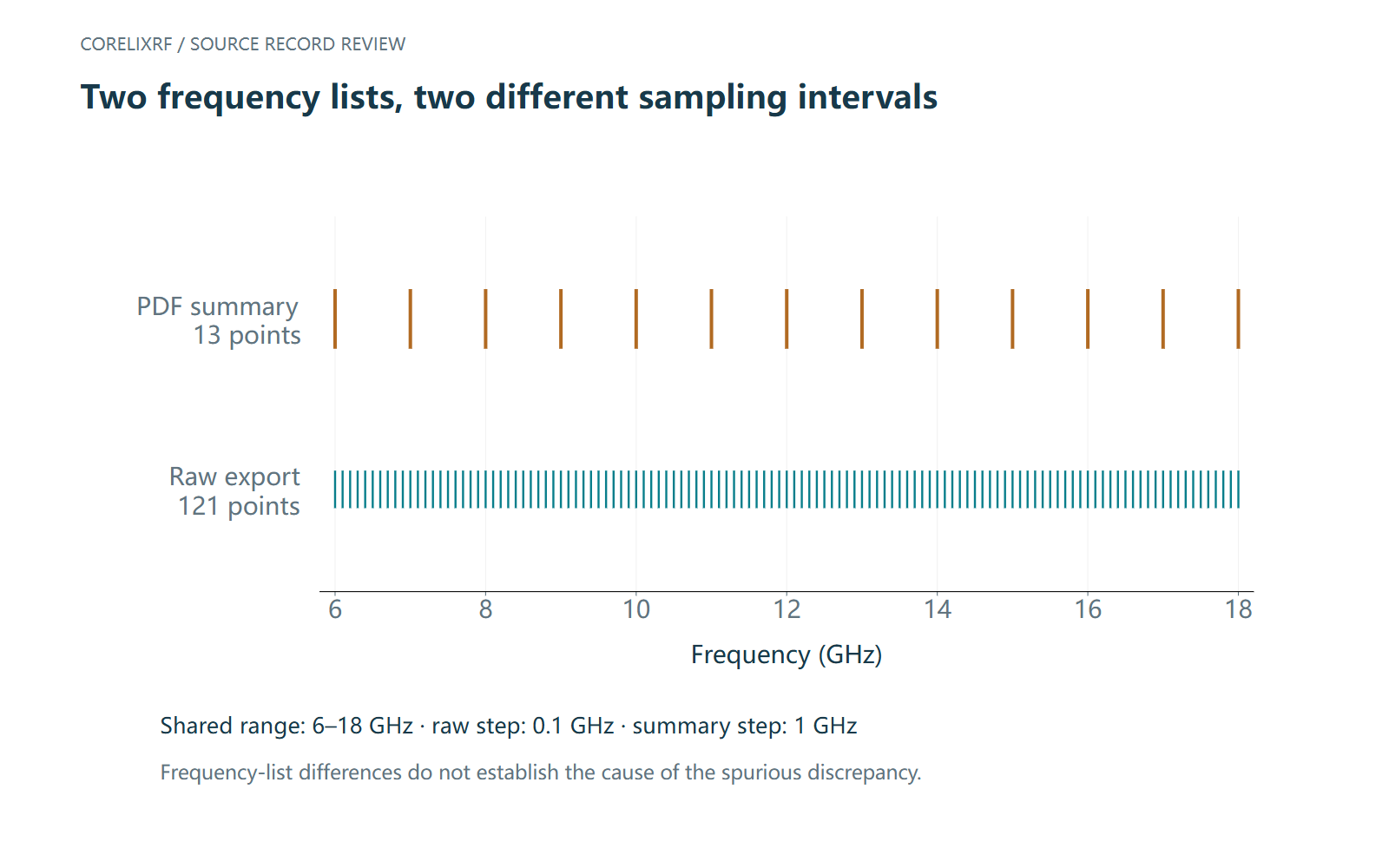
Compare the report’s 13 summary points with overlapping points in the 121-point export, then assess additional frequencies separately. The gain-flatness review demonstrates why conclusions depend on the stated point set. Different lists are a condition to investigate, not proof of the discrepancy’s cause.
For the spurious entry, bind the PDF summary location to the spur.xlsx row, 16,700 MHz point and +67 kHz offset. Add the closing file, page or sheet, revision and accepting reviewer when a matched record, explained scope difference, calculation correction or agreed repeat resolves it. Retain both original values while open and preserve unrelated usable measurements.
Send filenames, revisions, disputed points and original values with a CorelixRF report-clarification inquiry, checking the factory testing and documentation scope for requested files. The separate efficiency test-data review addresses missing or invalid DC inputs; it does not resolve this spurious discrepancy.
Submit the two report revisions, exact amplifier configuration, and test-condition differences requiring clarification.
Clarify Amplifier Test Reports