
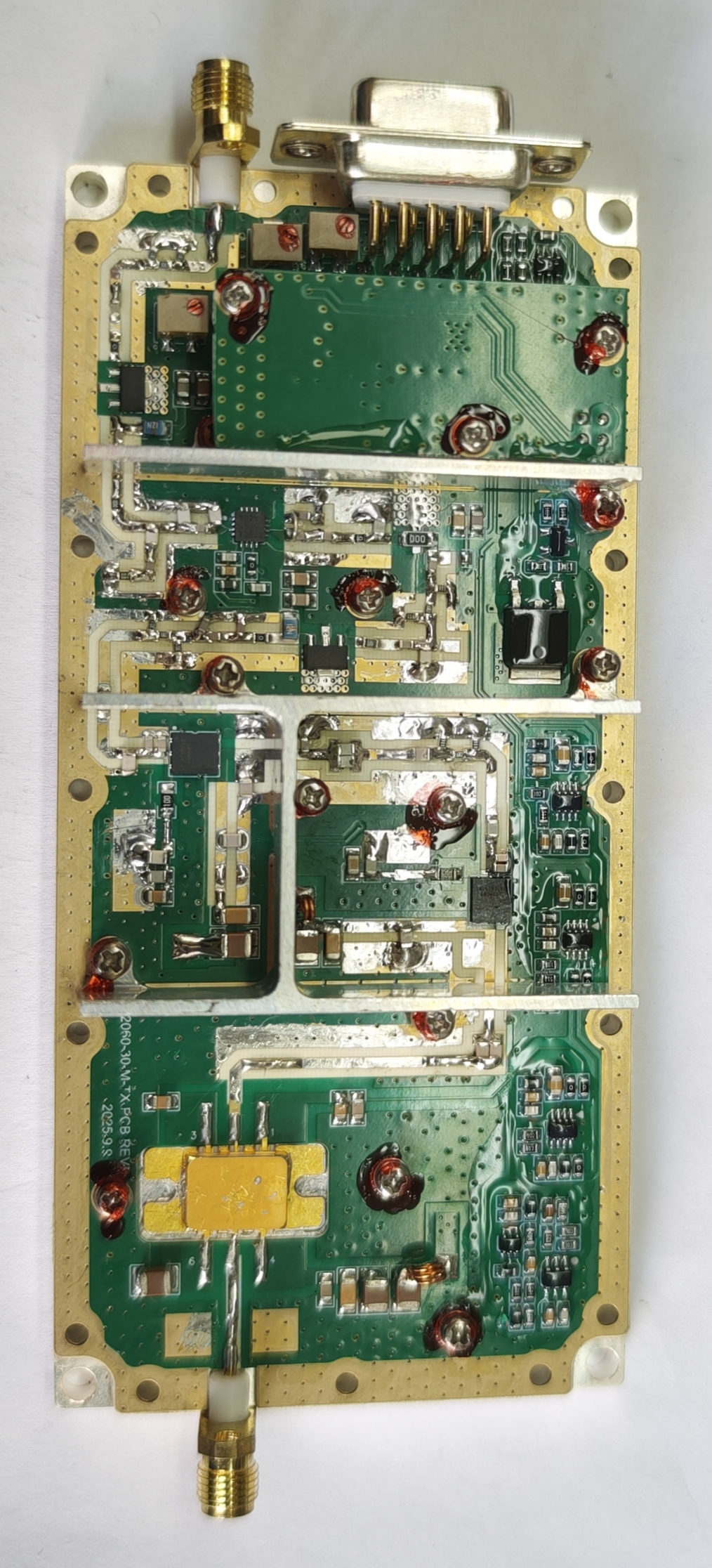
SSPA reliability and observed availability require separate failure, downtime, and recovery records. Semiconductor construction alone does not prove uptime, outdoor qualification, or maintenance-free operation. Begin with the service that must remain available and the evidence used to count an interruption.
Define the unavailable state
Decide whether loss of RF output, reduced output below a required level, a control failure, or a protection trip makes the service unavailable. Use the same definition across the observation period. Record planned maintenance separately if the contract treats it differently from unplanned downtime.
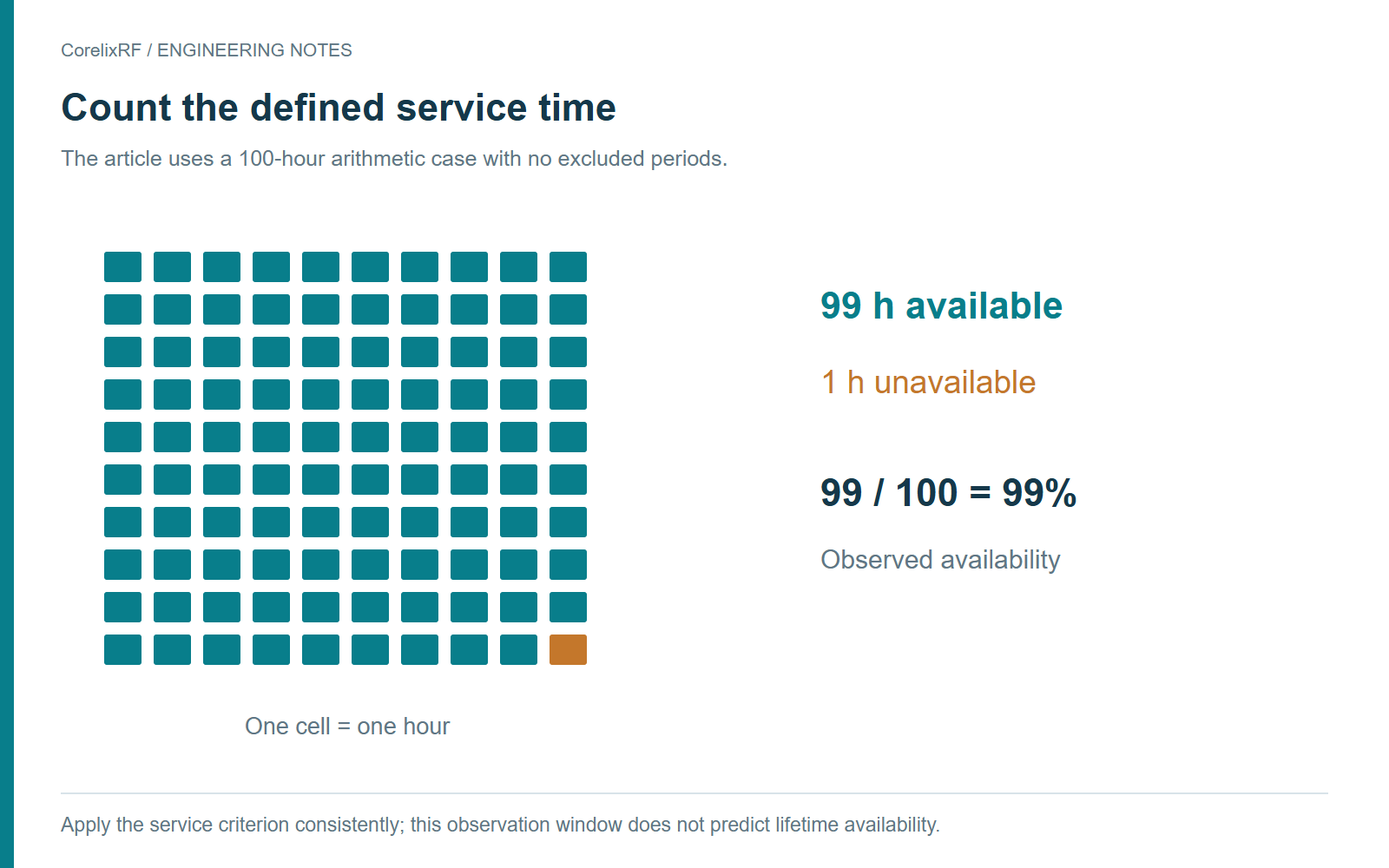
For a defined service window, observed availability is available time divided by included observation time. Keep the ledger below separate from RF amplifier reliability evidence, which concerns failure and exposure claims rather than this service-time fraction.
Account for service time before quoting availability
This hypothetical ledger counts all 100 h, including any maintenance, and counts 1 h as unavailable under the agreed service criterion. If a real contract excludes planned maintenance, state its duration and adjust the denominator explicitly rather than silently deleting downtime.
| Time category | Example | Treatment |
|---|---|---|
| Observation window | 100 h | Use the defined service window as denominator |
| Unavailable service | 1 h | Count according to the stated service criterion |
| Available service | 99 h | 99 / 100 = 99% observed availability |
| Excluded periods | None in this example | Disclose any exclusions in real records |
The result is 99% observed availability for this window only. Retain event start, restoration confirmation and excluded periods with the calculation; the short observation does not establish long-term availability or automatic failover.
Trace the causes outside the RF device
Associate each interruption with symptoms and conditions, checking supply, cooling, interconnects, controller and load. RF amplifier overheating diagnosis examines a temperature-related interruption; RF amplifier thermal management checks whether the installed cooling boundary is appropriate. An alarm alone does not identify the root cause.
Preserve temperature location, supply readings, forward or reverse power where actually available, event timestamps, and the actions taken. Do not invent telemetry channels because a general product description mentions monitoring.
Trace a recovery event through fault occurrence, diagnosis, spare-part wait, repair, and service-restoration confirmation. Preserve unknown timestamps. Reducing diagnosis time needs troubleshooting evidence; reducing spare wait needs logistics evidence. A shorter total recovery time alone does not identify which part improved or establish a lower hardware failure rate.
Evaluate recovery and redundancy as system functions
A spare module does not establish failover. Define fault detection, the change command, switched interfaces and verification of restoration. Check shared supply, cooling and control dependencies through the RF service continuity review before treating a second path as independent.
Keep the discussion tied to the documented configuration. Do not claim uninterrupted output from the mere presence of two amplifiers. Where automatic recovery is not specified and tested, describe the actual manual recovery procedure and its measured duration.
Turn the record into a maintenance decision
Choose maintenance work from the recovery breakdown: slow diagnosis calls for better fault evidence; spare-part waiting calls for logistics work; repair delay calls for access or repair-process changes. A replacement also needs the RF amplifier replacement compatibility review. Record which segment the action is intended to shorten and verify it on later events.
Review changes against the approved operating limits rather than proposing an unsupported derating percentage. The resulting output is an availability and recovery review with identifiable evidence gaps. Architecture comparisons belong in SSPA versus TWTA; this page evaluates the operation of the selected system.
Share the SSPA configuration, operating history, and replacement or maintenance-interface questions for the RF hardware. Use the RF power amplifier platforms page to compare the product family, then request the exact configuration and evidence required by this review.
Discuss SSPA Hardware Support