
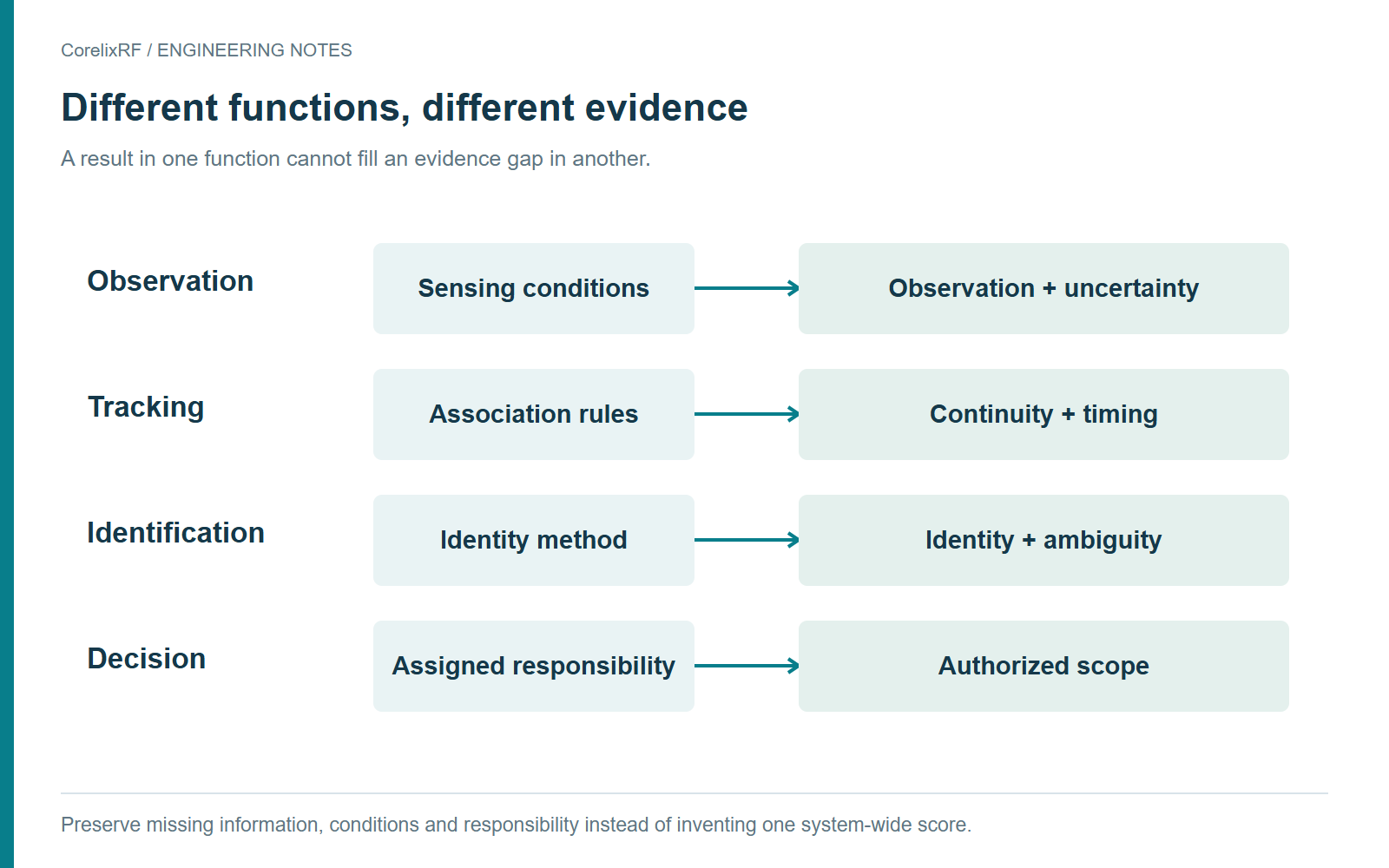
A counter-drone technology comparison starts with what each route can observe: RF sensing examines radio emissions, radar examines reflected signals, optical systems examine imagery, and acoustic systems examine sound. Compare their evidence against the same required detection, tracking or identification task before considering a separate response function.
Separate the required functions
A radio observation, an image and a track report are different outputs. Specify what must reach the next decision: an alert, a location, a continuous track or a supported identification. Combining outputs also needs multi-sensor data association testing for timing, duplicate observations and conflicting records.

Split a broad request to ‘identify a drone’ into an observation, a maintained track if required, an identification criterion, and a separately authorized response decision. A sensor observation may provide an input to later processing without establishing identification. Keep unanswered functional requirements visible rather than assigning them to a technology label. For the component portion of the requirement, review the RF front-end platform scope and keep its hardware responsibilities separate from complete-system outcomes.
Compare the observation routes
The comparison below uses the FAA’s technical considerations and CBO’s 2026 technology review as technical background, without adopting their scenarios as product specifications. Ask suppliers for evidence under the required site conditions.
| Route | Observation and dependencies | Comparison limit |
|---|---|---|
| Passive RF-link sensing | Receives emissions within its covered signals; may depend on signal recognition | No relevant detectable emission means this route has no link signal to observe; check RF background |
| Radar | Observes transmitted-energy returns; depends on target and clutter conditions | Test hovering and small-target cases as required; a return is not identity |
| EO/IR | Provides imagery in the sensor’s field of view; cueing and image quality matter | Verify acquisition and validation under relevant viewing conditions |
| Acoustic | Observes sound; depends on the target’s acoustic signature and background | Compare recorded noise and propagation conditions; do not borrow another route’s coverage |
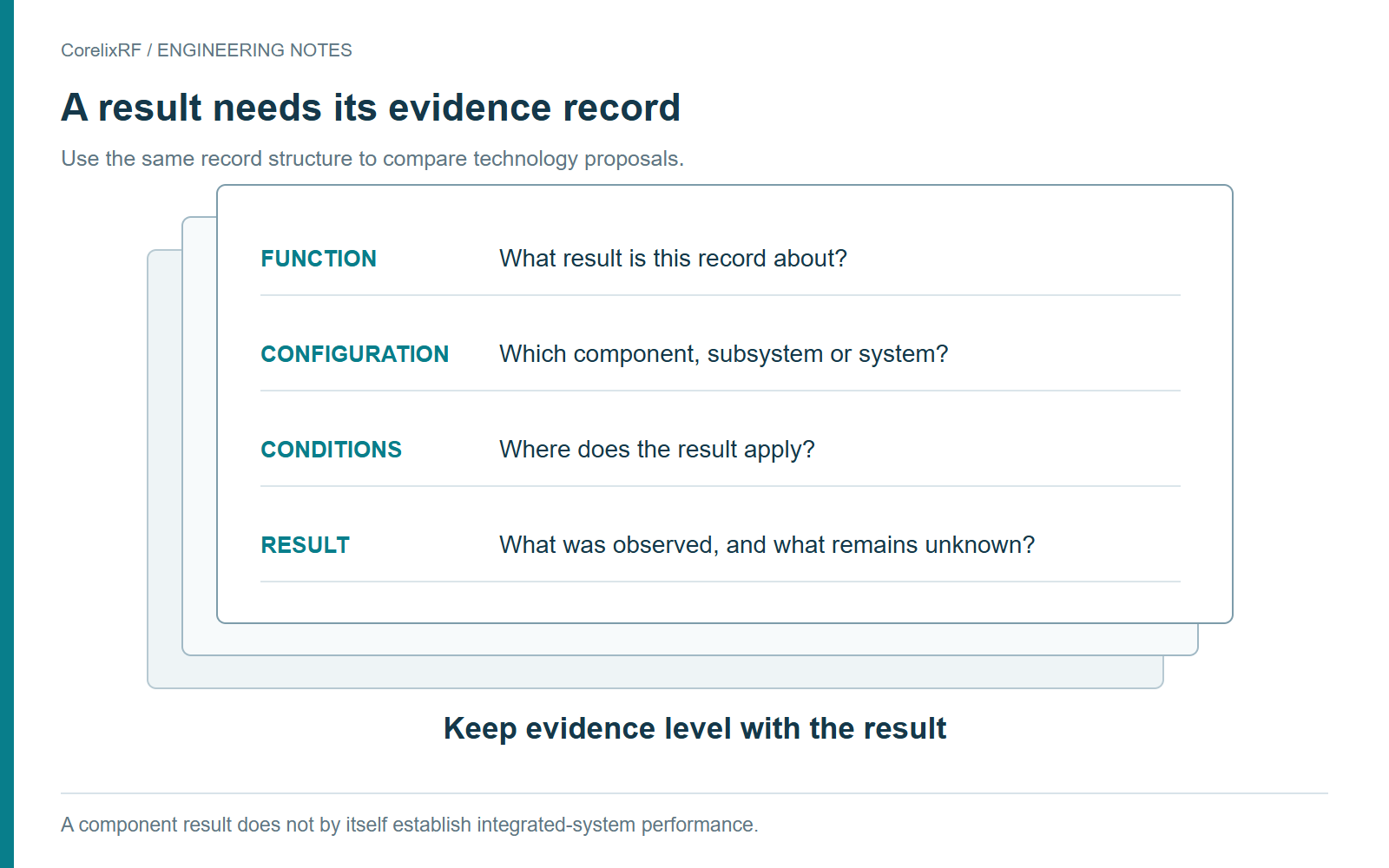
For one requirement to observe an aircraft that has no detectable radio link, passive RF-link sensing leaves a gap; a radar or optical route needs evaluation on its own conditions. Conversely, a radio observation can add information unavailable from an image alone. Complementary inputs still need a tested association and decision process.
Review authority separately from capability
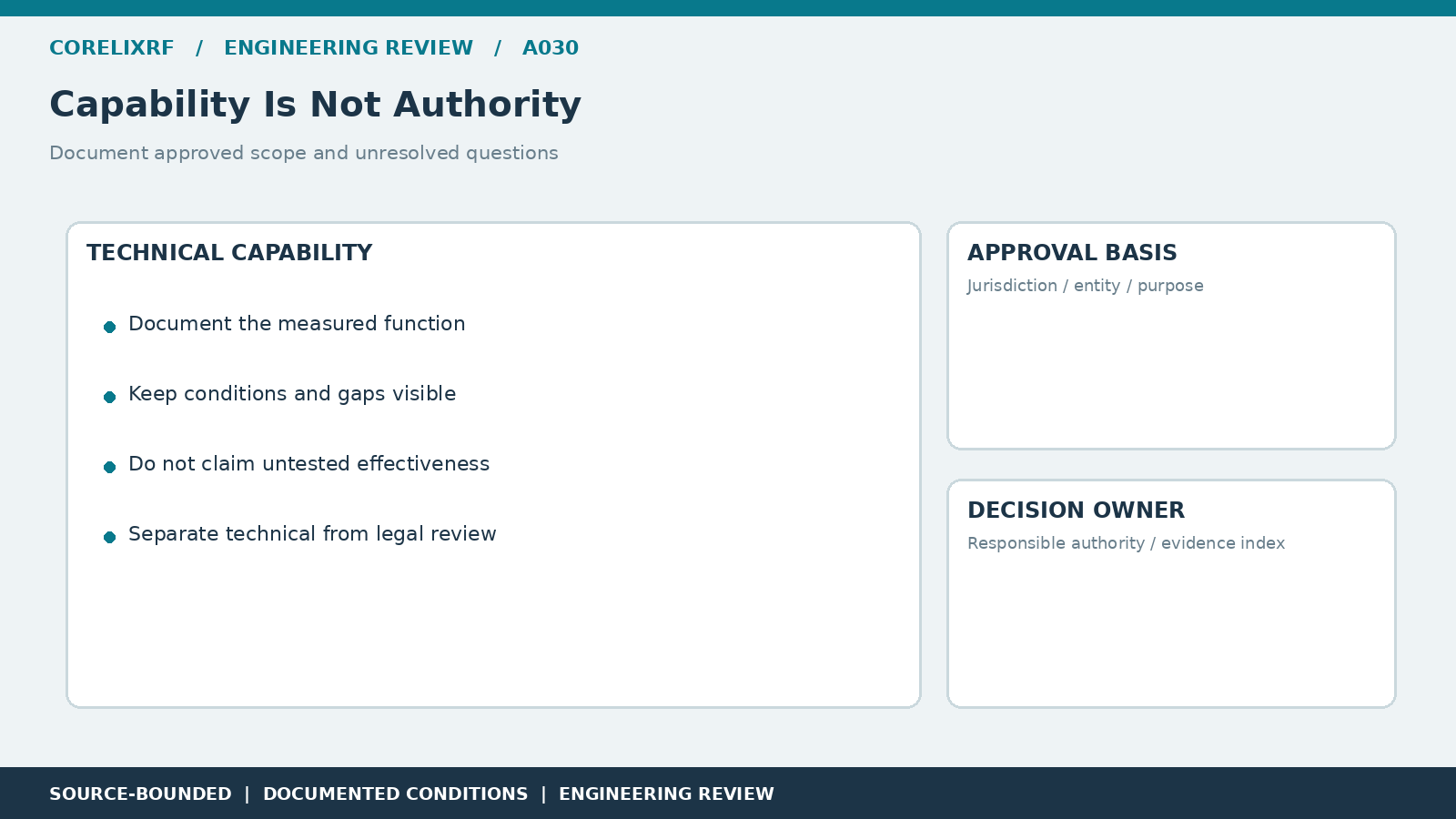
The ability to perform a technical function does not establish permission to perform it. Identify the jurisdiction, responsible entity, activity, and current approval basis. The compliance evidence index provides a structure for that record.
Test the required function across routes
For each route, require its observation criterion, missed and false observations, timing and uncertainty under the same relevant scenario. For tracking, verify continuity rather than counting repeated alerts. Identification needs its own ambiguity rule. A multi-object claim also needs multi-target capacity testing with a defined count, concurrency and observation interval.
A bundled proposal must identify which route supplies each required function. Use RF hardware supply-scope review to assign delivered and external items, then supplier evidence comparison to compare offers against the same requirement. A missing processing function cannot be repaired by adding a power-amplifier specification.
Choose the routes to evaluate from the unmet observation and validation tasks, stating the conditions still to test. Carry that choice into counter-UAS system architecture for function and interface allocation. Keep sensing, operator assessment and any authorized response as separate responsibilities; no universal success rate or route ranking follows from this comparison.
Identify the RF component function and interfaces assigned by your project's selected technology route.
Discuss RF Component Functions