
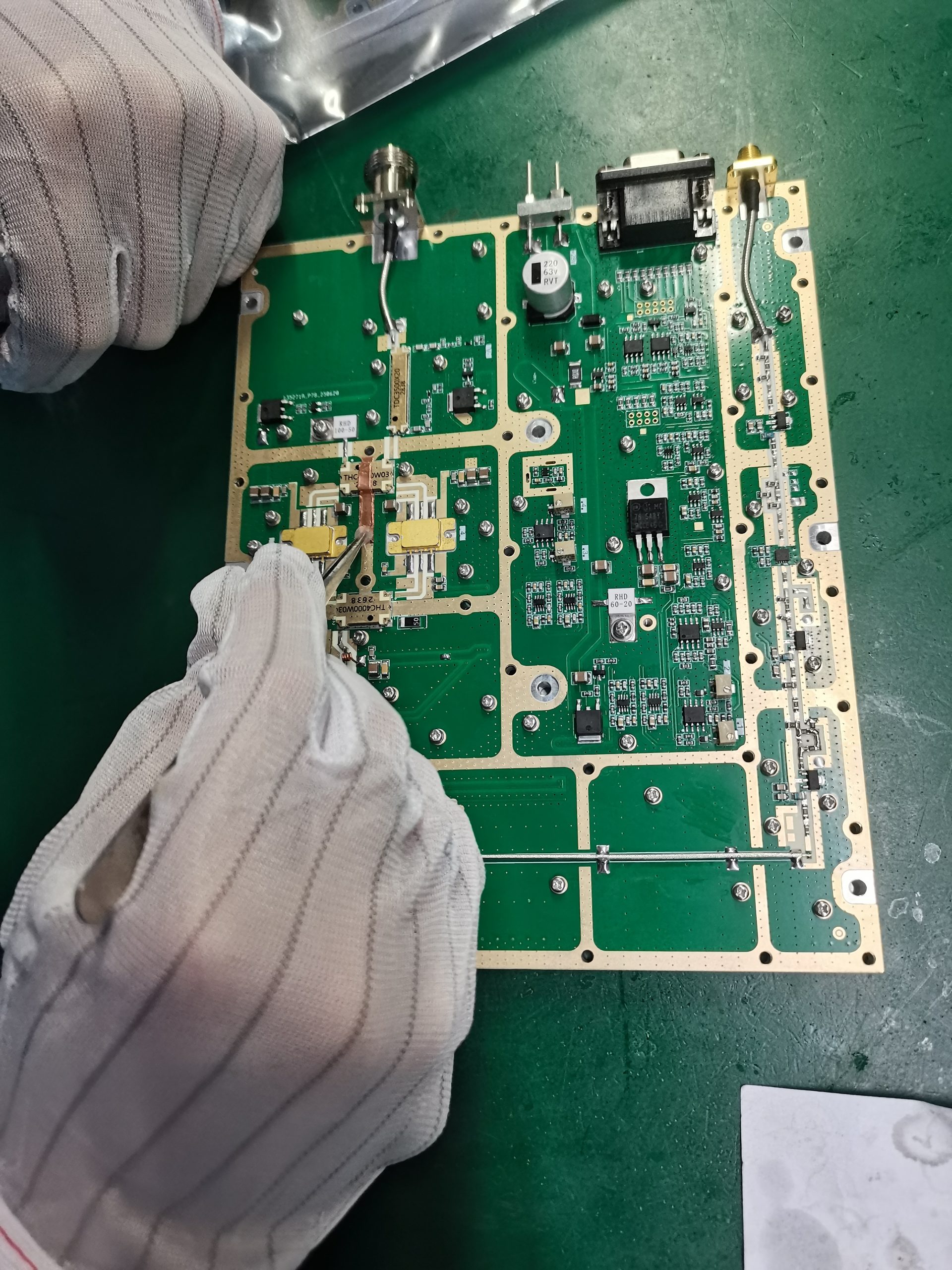
GaN power amplifier efficiency comparisons need the same efficiency definition, operating point, and evidence level before candidates can be ranked. A useful comparison aligns the frequency, waveform, RF output point, electrical-input boundary, and thermal conditions. Without that alignment, two efficiency numbers may describe different engineering tasks.
Compare the same quantity
Label each figure as drain efficiency, PAE or another explicitly defined boundary before comparing it. The numerator and included electrical loads must match; otherwise identical source data can yield different efficiency percentages. Keep the boundary definitions in the matrix below.
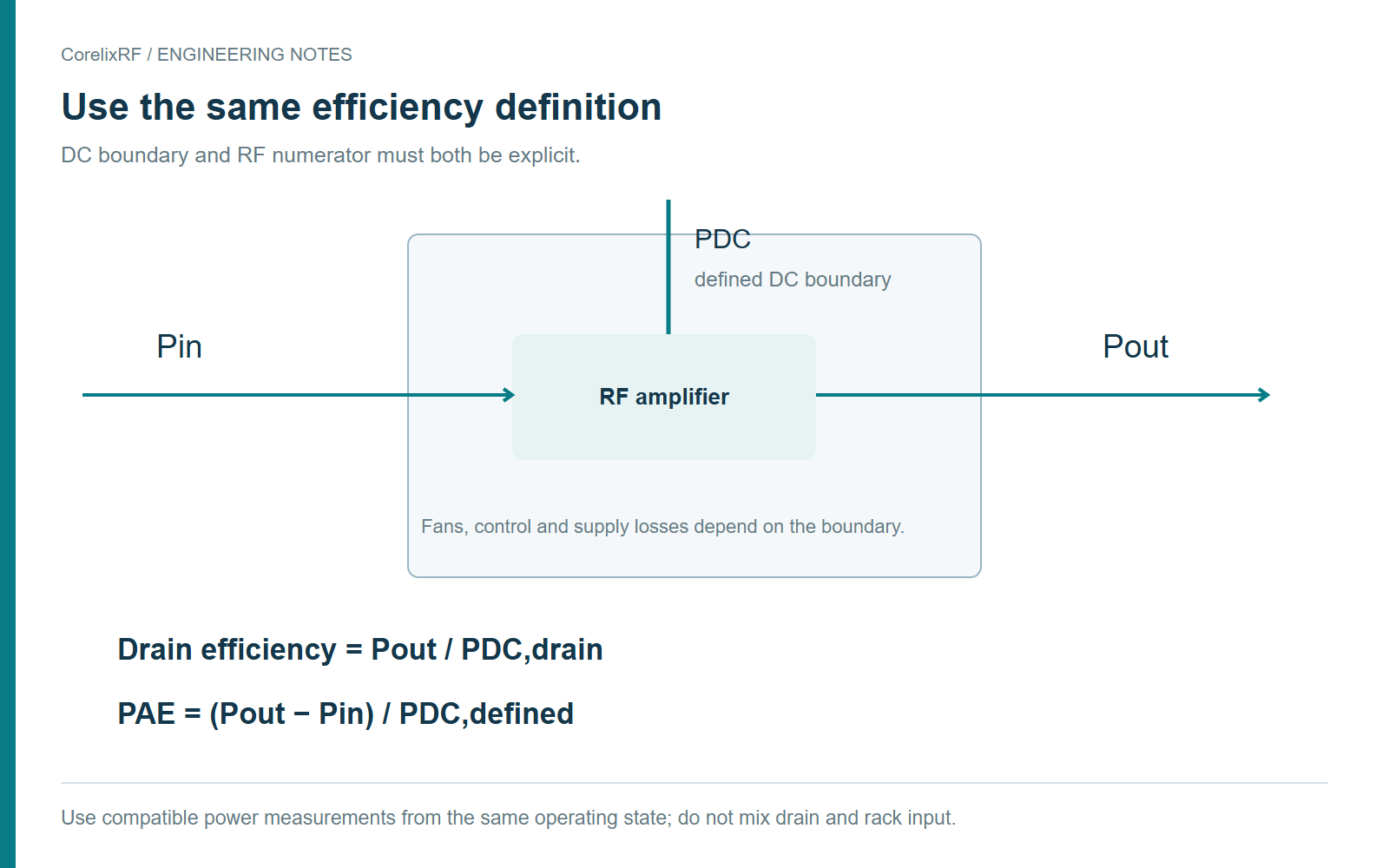
Keep rated, typical, and measured values separate. Do not compare a guaranteed requirement from one source with a best-case sample result from another without identifying that difference.
Align output and waveform
Align frequency, waveform, bandwidth, average/peak convention and back-off reference. GaN amplifier applications adds the integration and output-quality conditions needed for the requested use; saturation data alone cannot establish the linear operating point.
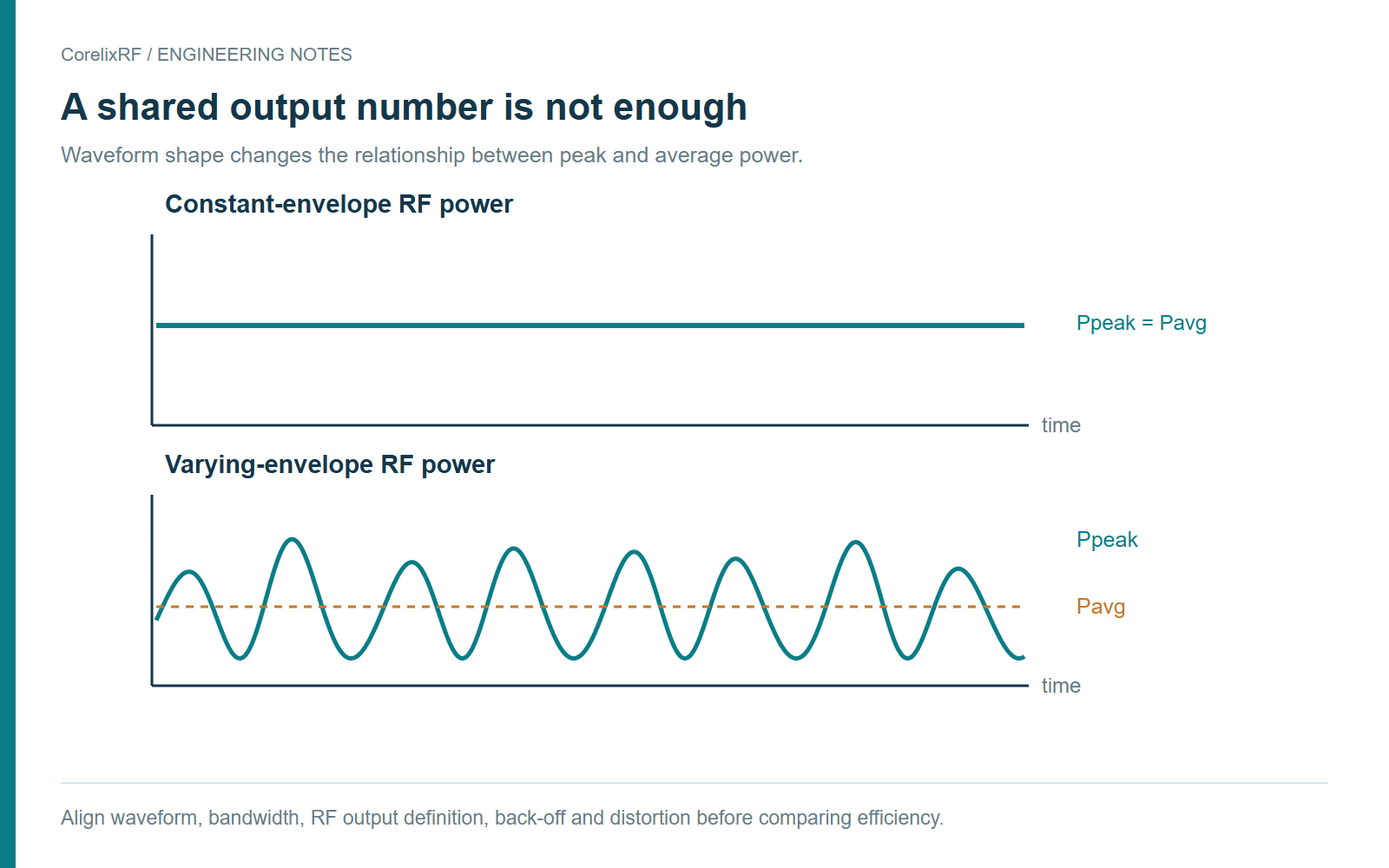
If the two amplifiers meet different distortion requirements, the efficiency comparison is incomplete. Ask for results at matching conditions, or report that a direct ranking is not supported by the supplied evidence.
Preserve the thermal boundary
Document supply and current at the relevant input boundary and the cooling conditions used. A lower electrical consumption figure must not be combined with RF output from another run. Avoid inventing a heat-dissipation or temperature-rise figure from a missing current value.
The comparison table should show metric definition, conditions, evidence type, and unresolved mismatches before any ranking. It evaluates documented implementations, not a universal ranking of semiconductor materials. The modulated operating-point review addresses efficiency and linearity within one signal requirement.
Build the comparison matrix before ranking candidates
Complete the same fields for both candidates. A missing entry is a limit on the comparison, not evidence that the candidate performs poorly.
| Comparison field | Record for each candidate | Requirement for a direct comparison |
|---|---|---|
| Metric and electrical boundary | Drain efficiency, PAE, module DC conversion, or complete-system input | Same numerator and included electrical loads |
| Frequency and signal | Test frequency, waveform, occupied bandwidth and duty where relevant | Matching conditions for the intended use |
| RF operating point | Input/output reference planes, output definition and back-off reference | Comparable useful RF output |
| Signal quality | Applicable EVM, ACPR/ACLR or other specified criterion, with settings | Both candidates satisfy the same service requirement |
| Supply and cooling | Voltage/current measurement points, cooling and temperature points | Explicit, comparable test conditions |
| Evidence strength | Specification limit, typical value or identified test result | Keep guarantees and observations distinguishable |
Resolve three mismatches separately: efficiency definition, waveform/operating point, and evidence strength. A shared GaN label removes none of them. A broader GaN versus GaAs or GaN versus LDMOS comparison is a different task and still needs matched implementation evidence.
Use the available reports without creating a false ranking
The supplied 2–6 GHz reports contain current entries, whereas the 6–18 GHz workbook lacks usable current for its efficiency formulas. The efficiency test-data review traces that specific gap. These files illustrate why product data cannot be spliced together; this discussion has not verified their GaN device identity and does not present them as a GaN technology ranking.
Retain matching gain or output observations where identity and setup support them, while leaving the efficiency comparison open. The comparison outcome is either a set of matched operating points or a precise list of mismatches to resolve, not rejection of every useful RF record.
Attach the matrix to a CorelixRF RF inquiry when an offer depends on efficiency. Check requested paired RF/DC files against the factory testing and documentation scope and identify the exact configuration and state required.
Provide the exact amplifier candidates and matched waveform, power, bias, and temperature conditions for your efficiency inquiry.
Discuss a GaN Efficiency Comparison