
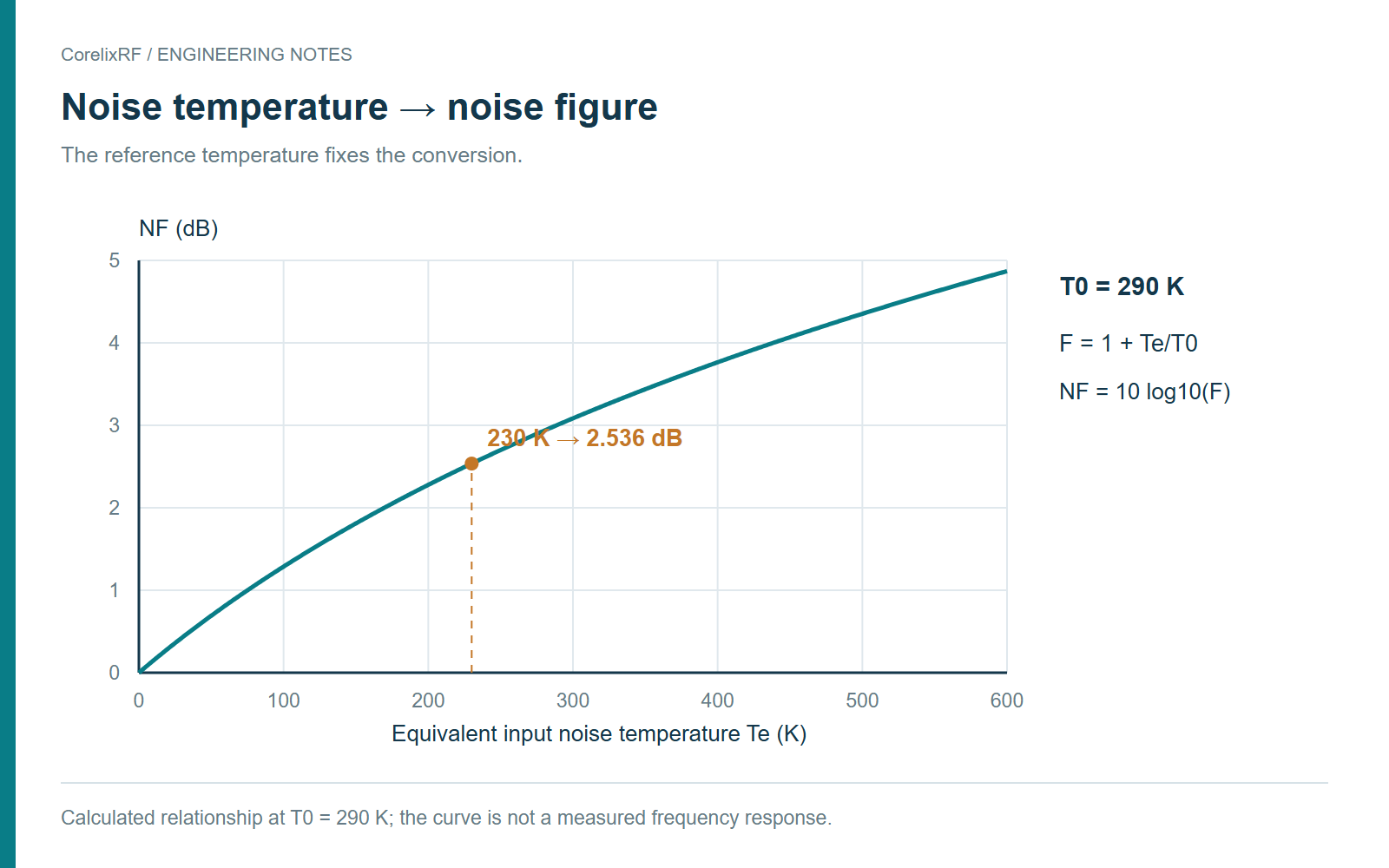
Converting noise temperature to noise figure requires the equivalent input-noise definition, reference temperature, and device boundary to be aligned. Equivalent input noise temperature describes added noise as a temperature at the input. It is not the LNA’s ambient, case, or junction temperature.
Identify the two quantities before calculating
Noise factor F is a linear ratio; noise figure NF is its decibel form. For equivalent input noise temperature Te and the standard reference temperature T0 = 290 K, the relationship is F = 1 + Te/T0 and NF = 10 log10(F). Use kelvin in the temperature ratio.
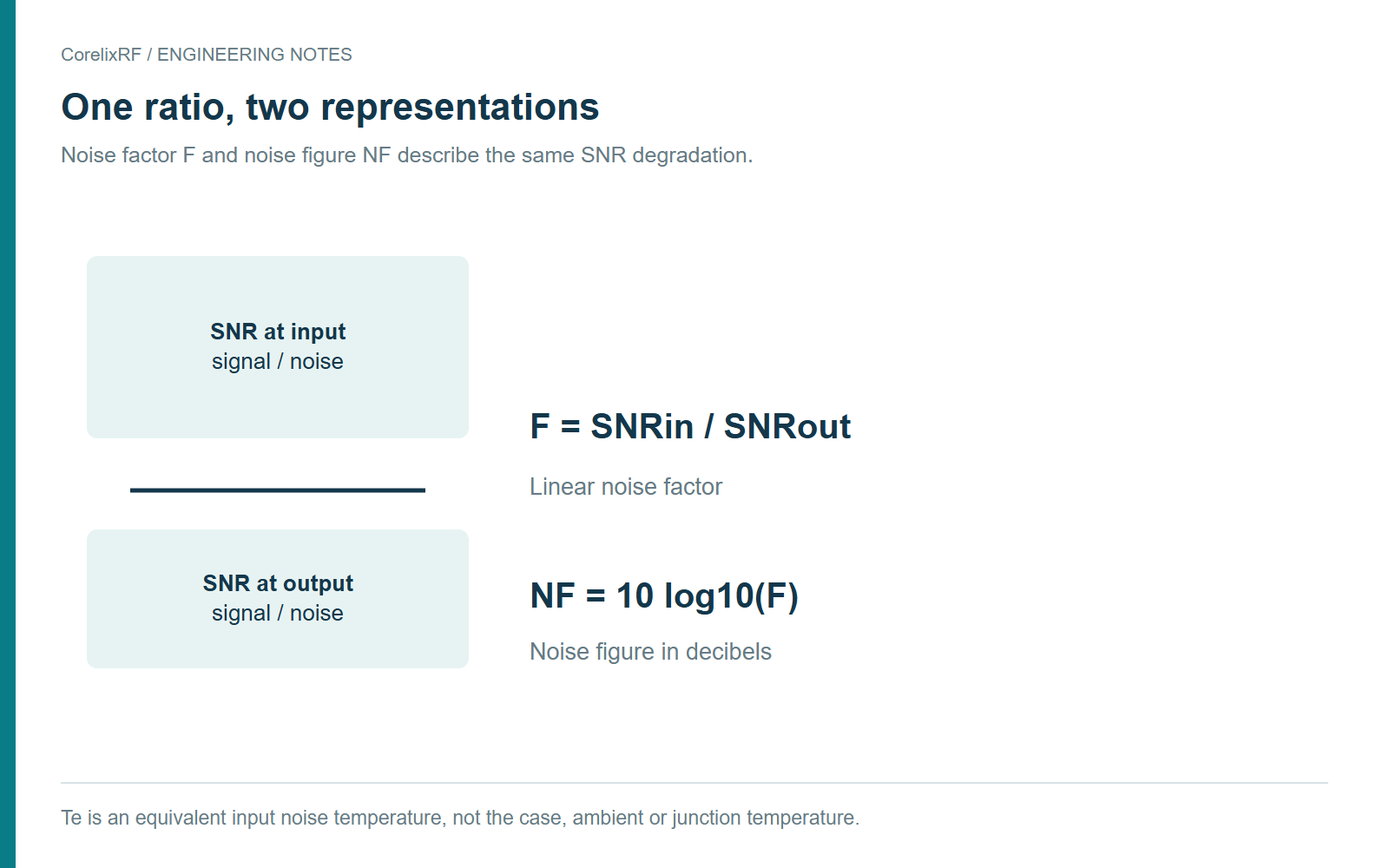
The 290 K reference is part of the definition. It does not mean every noise test was performed with the hardware held at 290 K, and it does not establish an operating-temperature rating. Analog Devices explains the relationship in its noise-temperature analysis.
Work through a conditional conversion
Before calculating, confirm that the source describes device equivalent input noise temperature Te rather than a system temperature including antenna and other stages. The supplied Q-band LNA document CRF-DS-QLNA3750040200-A0-V1.0 lists no more than 230 K. If that limit has the stated Te meaning and device boundary, use T0 = 290 K:
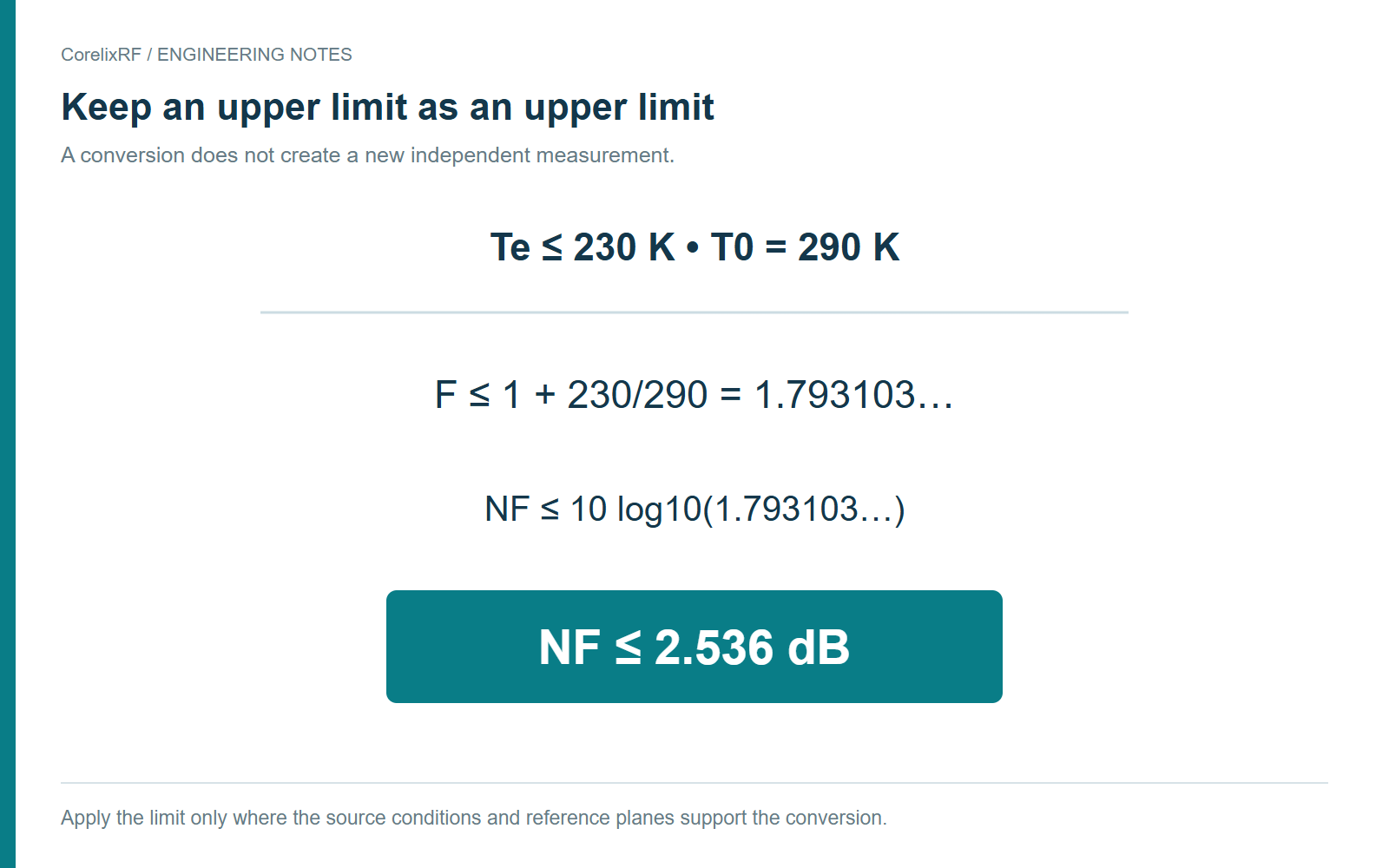
F = 1 + 230/290 = 1.7931
NF = 10 log10(1.7931) ≈ 2.536 dB
Under those same assumptions, an upper bound of 230 K maps to an upper bound of approximately 2.536 dB. This is a conversion of the document’s limit, not a second independent measurement or a guarantee for an assembled receiver. Confirm the precise configuration and source conditions before using it in a purchase specification.
Check the conversion in reverse with Te = 290 × (10^(NF/10) − 1) K for the same 290 K reference. Use the unrounded NF from the original calculation before comparing the recovered Te with 230 K. A rounded display value can produce a small round-trip difference; kelvin belongs to Te, while noise factor is dimensionless and NF is in dB.
Match the reference plane and frequency
Use the noise-figure reference-plane review to identify whether a quoted result includes a cable, filter or limiter. A component considered in LNA input protection can add loss ahead of the LNA; a combined result is not automatically the bare-device quantity needed by this conversion.
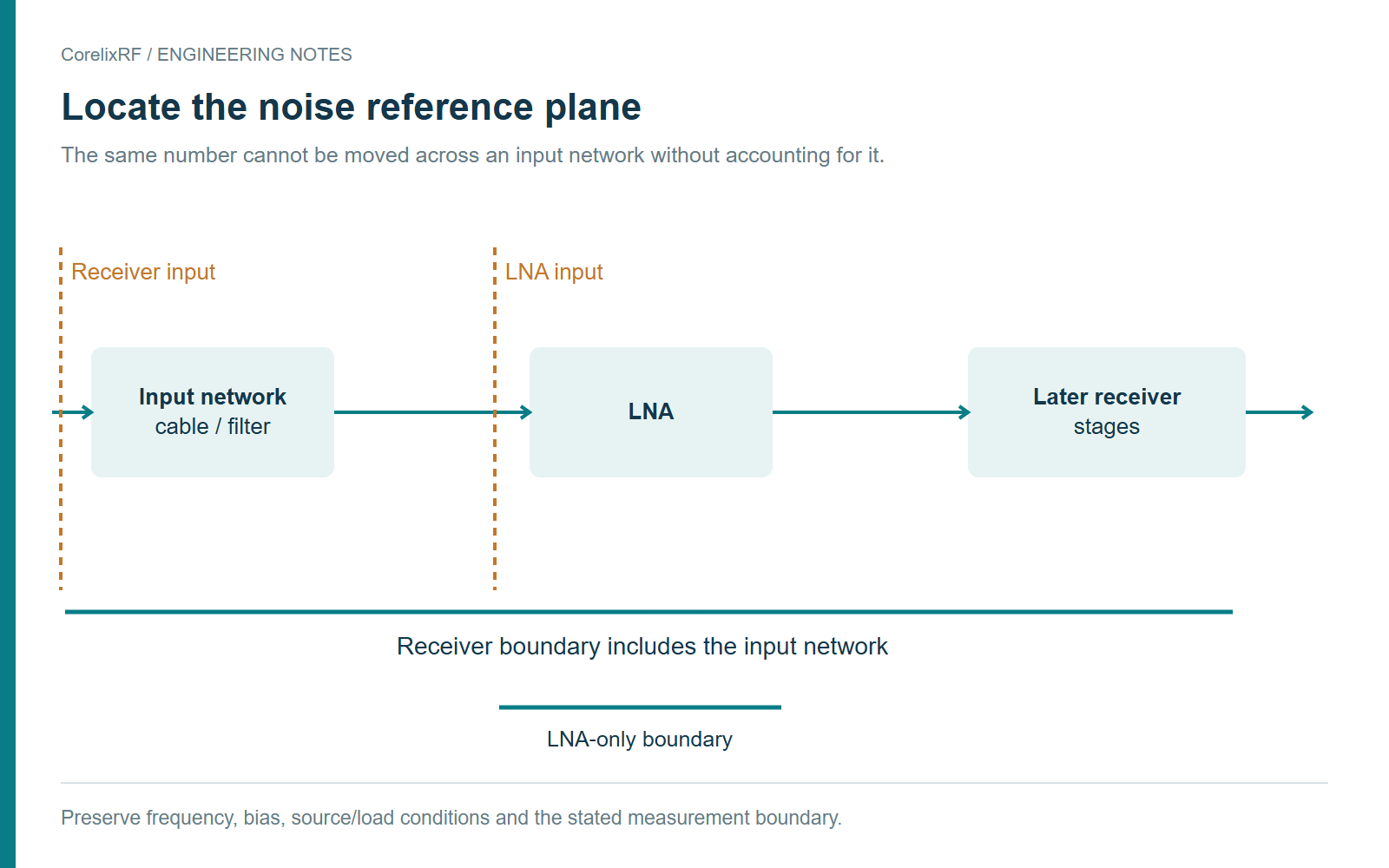
Preserve frequency, bias, physical-temperature conditions and the source’s maximum/typical/measured designation. LNA temperature compensation evaluates behavior as physical temperature changes; LNA design evaluates bias and matching choices. Neither question is answered by converting one K value to dB.
Keep conversion separate from receiver sensitivity
Converting K to dB changes the representation of one noise quantity. It does not determine the full receiver’s sensitivity, blocking behavior, or signal-processing threshold. Those require the rest of the receive-chain definition. Use the receiver-chain budget when the actual question is system performance.
Keep the conversion inputs visible
Retain these definitions beside the single calculation above.
| Quantity | Value | Meaning |
|---|---|---|
| Equivalent input noise temperature | 230 K | Assumed meaning of the source limit |
| Reference temperature | 290 K | Definition reference, not device operating temperature |
| Noise factor | F, dimensionless | Linear representation derived from the stated Te and T0 |
| Noise figure | NF, dB | Decibel representation of the same quantity; here a conditionally converted upper bound |
For LNA selection, carry the original quantity, reference temperature, frequency conditions, plane and evidence strength into the comparison. Missing source conditions remain unresolved; extra decimal places do not make them known.
Send the exact LNA document, noise-quantity definition, reference conditions, and conversion question.
Clarify LNA Noise Specifications